Showing posts with label Bible. Show all posts

Tuesday, May 30, 2017

A Clairvoyant Dream of the Venus Rose and Revelation 22:16-17


Last night I had a dream which turned out to be "clairvoyant" - that is, it provided knowledge that I did not know about before.  The beginning and ending were vague, but the central portion of the dream I remember as it was repeated to me several times.

In the dream, it would seem that I was a new recruit to some Islamic religious organization. I go to some private place, perhaps a warehouse, and I come to realize that the religious organization is a mere front for an Islamist terrorist group. They want to carry out some terrorist attack, and I realize I would have two choices: either I would need to be trained to use a gun and shoot other people, or I would need to be trained to blow up bombs. At this point it is not clear if this meant that I should be a so-called "martyr" in a suicide bombing. I immediately realize I am in the wrong place, I need to get out of this organization. It was very clear this was murder, and against God's will.

I then decide to make my escape and get out of this radical religious group. It was complicated: I could not publicly turn against them, but if they did an attack, I would surely be implicated in the blame for it. For some reason, I have to wait until I come to a gas station. I approach the gas pump, and next to the gas pumps there is a small bookshelf or double stand.  On it, I see two Bibles, one with a brown cover, another with a white cover.  I pick up the one with the white cover, and there was some red symbol on it. In the dream, it was conveyed to me that this was the "Rosata" Bible. I open the Bible and read Revelation 22:16-17, and then close it.

At this point in the dream, there is a woman, or woman's voice, off to my right. She asks me, what passage did I read? I said it was Revelation 22:16-17. I think I asked her why she wanted to know. She repeats it again, what passage did I read?  I reply again, it was Revelation 22:16-17. This repeats, I don't know how many times, but it seems that the dream wanted me to remember the passage of Revelation 22:16-17.  And in the dream, I have no idea what the contents of the passage was, I only remember the reference, as it was repeated. I think this woman thanked me, but I never saw who she was.

So I turn and go to the car, and for some reason I take the white Bible with me. I then wonder if I chose the right Bible, I did not have time to compare the translations of the two. I then wonder what in the world does the word "Rosata" mean. The thought came it might be a Catholic translation, in which case it might have been the wrong one. Then I realize, why am I wasting my time with the Bible? I am at a gas station, and I have to concentrate on my escape, and I have very little time.

I drive away from the gas station, and at this point I make my escape. As I go down the road, I remember encountering several cars, which either tried to track me down or block me. Each time I was not sure if the cars belonged to the Islamist terrorist group, or to the authorities. I had to be very quick. At this time the dream fades, but the impression I had is I made my escape.

THE WORD "ROSATA" AS ROSETTA STONE

To interpret the dream, I first looked up the word "Rosata." The closest thing I could find was the Rosetta Stone, a trilingual stone discovered in Egypt:


It was discovered in Egypt in 1798 by French forces under Napoleon. It was eventually realized it was trilingual containing a duplicate message written in Egyptian hieroglyphics, the Egyptian demotic script, and finally ancient Greek. It was finally cracked by Jean-François Champollion in Paris in 1822, and this eventually allowed Egyptologists to read ancient Egyptian hieroglyphs, which had been lost to the modern world. If "Rosata" conveyed this meaning, then it could refer the revelation of ancient knowledge hidden in the Bible, something that was done by Swedenborg also in the 18th century with his massive work Heavenly Arcana (aka Arcana Coelestia).  The Bible was written in a symbolic manner, where each word carried several levels of meaning: the literal, the spiritual and the celestial. According to Swedenborg, in the same manner Egyptian hieroglyphs were once used to convey sacred spiritual knowledge, which later became perverted into magic:
"That by the Egyptians are signified knowledges opposed to the truths of the church, is because the representatives and significatives of the Ancient Church, which church had also been with them, were there turned into magic; for by the representatives and significatives of the church of that time there was communication with heaven. This communication was with those who lived in the good of charity, and was opened with many; while with those who did not live in the good of charity, but in its opposites, open communication was sometimes given with evil spirits, who perverted all the truths of the church, and with them destroyed its goods, whence came magic. This may likewise be manifest from the hieroglyphics of the Egyptians, which they also used in sacred things, for by them they signified spiritual things, and perverted Divine order." (Heavenly Arcana, n. 6692)
The Egyptian hieroglyphs themselves were also once sacred:
"As to Pharaoh's saying that he did not know Jehovah, the case is this: the Egyptians from ancient time knew Jehovah, because even in Egypt there had been the Ancient Church — as may be manifestly evident from this, that they had among them the representatives and significatives of that church. The hieroglyphics of the Egyptians are nothing else; for by these were signified things spiritual, and they knew also that they actually corresponded" (Heavenly Arcana, n. 7097)
What Swedenborg calls "correspondences" is more commonly known as symbolism. As the Rosetta stone was the key to discovering the ancient knowledge of Egyptian hieroglyphs, so the Bible along with the revelations given to Swedenborg is also key to discovering the hidden truths within Christianity.

THE WORD "ROSATA" AS A ROSE


Dreams can have multiple meanings, in the dream I had the impression that the word "Rosata" was spelled or pronounced as "Rosata." The word rosata is Italian for the work "pink." This may be correct, as I was thinking that the Rosata Bible in the dream was a Catholic translation (I do not know Italian). I had also associated it with a symbol that was pink or red. The other impression that I had is it simply meant a red rose, for the Rosata symbol on the white Bible seemed to be a symbol of a flower. And indeed, the word for "rose" in Italian is rosa. That this is correct can be determined from the city name of Rosetta in Egypt where the Rosetta stone was discovered. Here is the name meaning, from wikipedia:
"Both the Arabic name Rašīd (meaning "guide") and the western name Rosetta or Rosette ("little rose" in Italian and French respectively) are corruptions of a Coptic toponym, Trashit. Rosetta or Rosette was the name used by the French at the time of Napoleon Bonaparte's campaign in Egypt and thus became eponymous of the Rosetta Stone..."
I had no idea the word Rosetta means "little rose" until I decided to look that up for this blog.  So why a white Bible with a rose symbol on it? According to Swedenborg, the colors white and red are the primary colors of heaven:
"There are two colors that are fundamental of the rest in the spiritual world, white and red. White derives its origin from the light of the sun in heaven, and thus from spiritual light, which is white; and red derives its origin from the fire of the sun there, and thus from celestial light, which is flamy. The spiritual angels, because they are in the truths of wisdom from the Lord, are in that white light; therefore they are clothed in white: and the celestial angels, because they are in the goods of love from the Lord, are in that flamy light; therefore they are clothed in red." (Apocalypse Revealed, n. 231)
The primary doctrine of the New Church is that of love and truth, and this is represented by the colors red and white. By selecting the red and white Bible over the brown Bible, that would signify a selection of the doctrines of the New Church over that of a falsified version of Christianity, signified by the brown Bible.

THE PASSAGE OF REVELATION 22:16-17


Clear in my mind, repeated over several times from the dream, was the reference to Revelation 22:16-17. So today, I looked it up, it says this:
I Jesus have sent My angel to testify to you these things in the churches. I am the root and the offspring of David, the bright and morning star. And the Spirit and the bride say, Come. And let him who hears say, Come. And let him who is thirsty come. And whosoever will, let him take the water of life freely. (Rev. 22:16-17)
The interesting reference here is the "root and the offspring of David, the bright and morning star." Here is the spiritual meaning of that passage:
"I am the root and the offspring of David, the bright and morning star, signifies that He is that Lord who was born in the world, and was then the light, and who will come with new light which will arise before His New Church, which is the Holy Jerusalem. I am the root and the offspring of David, signifies that He is that Lord who was born in the world, and thus the Lord in His Divine Human. From this He is called the root and the offspring of David, and also the branch of David (Jer. xxiii. 5; xxxiii. 15): also the rod out of the stem of Jesse, and the shoot out of his roots (Isa. xi. 1, 2). The bright and morning star signifies that He was then the light, and that He will come with new light, which will arise before His New Church, which is the Holy Jerusalem. He is called the bright star from the light with which He came into the world, on which account He is called a star and also the light: a star, Num. xxiv. 17: and the light, John i. 4-12; iii. 19, 21; ix. 5; xii. 35, 36, 46; Matt. iv. 16; Luke ii. 30-32; Isa. ix. 2; xlix. 6. And He is called the morning star from the light which will arise from Him before the New Church, which is the New Jerusalem. For by a star is signified the light from Him, which in its essence is wisdom and intelligence; and by the morning is signified His coming, and the New Church then..." (Apocalypse Revealed, n. 954)
That is the spiritual meaning of that passage. However the phrase "bright and morning star" in the literal sense specifically refers to the planet Venus, which is known as the morning and evening star. Venus was commonly known as the "morning star" as it appeared as the brightest star in the east right before sunrise. It is thus a symbol of the herald of the Lord's coming, signified by sunrise.

So, what does this, if anything, have to do with the rest of the dream?  At first nothing. However, I then discovered that in ancient mythology, the symbol for Venus was the rose. From Wikipedia:
"Venus' signs were for the most part the same as Aphrodite's. They include roses, which were offered in Venus' Porta Collina rites, and above all, myrtle (Latin murtos), which was cultivated for its white, sweetly scented flowers, aromatic, evergreen leaves and its various medical-magical properties. ...As goddess of love and sex, Venus played an essential role at Roman prenuptial rites and wedding nights, so myrtle and roses were used in bridal bouquets."
Again, note the ancient rites of Venus includes roses for the color red, and myrtle flowers for the color white, the two primary colors of heaven for love and truth which is the origin of marriage love between a man and a woman. And interestingly the passage of Revelation 22:16-17 mentions the bride, a symbol of the church.

THE VENUS ROSE

The association between Venus and the rose flower goes even further, I discovered something called the "Venus Rose." If one traces the orbital path of Venus as seen from earth, the path forms something called the "Venus Rose" - a pattern that appears in plants of the rose family.


This indicates there was some ancient symbolism hidden in some of these ancient pagan rites, which Swedenborg states originated from a very ancient system of knowledge that predated Judaism and goes all the way back to ancient Egypt. Here is the pattern of the Venus Rose as it appeared in 1799 in an astronomy book by James Ferguson:


SUMMARY CONCLUSION

The evidence indicates that this is a clairvoyant dream of Revelation 22:16-17, where the passage is symbolically portrayed by symbols in the dream. The reference to the Rosetta Stone would signify a key to lost ancient knowledge, and the the colors of white and red signify love and truth, the basis of heaven and the doctrines of the New Church. For me to belong to an Islamist terrorist organization, and for me seeking to escape it, would signify a desire to leave a false religion and to find the truth. In this part of the dream, I may have stood in the place of another person who was in a similar situation. The rose is used as a symbol in certain mystical Sufi schools of Islam, where the rose is a symbol of one's quest for Divine love. Two prominent books aligned with Sufism are The Rose Garden by Saadi and Mahmud Shabistari's The Rose Garden of Secrets. The Sufi master Jilani is known as "the Rose of Baghdad" and his order, the Qadiriyya, uses the rose as its symbol.

Monday, April 24, 2017

Does Primary Spiritual Authority reside in the Roman Catholic Church?


In the doctrines of the New Church, all spiritual authority is from the Lord alone, and from the Word as revealed in scripture. Moreover spiritual doctrines have been revealed by which the higher spiritual meaning of scripture can be opened. That scripture is the foundation of truth, the Lord declares in the following passage:
Man shall not live by bread alone, but by every word that proceeds out of the mouth of God. (Mt. 4:4)
That the Lord is the sole authority can be seen that the Lord is the Word made flesh:
In the beginning was the Word, and the Word was with God, and the Word was God . . . In Him was life, and the life was the light of men (John i. 1, 4)
The Roman Catholic Church, however, departs from this central truth and claims that sole spiritual authority resides in its church and priesthood, and they will use some false arguments to support this claim. This claim is correctly rejected by the Protestants, as well as the Orthodox, and it continues to keep the Christian world divided. There are other adverse consequences of this claim:
  1. The argument of authority is used as a basis of doctrine, thus elevating the doctrines of men over that of God and His Word.
  2. The argument of authority, when uses as a basis of doctrine, discourages higher rational thinking on spiritual matters, and closes off the higher spiritual understanding. See Truth by Religious Tradition and Authority vs. Spiritual Truth.
  3. The argument of authority is not accepted outside of the Catholic Church as a rational justification for any dialogue.
That the Roman Catholic Church continues to claim to have "sole spiritual authority" can be seen from their own statements, which can be seen from Beginning Catholic - Catholic Church Authority. It begins as follows:
The source and nature of Church authority is one of the major issues that beginning Catholics have to examine and come to terms with.
They claim it is supported by both scripture and history, and that their claim is "misunderstood" when others say they misplace worship. We should be clear here: the authority claimed by the Roman Catholic Church goes beyond that of mere ecclesiastical governance, it is an exclusive claim to authority to determine the truth, and an exclusive claim that their organization is the one true church. Moreover, they declare it is impossible for the Catholic Church to mislead people in its official teachings. So lets examine the support for such a claim, one by one, using the above web site, as well as supporting arguments from other Catholic web sites.

CLAIM #1: CHURCH AUTHORITY COMES FROM DIRECT APOSTOLIC SUCCESSION


The web site mentions three scriptures in which Jesus states that as the Father sent Him, so he sends his apostles (Mt. 10:40, 28:18-20, Lk, 10:16, Jn. 20:21). And from this they want others to jump to the conclusion that spiritual authority resides solely in the Catholic Church. But this is not what scripture says. God is Divine truth, and inasmuch one represents and spreads the truth, if that truth is rejected one rejects the Lord Himself. It then goes on to mention examples of ecclesiastical governance. But what it fails to mention is that the Catholic Church claims to have special authority in its priesthood due to direct apostolic succession. Similarly, the Jewish Pharisees resorted to this line of argument against Jesus, by stating Abraham is their father (Jn. 8:33). Jesus retorted if they were Abraham's children they should do his works (Jn. 9:39). A succession of men, whether by birth or office, should not be used as a guarantee of authority.

That Jesus Christ forbade placing spiritual authority in men is explicitly stated in scripture:
But be not ye called Rabbi: for one is your Master, even Christ; and all ye are brethren. And call no man your father upon the earth: for one is your Father, which is in heaven. Neither be ye called masters: for one is your Master, even Christ. (Mt. 23:8-10)
Those who claim spiritual authority in men will then ask the question, why do we call our biological fathers father? But this is to miss the point entirely. Jesus is not talking about mere literal titles. Jesus forbids anyone to place spiritual authority in men. Another weak counter argument I have seen is that Paul stated he acted like a father to those who need to learn like children (1 Thes. 2:11). But this is an analogy, Paul is not making any special claim to authority, merely that he had to teach them the truth. It is interesting when people make these arguments against Jesus, when I ask them what then did Jesus mean, they have no answer. It is a passage they choose to ignore. When one places spiritual authority in one's self, this leads to spiritual pride. Swedenborg confirms that Jesus was not talking about mere literal titles, but rather those who place spiritual authority in themselves:
"Be not ye called teacher; for one is your Teacher, even Christ. And call no man your father on earth; for one is your Father, which is in the heavens. Neither be ye called masters; for one is your Master, even Christ (Matt. 23:8-10). Without doctrine it would follow from this that no man ought to call another teacher or father or master; but from doctrine it is known that this is permissible in the natural sense, but not in the spiritual sense." (True Christian Religion, n. 226.6)
Furthermore:
"...this is said because the "Father" means the Lord, who creates and begets us anew, and because He alone teaches and instructs; so when man is in a spiritual idea he will think of the Lord alone as the Father and Master; but it is otherwise when man is in a natural idea. Moreover, in the spiritual world or in heaven, no one knows any other father, teacher, or master than the Lord, because from Him is spiritual life." (Apocalypse Explained, n. 631)
The reason why Jesus gave this commandment is to ensure no one out of pride would claim spiritual authority over others:
Whosoever shall exalt himself shall be abased; and he that shall humble himself shall be exalted. (Mt. 23:12)
It is sinful to place any authority or claim in oneself, for all that is good and true in oneself does not come from the self, or the ego, but from God alone. We are but recipients of these in our will and understanding. To give "glory and honor" to the Lord is to acknowledge this:
"By giving to the Lord glory and honor nothing else is meant in the Word but to acknowledge and confess that all truth and all good are from Him, and thus that He is the only God; for He has glory from the Divine truth and honor from the Divine good." (Apocalypse Revealed, n. 249)
CLAIM #2: JESUS PASSED AUTHORITY TO PETER AND THENCE TO THE CATHOLIC CHURCH


This is somewhat the same as the first claim, and this one definitely shows how the Roman Catholic Church claims exclusive authority for itself in its priesthood, which is properly rejected by the Protestants. Although the Roman Catholic Church will say Jesus Christ is the primary authority, this is but a springboard to place spiritual authority in themselves. I will quote from Beginning Catholic - Catholic Church Authority:

“And I tell you, you are Peter, and on this rock, I will build My Church, and the powers of death shall not prevail against it. I will give you the keys of the Kingdom of Heaven, and whatever you bind on earth shall be bound in Heaven, and whatever you loose on earth shall be loosed in Heaven.” (Mt 16:18-19)
This is a key passage for understanding the Catholic doctrine of Church authority: * Christ’s deliberate intent to establish a new Church (“I will build My Church”) * His choice of Peter as the foundation, or head, of this Church * Christ confers on Peter his own divine authority (“the keys of the Kingdom of Heaven”) for ruling the Church (“bind” and “loose”). This power to “bind and loose”, repeated also in Mt 18:18 to the Apostles as a whole, is understood as applying first to Peter and his successors (the Pope), and then to the rest of the Apostles and their successors (the other Bishops) in union with Peter.
Peter (Petra) does indeed mean rock, and the Catholic Church takes this to mean that Peter and his successors (whom they presume are themselves) is the foundation of the authority of the Church. But notice the misquote, the website "forgot" to mention what precedes:
When Jesus came into the coasts of Caesarea Philippi, he asked his disciples, saying, Whom do men say that I the Son of man am? And they said, Some say that thou art John the Baptist: some, Elijah; and others, Jeremiah, or one of the prophets. He saith unto them, But whom say ye that I am? And Simon Peter answered and said, Thou art the Christ, the Son of the living God. And Jesus answered and said unto him, Blessed art thou, Simon Barjona: for flesh and blood hath not revealed it unto thee, but my Father which is in heaven. (Mt. 16:13-17)
This is a BIG DIFFERENCE.  It is Jesus Christ who is the foundation of the church, it is He who is the rock. The Christian Church is founded on His Divine identity. Take away that and there is no church. And yet the Catholic Church misplaces this authority in themselves, even to the point of declaring the Pope is the "Vicar of Christ." A "rock" or foundation in the spiritual sense means one's foundation of truth (see Mt. 7:24), and Paul confirms that the rock is Jesus Christ:
And did all drink the same spiritual drink: for they drank of that spiritual Rock that followed them: and that Rock was Christ. (1 Cor. 10:4)
That this is a willful distortion of scripture in order to make claims of spiritual power and authority over others, can be seen by examining scripture:
Jehovah is my rock (Ps. 18:2).
For who is God save the Jehovah or who is a rock save our God? (Ps. 18:31)
Unto thee will I cry, O Jehovah my rock (Ps. 28:1)
He only is my rock and my salvation (Ps. 62:2) .... etc.
So what does the New Church have to say on the matter? In the spiritual sense, it has nothing to do with Peter or the Roman Catholic Church, confirming that the Protestants are correct in rejecting this claim:
"...good takes on a quality through truths, good without truths having no quality and where there is no quality there is neither force nor power. From this it is clear, that good has all power through truths, or charity through faith, and neither charity apart from faith nor faith apart from charity has any power. This is meant also by the keys given to Peter, for "Peter" there means, in the spiritual sense, truth from good which is from the Lord, thus faith from charity; and the "keys" given to him the power over evil and falsities. These things were said to Peter when he acknowledged the Divine of the Lord in His Human; which means, that those have power who acknowledge the Divine of the Lord in His Human, and from Him are in the good of charity, and in the truths of faith." (Apocalypse Explained, n. 209.4)
Moreover, each particular disciple of the Lord represented a different aspect of the church:
"Peter" here [signifies] Divine truth proceeding from the Lord's Divine good, and in the internal sense, every truth from good that is from the Lord. The "rock" [petra] that is spoken of in the Word where Peter is mentioned, and from which Peter's name is derived, has a like signification. The Lord's twelve disciples represented all the truths and goods of the church in the complex; Peter represented truth or faith, James charity, and John the works of charity. But here Peter represented faith from charity, or truth from good which is from the Lord, because Peter here acknowledged the Lord in heart" (Apocalypse Explained, n. 206.3)
The internal motivation of many in the Roman Catholic Church was seen by Swedenborg was not for spirituality, but for the sake of self power. Whether one believes Swedenborg or not, if the first thing Catholics talk about is the authority of their church over all spiritual matters one should question the motivation behind such interest. Is it for the sake of love of others? Or is it for the sake of power over others? Again:
"They who are in the good of genuine charity, and read the words which the Lord spake to Peter — I say unto thee that thou art Peter, and upon this rock I will build My church, and the gates of hell shall not prevail against it; and I will give unto thee the keys of the kingdom of the heavens, and whatsoever thou shalt bind on earth shall be bound in the heavens, and whatsoever thou shalt loose on earth shall be loosed in the heavens (Matt. xvi. 15-19) — they being in affection for truth from the good of genuine charity, love to be taught what is meant by these words; and when they hear that by the rock there upon which the church will be built, and consequently by Peter, is signified the faith of charity, and that thus the keys for opening and shutting heaven are given to that faith (see the preface to Gen. chap. xxii.), they then rejoice and are affected by that truth, because thus the Lord alone, from Whom faith is, has that power. But they who are not in affection for truth from the good of genuine charity, but in affection for truth from some other good, and especially if from love of self and the world, are not affected with that truth, but are made sad, and are also made angry, inasmuch as they wish to claim that power to the priesthood. They are made angry because they are thus deprived of dominion, and they are made sad because they are deprived of honor." (Heavenly Arcana, n. 4368.3)
That this is the continued focus of the Roman Catholic Church, one can see by perusing multiple web sites, such as Scripture Catholic - the Church, where the same errors are repeated over and over.

CLAIM #3: THE CATHOLIC CHURCH IS THE PRIMARY AUTHORITY SINCE IT DETERMINES SCRIPTURE

The Catholic Church maintains that it was from its own spiritual authority which determines scripture. They essentially are stating their authority is above scripture and have the right to declare what is scripture and what isn't.  That they claim this, can be seen from Whats Your Authority:
The fact is that the Holy Spirit guided the Catholic Church over time to recognize and determine the canon of the New and Old Testaments in the year 382 at the synod of Rome, under Pope Damasus I. This decision was ratified again at the councils of Hippo (393) and Carthage (397 and 419). You, my friend, accept exactly the same books of the New Testament that Pope Damasus decreed were canonical, and no others... This means you accept the canon of the New Testament that you do because of tradition, because tradition is simply what is handed on to us from those who were in the faith before us.
And this is their argument for tradition and authority as the source of faith.  From Scripture and Tradition:
In the Second Vatican Council’s document on divine revelation, Dei Verbum (Latin: "The Word of God"), the relationship between Tradition and Scripture is explained: "Hence there exists a close connection and communication between sacred Tradition and sacred Scripture. For both of them, flowing from the same divine wellspring, in a certain way merge into a unity and tend toward the same end. For sacred Scripture is the word of God inasmuch as it is consigned to writing under the inspiration of the divine Spirit. To the successors of the apostles, sacred Tradition hands on in its full purity God’s word, which was entrusted to the apostles by Christ the Lord and the Holy Spirit. 
"Thus, by the light of the Spirit of truth, these successors can in their preaching preserve this word of God faithfully, explain it, and make it more widely known. Consequently it is not from sacred Scripture alone that the Church draws her certainty about everything which has been revealed. Therefore both sacred Tradition and sacred Scripture are to be accepted and venerated with the same devotion and reverence."
And it is true: the older Christian churches are dependent on tradition and authority. Moreover, Protestants don't like to admit this, but most of their theology and doctrine they inherited from the Catholic Church. But argument from tradition and authority is not a strength, it is a weakness.  It is from tradition and religious authority that falsehoods have corrupted the Christian Church. To merely say something is inspired because of authority is a logical fallacy. All that the councils did was separate the valid documents of the words of Jesus and the apostles from the internal evidence of the text itself, and what had been preserved from a variety of different local churches. This was done to "weed out" the false gospels that were prevalent at the early time. Textual critics can also easily determine that they were forgeries without any claim to "authority" in themselves. In reality the church councils did not define what is Divinely inspired, they just declared which were valid documents of the words of Jesus and His apostles. The same web site goes further:
Any Christian accepting the authority of the New Testament does so, whether or not he admits it, because he has implicit trust that the Catholic Church made the right decision in determining the canon.
In other words, the canon of scripture is used as an argument to support that one should blindly follow authority, rather than the internal evidence of the text itself, and the testimony of the local churches where they were in use.

The argument, however, falls flat on its face when one sees what the Catholic Church selected as their scripture. First they selected the Septuagint (a Greek translation) as their basis, and in selecting the Septuagint as their basis, they introduced major interpolations to the Hebrew text from the Septuagint, to wit: Baruch, Letter of Jeremiah, additions to Daniel, and others, such as the later fictional accounts of Tobit and Judith. Moreover, the texts they selected came from churches that belong now to Orthodox and Eastern branches of Christianity, not the later Catholic Church.

This alone shows that truth from authority cannot be completely trusted. The false additions from the Septuagint were only corrected during the Protestant Reformation.

A REVELATION OF THE TRUE CANON OF THE BIBLE


In the New Church, one is no longer dependent on tradition and human authority with is not only prone to errors, but also at times subverts the truths of God's Word. First, Jesus Christ Himself revealed what is canonical for the Old Testament:
And he said unto them, These are the words which I spake unto you, while I was yet with you, that all things must be fulfilled, which were written in the law of Moses, and in the prophets, and in the psalms, concerning me. (Luke 24:44)
Jesus refers to a very specific set of scriptures here from the Jewish canon of the Old Testament. The law of Moses is the Torah, and the prophets refer to another section called the Nevi'im. Outside of these two sections Jesus selects one book, the Psalms. The original Hebrew canon was modified by the Greek Septuagint, and it is from this that the Christian churches, including the Roman Catholic, inherited the majority of their canon.

Needless to say, it has nothing to do with church authority of the Roman Catholic Church. By the same logic, since the Jews preserved the canon of the Old Testament, does that mean we should follow the spiritual authority of Jewish rabbis? Of course not. Its a ridiculous argument.

Compare the below chart of the Old Testament, which compares the Jewish canon with that of the Catholic, Orthodox and Protestant branches:


Note that, separate from the Law and Prophets, the Jews created a separate section known as "Ketuvim" which simply means the "Writings."  Of these, Jesus only selected the Psalms. The only other book he quotes from is the book of Daniel (Mt. 24:15, Mark 13:14), which properly belongs among the Prophets.

There is one case where some claim that Jesus references 2 Chronicles as scripture:
Wherefore, behold, I send unto you prophets, and wise men, and scribes: and [some] of them ye shall kill and crucify; and [some] of them shall ye scourge in your synagogues, and persecute [them] from city to city: That upon you may come all the righteous blood shed upon the earth, from the blood of righteous Abel unto the blood of Zechariah son of Barachias, whom ye slew between the temple and the altar.  (Mt. 24:34, 35; see also Luke 11:49-51)
The claim here is that Zechariah, is a priest whose death is recorded in 2 Chronicles 24:20-21. However this identification is false. It more likely refers to the priest Zechariah who was the father of John the Baptist. From Wikipedia - Zechariah:
"Origen suggested that the Zechariah mentioned in Matthew 23:35 as having been killed between the temple and the altar may be the father of John the Baptist. Orthodox Christian tradition recounts that, at the time of the massacre of the Innocents, when King Herod ordered the slaughter of all males under the age of two in an attempt to prevent the prophesied Messiah from coming to Israel, Zechariah refused to divulge the whereabouts of his son (who was in hiding), and he was therefore murdered by Herod's soldiers. This is also recorded in the Infancy Gospel of James, an apocryphal work from the 2nd century."
This latter explanation is more likely, as the statement of Jesus would include all the prophets from Abel to the father of John the Baptist. So, this means that the books of the Ketuvim are not necessarily authoritative in the same way as the Law, Prophets and Psalms of Hebrew scripture.

In the New Church, Divinely inspired scripture are those works which have an internal spiritual sense from internal evidence in the text itself. The canon of the New Church is not based on tradition or authority, but rather Divine revelation from Jesus Christ. The criteria and evidence for Divinely inspired scripture is given in Heavenly Arcana (or Arcana Coelestia). For the Old Testament, it closely follows the Jewish canon just discussed, but also includes the book of Lamentations. For the New Testament, the Gospels and Apocalypse are Divinely inspired, whereas the letters of the apostles are works included for the edification of the church. The Divinely inspired canon is as follows:
"The books of the Word are all those which have an internal sense; and those which have not an internal sense are not the Word. The books of the Word in the Old Testament are the five books of Moses, the book of Joshua, the book of Judges, the two books of Samuel, the two books of the Kings, the Psalms of David, the Prophets, Isaiah, Jeremiah including the Lamentations, Ezekiel, Daniel, Hosea, Joel, Amos, Obadiah, Jonah, Micah, Nahum, Habakkuk, Zephaniah, Haggai, Zechariah, Malachi; and in the New Testament the four Evangelists, Matthew, Mark, Luke, John; and the Apocalypse." (Heavenly Arcana, n. 10325).
As for the letters of the apostles, they are "Divinely influenced," but do not have the same level of inspiration where there is a spiritual sense behind each and every word. This revelation comes from Jesus Christ Himself:
"That the Lord manifested Himself before me His servant, and sent me to this office, and that He afterward opened the sight of my spirit, and so has admitted me into the spiritual world, and has granted to me to see the heavens and the hells, also to converse with angels and spirits, and this now continuously for many years, I testify in truth; likewise, that from the first day of that call I have not received any thing which pertains to the doctrines of that church from any angel, but from the Lord alone while I read the Word. For the sake of the end that the Lord might be constantly present, He has disclosed to me the spiritual sense of His Word, in which Divine truth is in its light, and in this light He is continually present. For His presence in the Word comes only by the spiritual sense; through the light of this, He passes into the shade in which is the sense of the letter; comparatively, as it is with the light of the sun in the day time, passing through a cloud that is interposed." (True Christian Religion, n. 779-780)
This, of course, will be opposed by those of the Roman Catholic Church whose interest is primarily in claiming sole spiritual authority in matters of the Christian Church, and such a spiritual conflict is foretold in the prophecy of the Apocalypse. With those of the New Church, the Roman Catholic Church cannot use scripture as a false argument to support their authority, as the New Church has a higher and more strict standard than they do.

The revelations of the New Church are not limited to the Biblical Canon, but also the revelations contain the true doctrines of Christianity by which scripture should be interpreted, This is the Second Coming of the Word of God, which is described in more detail in the post Is the Second Coming a Physical Event or Spiritual Event?

THE NEW CHURCH IS NEW SPIRITUAL FREEDOM

With the New Church, all doctrine is drawn from scripture, and true spiritual freedom is truly restored in Christianity, where it is no longer necessary to depend on authority or tradition, or the teachings derived from the opinions of men. With these revelations, one can rationally explore and open up one's spiritual understanding, and one is not dependent on truth by reason of authority. True authority is from scripture, and the doctrines of the New Church opens up scripture to anyone willing to examine them. The doctrines are primarily described in The Doctrines of the New Jerusalem (or The Four Doctrines and New Jerusalem and Its Heavenly Doctrines) and True Christian Religion. Additional doctrines can be found scattered throughout Heavenly Arcana, a large multi-volume work.

When spirituality is rationally understood, where there are no "mysteries of faith" or "blind belief", the higher spiritual understanding is opened which leads to new spiritual light - see Truth by Religious Tradition and Authority vs. Spiritual Truth. However this spiritual light cannot be opened until the former falsehoods are exposed, and thence removed from the mind. Swedenborg saw this spiritual light was now available to all, but the angelic world had slim hope for those of the Christian Church, as it has been infested by falsehoods:
"...the man of the church will hereafter be in a freer state of thinking on the things of faith, thus on the spiritual things which are of heaven, because spiritual freedom has been restored. For all things have now been reduced to order in the heavens and in the hells, and from them flows in all thought about Divine things and against Divine things — from the heavens all thought in harmony with Divine things, and from the hells all thought against Divine things. ...Because spiritual freedom has been restored to man, therefore the spiritual sense of the Word has now been uncovered, and by means of it interior Divine truths have been revealed; for man in his former state would not have been able to understand those truths, and he who would have been able, would have been ready to profane them.  
"I have had various conversations with angels concerning the state of the church hereafter, and they said that they know not things to come, because to know things to come is of the Lord alone; but they know that the slavery and captivity in which the man of the church has been hitherto, has been taken away, and that now from restored freedom he can better perceive interior truths, if he wishes to perceive them, and so can become interior, if he wishes to become so; yet they have slender hope of the men of the Christian Church, but much of a people quite remote from the Christian world, and hence removed from infesters, which is such as to be able to receive spiritual light, and to become a celestial spiritual man; and they said that at this day interior Divine truths are revealed in that people, and are also received with spiritual faith, that is, in life and heart, and that they adore the Lord." (The Final Judgment, n. 73-74).
Those who fail to question their beliefs will for the most part fail to see this truth. But for those who question their religious beliefs, and who wish to seek the truth for themselves, new spiritual light awaits.


Thursday, October 27, 2016

More Clairvoyant Dreams of the Numerical Symbolism of the Psalms


As stated earlier, I have been going through my translation and commentary of the Psalms, validating the translation with the numerical counts of words in the original Hebrew.  I have been finding that the Masoretic text is very accurate, and the immediate benefit of word counts is one can determine if the text is accurate. I have found a number of occasions where a supposed "mistake" in the original Hebrew was actually not a mistake, but was done intentionally in order to arrive at a certain number count. There have been a few scholarly studies on this, including Cantos and Strophes by Van der Lugt, and Numerical Secrets of the Bible by Casper Labuschagne (see his web site at Casper Labuschagne's Homepage). Another scholar who has done good work on this is Duane Christensen. It is in reality an ignored area of study due to a number of "numerological quacks," not to mention the Jewish Kabbalists.

The one thing that got me started on this project in the first place is Psalm 145, which is missing a bicolon for the letter nun. This missing verse is found in the Septuagint, the Dead Sea scrolls, and one Hebrew manuscript outside of the Masoretic. I originally thought the Masoretic had dropped this verse, which led me to compare the translation of the Masoretic with the Septuagint (LXX) for the Psalms. I have found, after analyzing the word count of Psalm 145, that the additional verse for the letter nun found in the LXX and Dead Sea Scrolls is a spurious addition to the text. It completely ruins the pattern, which is obvious when one understand the underlying numerical pattern. Just like Psalm 9, 10, 25 and 34, the absence of an acrostic verse is intentional. I can now explain these acrostic Psalms, and why certain letters are missing. For that reason I had to withdraw an earlier article on Psalm 145, it needs to be rewritten due to this new research. In the translation I withdrew some LXX variants that I now know are also invalid. I am debating whether to include this numerical research in the translation and commentary of the Psalms, or if this should be separated into another work.

In the meantime, there have been more clairvoyant dreams about this numerical research into scripture (see the previous post A Clairvoyant Dream of the Numerical Symbolism of the Psalms).  I thought these were rather funny and curious - they occur independently, when I happen to ask about other people's dreams. So in one dream, this woman is shopping for bread. She is in the store and cannot read the prices of the bread. I then walk into the store, and then I explain - "That loaf of bread is $1.49.  The other loaf of bread is $1.69.  And that one over there is more expensive, it is $5.99." The person who had the dream had no idea what it meant.  To me it was immediately obvious. The loaves of bread represent the word of God which gives eternal life:
It is written, Man shall not live by bread alone, but by every word that proceedeth out of the mouth of God. (Matt. 4:4)
Here is another:
And Jesus said unto them, I am the bread of life: he that cometh to me shall never hunger; and he that believeth on me shall never thirst. (John 6:35)

In the spiritual sense, bread represents love, and water or wine represents truth. Those who read the Word, and follow it, immediately open their inward soul to receive a Divine influx of love and truth. This is the bread of eternal life.

So, what about the prices of bread in the dream? One was $1.49, another $1.69, and another was $5.99. Completely independent of the person who had the dream, I had been explaining the meaning of the numbers of Psalm 12:6:
The speech of Jehovah is pure speech: as silver refined in a furnace of earth, purified seven times (Ps. 12:6)
Psalm 12 is an interesting and simple study in numerical research. It is composed of two stanzas of 4 bicolons (or verses, but verse numbers were added later so I prefer bicolons). Each stanza is exactly 37 words.  But where things get interesting is Psalm 12:6. It is the sixth bicolon of Psalm 12, after which comes the seventh bicolon. The total word count of the Psalm up to the sixth bicolon, or verse 6, is exactly 49 words. The number 49, of course, is 7 x 7. I was explaining this exact passage to someone else, and the next day someone completely independent of this conversation had the dream. The price $1.49 = 149 cents = 100 + 49.  And in the number research, I was seeing that large numbers over 100 would be decomposed into smaller numbers, using 100 as one of the sums.

So that explains the number 149. What about 169?  Well that was simple, the night before I did a numerical study on Psalm 69. As for the number 599, that I am not sure, but there were a number of instances where I took note of the number 59 but that was earlier in my research.

THE DREAM OF THE ELEVEN PILLARS

So that was one dream, here is another, and this one just about blew me away.  Another person approached me and said she had a dream of me where I was at a table, typing on my laptop. Underneath the laptop there was a circular platform, and there was a circle of 11 pillars. On top of the 11 pillars was my laptop. I then told her in the dream: "Count the pillars." She counted them, and there was eleven. I thought that was a curious dream, initially I thought she was mistaken. I asked are you sure they were not twelve?  No, she was certain, it was 11 pillars.

At the time, I was about to do a word count on Psalm 75. I then looked, and lo and behold, here was the passage of the Psalm I was about to study:
The earth and all who dwell in her are dissolved, I balance the pillars of it (Ps. 75:3)
In the spiritual sense, the "earth" is not planet earth, but whenever the earth is mentioned in scripture in the majority of cases it represents the church as to truth.  The "pillars," in the spiritual sense, are the lower natural truths derived from scripture that support the church, for the church is built on doctrine. Pillars ascend upward, for within the lower natural truths there are higher spiritual truths hidden within them. This is the hidden reason why in the ancient world many temples were built with pillars, for back then everything was representative of spiritual things.

So I looked at Psalm 75, I did not find any reference to 11 pillars.

However, as I did the word counts based on the stanzas, an interesting pattern emerged:

The first stanza of Psalm 75 are the first 3 verses. The total word count of the first 3 verses in the original Hebrew is 22. And of course, 22 = 2 x 11.

The next stanza of Psalm 75 is verses 4-6. The total word count of verses 4-6 in the original Hebrew is 22, and 22 = 2 x 11.

In the next Psalm, Psalm 76, there are three stanzas that have a word count of 22.

The word "pillar" is mentioned one other time in the Psalms: Psalm 99.  And of course, 99 = 9 x 11.

And that just took me by complete surprise. The person had the dream before I even did the analysis of Psalm 75. Some may call it "coincidence" or "synchronicity," but in reality there is a spiritual world which affects us in our daily lives. What Swedenborg discovered, when he was in a state of waking visions, that reading scripture, especially in the original Hebrew, opens the mind to direct communication with angelic realms.

I decided to do a bit of research, to see if there was any temple that had 11 pillars. Indeed, there is one where it appears in a temple site in Bolivia, and it is known as Tiwanaku.  There is a wall of 11 pillars, and it is used to count by fives to divide the year into 20 half months of 18 days in what is known as the Tiwanaku soli-lunar calendar.  Here is a graphic on how the wall of 11 pillars works:


Which is interesting, even though it is a flat wall the graphic shows a circle of how the sun moves throughout the year.  For a complete explanation of the calendar, see the site, Tiwanaku Soli Lunar Calendar. For some "odd" reason, back then in Bolivia the kingdom used the Egyptian royal cubit. You won't find that information in your history books.

So what does this calendar have to do with Psalm 75? Not much, the Hebrew calendar is different. However, the arrangement of the 11 pillars is an easy method to count by fives.  And of course Psalm 75 is a multiple of 5, and it happens to be the middle Psalm of 150 Psalms.

One last point here, in the original dream, my laptop was on top of 11 pillars. Psalm 75 is composed of sections of 22 words.  It is easy to see here: the Hebrew alphabet of course has 22 letters, and this is why my laptop was seen on top of 11 pillars. And I was busy counting Hebrew words. Its boring, but when one makes discoveries like this it is rather nice - there are several aspects of the Psalms that I can explain why they were structured in the way they are. I have seen several more interesting items come up like this, but it take me away from the research just to blog about them. I did ask the person was she aware that the Hebrew alphabet had 22 letters, and she did not. So someone, somewhere, knew what I was going to discover in Psalm 75 before I even analyzed it.

Wednesday, October 12, 2016

A Clairvoyant Dream of the Numerical Symbolism of the Psalms


I have completed the first phase of a massive translation and commentary on the Psalms, which I initially discussed earlier in which someone had a clairvoyant dream about the corrections I had been making in the translation (see A Clairvoyant Dream of a New Translation of the Psalms).  It documents every mistranslation, and not only that, it restores the lost poetic structure of the Psalms.  It includes commentary on just about every single Psalm gathered from the writings of Emanuel Swedenborg, to explain its spiritual sense. So it was complete for every Psalm, except for Psalm 119.  Psalm 119 has defied interpretation, even for computer analysis, and to most it is just an endless repetition of the same phrase, over and over again.

So there things stood. However, I noticed an odd numerical symbolism for the number 119, which I discussed earlier (see The Bow of Brass and the Numerical Symbolism of Psalm 119). I have now determined conclusively that this numerical symbolism is not accidental, it is intentional, In fact it pervades all the Psalms.  Hints of this can be seen here and there - for example, the eight terms of the law that are repeated in Psalm 119 are all found together in Psalm 19, and of course 119 = 100 + 19. Psalm 119 is the longest acrostic Psalm, and we also have Psalms 9 and 10 which were split from a single Psalm. Some scholars, including the Greek Septuagint, prefer to merge Psalm 9 and 10 into one. But this is a mistake, the division was intentional.  9 + 10 = 19, and 19 + 100 = 119. So, something is afoot here, and it involves numbers.

So as Psalm 119 sticks out like a sore thumb, I decided to dig a bit to see what other researchers have done.  I decided to start with Psalms 9 and 10, which form an imperfect acrostic and seemed easier to  handle. I found this interesting poetic analysis, in which they dive into several details, but one thing the researchers discovered is that different stanzas (or strophes, as some prefer) have balanced word counts. For those who want to take a look, see it here: EVIL AND THE DISRUPTION OF ORDER: A STRUCTURAL ANALYSIS OF THE ACROSTICS IN THE FIRST BOOK OF PSALMS.  However skim through it, its overwhelming, and unfortunately while some insights are given about word counts the authors make some errors.  One researcher who seems to have gathered a lot of data on the numerical structure of the Psalms is Pieter van der Lugt, who has written no less than 3 volumes on the Psalms discussing their poetic structure (see Cantos and Strophes in Biblical Hebrew Poetry).  It is three volumes, and just about inaccessible as can be to the general public: each volume is over $200.

Fortunately, I know the methods that are used, and I have started to incorporate that into the poetic analysis of each Psalm in the translation and commentary. The numerical analysis has turned insightful in many cases. I can explain oddball features and sometimes what scholars called "mistakes" which are not "mistakes." Sometimes I corrected what I had in the Psalms; at other times I saw mistakes these researchers have done.  So I was going through each Psalm fixing the poetic structure, doing the numerical analysis, and then I saw a pattern that I thought was a fluke.  I put it in the "interesting" box and continued. Then it popped again. And again. Not only was I able to fix the poetic structure, but in several cases I could determine which text was the accurate one among the variants. I was absolutely stunned. One or two Psalms is a coincidence. But after having gone through over half of them, I can say now there are very detailed numerical patterns.  And I am not talking about gematria (which is probably invalid) nor creating silly crossword puzzles. It has to do with word counts and letters counts. A hidden symbolism in scripture was opening up. And the authors were very clever in hiding it. And then I had that Eureka moment, where I went through a huge Psalm and validated the theory.

It was when I had that "Eureka" moment, someone had a clairvoyant dream about me. They saw me in my office, and some very old spider webs were removed. A very hard to find spider was also taken away.  This was very similar to a dream concerning a spider which represented a Biblical mistranslation  (see A Clairvoyant Dream of a New Translation of the Psalms).  Now, some very old knowledge was being uncovered. I then explained to the person who had the dream what it meant - that day or two before I had just discovered I numerical pattern.  There was also another dream, in which I was traveling, and injury was removed from my foot by a Jewish doctor.  They asked for his "phone number" repeatedly.  But he would not give it. That was obvious - I had uncovered some numerical symbolism in scripture. But this was something the Jewish scribes had kept secret, who of course back then were also known as "doctors" of scripture. Removing an injury in the foot? That was precognitive, around this time I caught an illness which effected my feet. But in the spiritual sense, feet represent the external, and in this case I am dealing with the external representation of scripture. Some errors are being removed. It is at the literal level, the lowest natural, which is represented by numbers. But when one sees the symbolism of the numbers, it then gets elevated into the spiritual interpretation.

So that is where I am at, but unfortunately counting words in the Hebrew text takes time, and if one is off by one word the pattern disappears.  The Masoretic it turns out is over 99% accurate. So the blog unfortunately has to take a backseat. I am finding the reason why every jot and tittle of scripture is important, and how the Jews were able to preserve it. In the meantime one can read this post: Spiritual Meaning of Numbers, or Numerology.

So expect in the future a publication on the spiritual commentary on the Psalms, which will include this numerical analysis, and will open up a new chapter in Biblical research. Or at least bring obscure research that has been collecting dust to the general public.

Saturday, April 16, 2016

Free Bible Tools, and a Spiritual Translation and Commentary on the Psalms


The multi-volume works of Emanuel Swedenborg has given us the most comprehensive commentary on the hidden spiritual meaning of the Bible.  In preparing for it, Swedenborg had to learn Hebrew, as well as find a translation that was close to the original Hebrew.  For this he used a Latin translation of the Old Testament by Schmidius.  When one understands the hidden spiritual sense of scripture, one realizes that it is very important to have an accurate translation.  And not only an accurate translation, but it is also important to translate in such a way, where possible, that distinct Hebrew words are given distinct English translations.  Unfortunately there is no English translation of the Bible that does this.  Worse, modern translations will paraphrase the Hebrew to make it "look nice" to modern English readers.  That we should have something close to the original Hebrew is important, as Jesus Himself declared:
For verily I say unto you, Till heaven and earth pass, one jot or one tittle shall in no wise pass from the law, till all be fulfilled. (Matt. 5:18)
Here, a "jot" is actually the smallest Hebrew letter yod, which is also the first letter of God's name, Yehovah.  A "tittle" is the stroke of a letter (see The Jot and Tittle Were NOT Vowel Points).  So if the English translations are not bad enough, I discovered that we probably have a missing line in the Masoretic Hebrew text that is present in the Septuagint (see Is the Masoretic Text of the Bible the Most Reliable?).  That just drove me nuts.  What else is missing?  That prompted me to start comparing the Masoretic with the Greek Septuagint, and from the research I have come to realize that next to the Masoretic, the Septuagint is a very, very important translation.  It will occasionally contain a more ancient reading that improves on the Masoretic (some I have documented here - see Masoretic misreadings in the Psalms, from the Septuagint).  The Masoretic dates from the 6th-11th centuries A.D., but the Septuagint was a translation from the Hebrew that was started in the 3rd century B.C.

So lately, for those who have been wondering, I have been trying to complete a translation and spiritual commentary on the Psalms.  Unfortunately that means I have been taking a bit of a "blog break," and I have received a few emails wondering where have I disappeared to.  So my apologies to my blog readers.  The translation is complete, and I have created a commentary on every Psalm gathered from the scattered quotes of Emanuel Swedenborg.  Its over a 1000 pages, and if there is a passage he did not discuss, a spiritual commentary is derived using a spiritual index of words discussed in other passages.

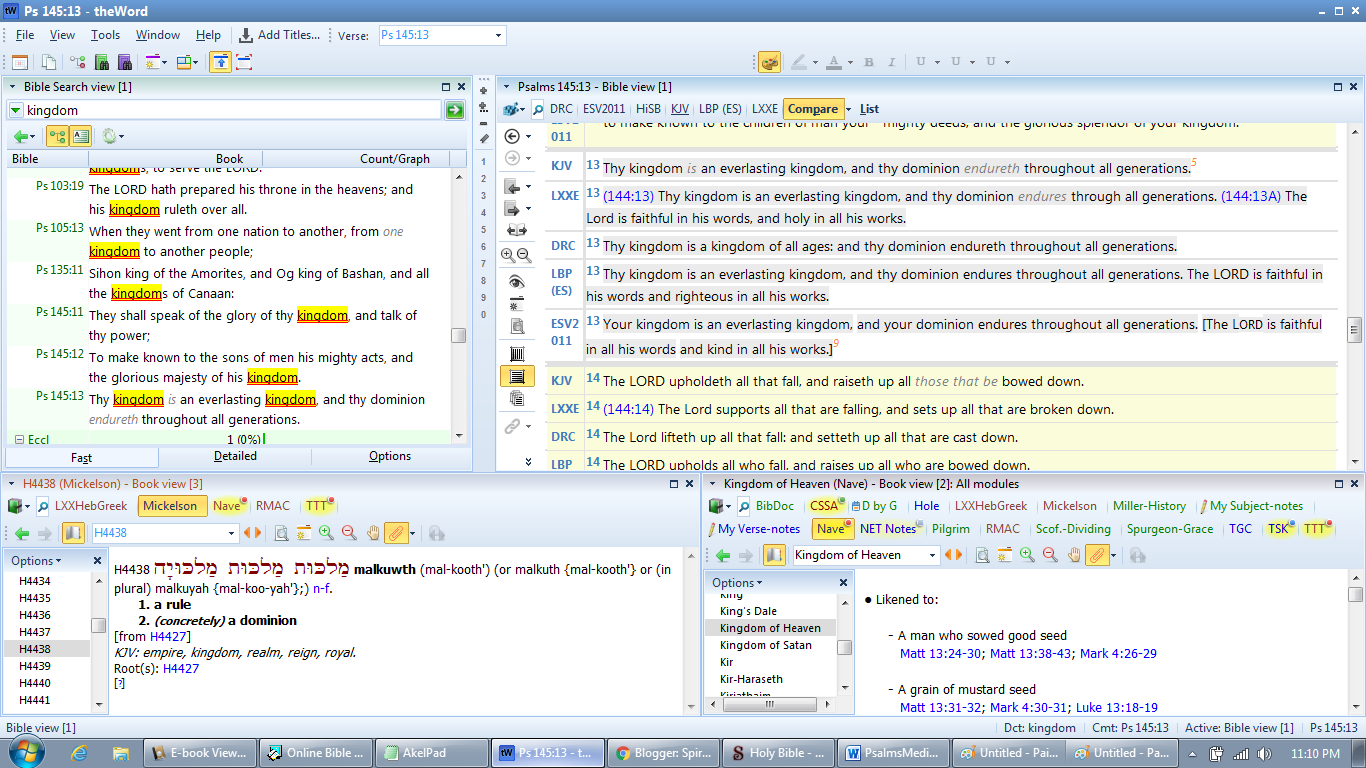
I thought I would share with everyone the tools I have been using - how do I do it?  One tool, completely free is theWord, which has a ton of add on modules with some Hebrew and Greek lexicons.  What is nice, one can line up multiple versions of the Bible in one view.  Here is a screenshot of the one I use, where I line up the KJV, the Septuagint, the Vulgate, Lamsa's Aramaic translation of the Peshitta, and finally the ESV:


I chose to show Psalm 145:13, as there is a missing line in the Masoretic that shows up in the Septuagint (the LXX) which got me started on this project.  Since I published all the works of Emanuel Swedenborg on Amazon (see The Divine Revelation of the New Jerusalem: Expanded Edition) I happen to have the original e-book so I use the e-book Calibre to view and search through it (see Calibre e-book reader).  However one more thing about the tool theWord.  I found an add on module, where I can examine the original Hebrew, lined up with the English.  Here is the same view, where I switch to the Hebrew view:


So another problem, is that Strong's concordance does not exactly always give accurate or complete definitions of Hebrew.  I more up to date lexicon is Brown Driver Biggs (BDB).  And guess what - it is all online for free.  For that I go to this web site: Bible Hub.

Now, there is the occasional problem where not only Strong's, but Brown Driver Biggs still does not get a Hebrew definition right.  So for those occasional confusing words, I go look up a cognate in Akkadian, otherwise known as ancient Assyrian.  All Akkadian words are catalogued in a multi-volume work, the Chicago Assyrian Dictionary.  And it just so happens you can download the entire set for free as a set of Adobe PDFs.  Just go here: The Assyrian Dictionary of the Oriental Institute of the University of Chicago (CAD).

So, what happens when I see a difference between the Masoretic text, and the Septuagint?  In theWord, you can use a Septuagint add in module which contains the original Greek.  If you want to look at it online, here is an online tool that lists the Septuagint Greek version for any text: StudyLight.

Next, I want to figure out what was the original Hebrew word for the Greek text.  With practice, one can make a likely guess.  But what if one wanted to see each and every Hebrew word that was translated into that particular Greek word in the Septuagint?  Unfortunately not a lot has been published in this area for the last 100 years.  For this, one needs to find the following standard reference work:

A Concordance to the Septuagint, by E. Hatch and H.A. Redpath


This was published in the years 1897-1906. Unfortunately one cannot find the complete set in Google's massive book scan (I have seen books mysteriously disappear from there over the years).  Luckily, someone actually took all three volumes and did a page scan and put it up on Wikimedia Commons.  You can see a full set here: Bible Ref Shelf.

So, what is the end result?  Each Psalm is actually written in a form of Hebrew poetry in which lines are parallel to each other, and all Bibles mangle the lines of poetry with their verses.  So the lines are fixed, and if I have made a correction to the translation I hyperlink it to a Hebrew word definition.  So for example, Psalm 145 now looks like this:


If the word is in blue, it means I have changed the translation from the KJV, and more often than not it is to improve the translation consistency.  If, however, the words are in italics, it means I have overridden the Masoretic with a better reading from another source - in many cases the Septuagint.  Psalm 145 is an acrostic Psalm, and there is a missing line in it.  Some debate whether its original or not, as not all Psalms contain all the letters.  But it is original - one can see that the missing 2 lines completes a section or stanza of 8 lines, and fills in for the missing letter nun.  I shift the verse numbers to the right, so that I can use indentations to show poetic stanzas in the Psalms.  This is not the only case where the Masoretic needs to be corrected, it is just one of many, but overall, the Masoretic is still 99% accurate, at least from my examination looking at the translation of the Psalms.

So what tool am I using to create an e-book?  There are a variety of tools, but the one I use is a free tool called Sigil.  Its not for beginners, you have to know what you are doing and at times have to understand the epub format.

So, my plan is to eventually publish this, if not as a book, then as an e-book.  It will include the translation, with every single translation change documented in translation notes, as well as a dictionary of the Hebrew word that was changed from the KJV.  It has been fixed to be modern English, and of course restores the poetic structure.  Alongside this, there will be over 1000 pages of commentary based on the writings of Emanuel Swedenborg.  It explains all of those odd poetic passages in the Psalms.  And yes, every single word does have a spiritual meaning applicable to one's spiritual development and growth.

I had one publisher look at it, but they wanted it reviewed by a Biblical scholar who directly knew Hebrew. So what am I doing for that?  As it turns out, a group of about 20 Biblical scholars have produced a translation of the entire Bible, with excellent translation footnotes, called the NET Bible, located online here: Bible.org.  I have been using it to validate the changes I have made. I disagree with their paraphrase translation, but there is excellent footnotes on the translation containing years of research, often from hard to find sources.  Unlike other translations, they put in all their translation research in the footnotes for everyone to examine, to see if they are right or not.

So when its done it will be done, I will post an announcement here on the blog so stay tuned on a future spiritual commentary of the Psalms, based on the revelations received by Emanuel Swedenborg.  One will see that the methods Swedenborg exposed allows for a systematic interpretation of scripture.

METHOD OF LAST RESORT: THE SPIRITUAL SENSE

One last note here.  There are situations that arise, where a text can be read in two different ways, either from revocalizing the Hebrew, or from a variant text.  Sometimes this is resolved by the parallel poetic structure.  I have seen cases where translators, not understanding the spiritual sense of scripture, will then try to unnecessarily alter the text.  So on a few occasions I have found that knowing the spiritual sense allows one to reconstruct the actual original.  This, I believe, is in reality how every "jot" and "tittle" of scripture is preserved.  And there is an actual case of how this works in Swedenborg's writings, when discussing the Lord's prayer.  Here is the passage:
"It was granted me to have a perception of angelic ideas about these words in the Lord's Prayer: "Lead us not into temptation, but deliver us from evil." Temptation and evil were rejected by the nearest good spirits, by a certain idea perceptible within me, and this even until what is purely angelic, namely, good, remained, without any idea of temptation and evil; the literal sense thus perishing altogether. In the first rejection innumerable ideas were being formed respecting this good — how good may come from man's affliction while the affliction still is from the man and his evil, in which there is punishment, and this with a kind of indignation joined with it that it should be thought that temptation and its evil come from any other source, and that one should have any thought of evil in thinking of the Lord. These ideas were purified the higher they ascended. The ascents were represented by rejections (spoken of also n. 1393), which were made with a rapidity and in a manner that were inexpressible, until they passed into the shade of my thought. Then they were in heaven, where there are only ineffable, angelic ideas concerning the Lord's good." (Heavenly Arcana, n. 1875)
The interesting point here is that the phrase of the Lord's Prayer "lead us not into temptation," which Swedenborg discussed here, is most probably a mistranslation, and a bad one at that.  This is due to how the original Aramaic saying was translated into Greek.  It makes it sound like God tempts us to do evil.  This probably came up early in the church, for the half brother of the Lord, James, mentions it:
Let no man say when he is tempted, I am tempted of God: for God cannot be tempted with evil, neither tempteth he any man:
But every man is tempted, when he is drawn away of his own lust, and enticed.
Then when lust hath conceived, it bringeth forth sin: and sin, when it is finished, bringeth forth death
. (James 1:13-15)
In the spiritual explanation of temptation, temptation is the result of a spiritual conflict between angels and evil spirits when one is being reformed and regenerated.  Before one can become spiritually regenerated, the evils and falsehoods in our will and thought have to be removed.  This can only happen through temptation and repentance.  Those who separate faith from works have a hard time going through repentance, since they tend to dwell on belief alone and not look at the actual deeds of their life.

So, what is interesting here, is that when Swedenborg reads "Lead us not into temptation," in his waking visionary state he sees that angels immediately reject the idea that God tempts anyone to do evil.  If one looks at the actual Aramaic, it says something like this:

Do not let us enter into temptation.

Swedenborg did not have any idea of the original Aramaic.  And yet, when he withdraws his mind from the literal sense, and is brought up into the spiritual sense, he arrives at the true meaning, through a series of "rejections" of apparent meaning that was in the literal sense.  From that, in certain cases one can derive what the actual literal saying.  As I was fixing the Psalms, more and more I was seeing cases where the closer I got to the original, the closer it was to the hidden spiritual sense.  And the closer the literal words are to the hidden spiritual sense, the more likely it is that reading the Word will open the mind between our world, and the spiritual world of good and truth, which can then flow in through Divine influx.

Monday, November 24, 2014

Bible Mistranslation: Confession vs. Thanksgiving


After realizing there is most probably a missing line in Psalms 145 in the Masoretic Hebrew text, which is found not only in the Greek Septuagint but also the Dead Sea scrolls (see Is the Masoretic Text of the Bible the Most Reliable?) I decided to check to see what else, if anything, could possibly be missing. I would say the Masoretic is probably 98% accurate, but I have found other cases where the Septuagint is correct. The odd thing is, the Masoretic and Septuagint tend to diverge (for that small 2% or so) when there is a New Testament quote involved. But I am finding something more disturbing: all English translations of the Bible are inaccurate in their translation. In every single Psalm I am finding mistranslations. Most of the time one may say it makes no difference in meaning, but this comes from an ignorance that each Hebrew word has a significant spiritual meaning different from other Hebrew words (for example, "adversary" has a different spiritual meaning from "enemy.") As such, many of the deeper hidden spiritual meanings of scripture is lost to the modern reader. I am trying to stay as close as possible to the KJV, and when I see an error, I correct and hyperlink it, which some versions have inconsistently noted in marginal notes. This way one can judge the other translations easily.

I wish I never saw that missing line, because this is taking up my spare time, so I have to decide whether to add a blog or proceed through this translation. Its a slippery slope:  I decided to incorporate Swedenborg's comments on the Psalms which helps explain the corrections, and the notes are now more than 400 pages. Swedenborg was a bit more careful, going with a very literal translation from the Hebrew into Latin by Schmidius, but even he makes occasional errors as he did not use a correct translation of scripture.

As I have been translating the Psalms I have found a significant mistranslation in the Bible.  It never says "thanksgiving" or "give thanks."  Yes, quite a shocker. It never says THANKSGIVING or GIVE THANKS in the Bible.


This word that is translated as "give thanks" or "thanksgiving" appears most often in the Psalms.  The Hebrew word is yadah, from which we get the name Judah. In some cases it is mistranslated as "praise," for which there is another Hebrew word.  The word yadah, in a very literal sense means to hold out the hand, and be extension worship with extended hands. It originates from the Hebrew word yad which means hand. We can see this kind of worship in ancient Egypt:

Worship of the Sun god

Worship of Hapi  by Rameses III

Worship of the Sun god

Worship of Osirus

In most ancient times Egypt did worship the one God, and portrayed different aspects of God in different ways. In process of time, it degenerated into polytheism.  When this ancient religion degenerated to such a point where nothing of truth was left, a new revelation was given to Moses on Mt. Sinai. But many of the Jewish rituals one can see has a more ancient origin. So notice, in worship, one lifted up one's hands, showing the palms of one's hands. The emphasis here, in the more ancient religion, was in what you did, not what you said. The hands signify the deeds that you have done, and showing the palms symbolized to reveal what you have done.

So what is the proper translation of Hebrew yadah?  In most cases, the proper translation is CONFESSION. In one sense, it is confession of one's sins, which is seen in this passage:
And Joshua said unto Achan, My son, give, I pray thee, glory to Jehovah God of Israel, and make confession unto him; and tell me now what thou hast done; hide it not from me. (Josh. 7:19)
The same word translated as confession here is translated as thanksgiving in other cases. To show the palms of one's hands means to not hide what one has done. This is a small example, but it shows how in process of time religion degenerates: instead of placing emphasis on how one lives, it degenerates into how one believes or what one says, regardless of life (thus the Protestant concept of faith alone is a big mistake). Does God actually need thanks? No he does not. Do we need to confess? Yes we do. When we confess our specific sins, our sinful nature, that opens our heart for God to come in and dwell inside of us. To confess a sin is much harder then paying lip service to offer thanks. So one does confess, it is much more valuable than offering thanks. Confession is simply not popular among the masses, everyone wants a feel good prosperity spirituality. It is easy to hide, hard to confess, but confession releases one from the power of darkness.

THE SPIRITUAL MEANING OF JUDAH AND ISRAEL

As said before, the name Judah is derived from this word meaning confession.  In Biblical history, one can see that eventually the Jews were divided into two kingdoms: Judah in the south, and the kingdom of Israel in the north. Although this is truly historical and did happen in ancient times, there is a hidden spiritual meaning behind this. Everything historical in the Bible has some significance in the spiritual world. The kingdoms of Judah and Israel represent two different levels or planes of heaven: Judah represents the higher heaven, the celestial, in which love predominates. Emphasis is placed on internal confession, which is an internal acknowledgment of the Lord. Israel represents the second or lower spiritual heaven, in which emphasis is placed on truth or praise. This is explained in detail in Swedenborg's work, Heavenly Arcana (aka Arcana Coelestia or Heavenly Secrets.) Thus when commentaries say that Judah means "praise," yet again a mistranslation is hiding a spiritual meaning.

As confession can mean confession of sin, it can also mean an internal confession of the Lord, for an acknowledgment of one's sin is also an acknowledgment that all good that one does originates not from self, but from God:
Whoso offers confession glorifies Me, 
And to him who sets his way, I will show the salvation of God. (Ps. 50:23)
In most translations confession is mistranslated as praise and set's one way is mistranslated by the KJV as conversation for some reason. This shows some Hebrew parallelism: the second line repeats what the first line already said. However different words are used: offering and confession relate to the will of the heart.  To set one's way is related to living by the truth, for removing falsity is ordering one's way. Without truth one will go the wrong way. This shows up consistently in scripture.  It is by truth one achieves salvation, for truth liberates one from falsity. Thus "God" is mentioned in the second line, and "God" (or Elohim) is always used in reference to Divine truth, and the name Jehovah is always used in referent to Divine love. The Divine love is to Divine truth as a father is to a son, for truth flows from love. Love and truth must always be conjoined together, thus one has the phrase "Jehovah God" (or LORD God) throughout the Old Testament.

Confession is thus a higher order of spirituality than just knowing or living by the truth: it is a deeper acknowledgment of one's sin, and opens one up one's will to God's will. Here is one passage from Swedenborg which describes it well, for many do not distinguish between one's internal will and one's internal thought:
"In David: I will confess to Jehovah according to His justice, and I will sing praise to the name of Jehovah Most High (Ps. vii. 17). Again: When I shall go . . . to the house of God, with the voice of joy and of confession, with a multitude who keep a festival (Ps. xlii. 4). Again: I will confess unto Thee O Lord among the nations, I will sing praises unto Thee among the peoples, for Thy mercy is great, even to heaven (lvii. 9, 10).
"From these passages it is manifest that confession has reference to the celestial of love, and is distinguished from what relates to the spiritual of love; for it is said confession and the voice of joy, confession and the voice of them who make merry, I will confess unto Thee among the nations, and I will sing praises unto Thee among the peoples — confession and confessing being what is celestial, and the voice of joy, the voice of them who make merry and sing praises, being what is spiritual. It is also said, confess among the nations, and sing praises among the peoples, because nations signify those who are in good, and peoples those who are in truth (see n. 1416, 1849, 2928) — that is, those who are in celestial love, and those who are in spiritual love. In the Word, with the Prophets, two expressions for the most part occur, one having reference to the celestial or good, and the other to the spiritual or truth, in order that there may be a Divine marriage in every part of the Word, thus a marriage of good and truth (n. 683, 793, 801, 2173, 2516, 2712, 3132). From this it is also manifest that confession involves the celestial of love, and that genuine confession, or that which is from the heart, can only be from good, the confession which is from truth being called the voice of joy, the voice of them who make merry, and that sing praises." (Heavenly Arcana, n. 3880.3-4)
Here is a song Confess by a new band The Wanted. Note the hand postures, closed fist, or hands in pocket, as opposed to an open hand seen in ancient Egyptian murals, popularizing "bad" behaviour as opposed to opposing it with humility. From a popular song one can determine what is popular in society. One must subdue one's own pride, not elevate it. It shows you can often observe someone's internal attitude or values from the external postures of the body (see A Visitation of Jesus and Prophecies of Russia and America for a visitation of Jesus on hand postures, where it is important to have an open hand and not a closed fist in all that one does):