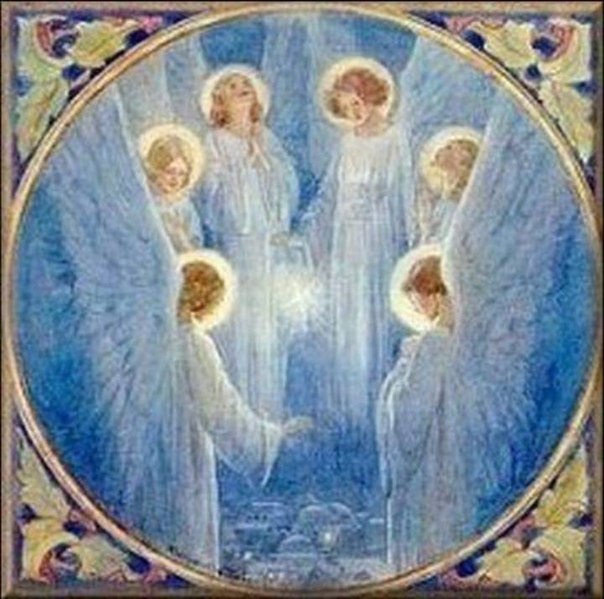
Showing posts with label Creation. Show all posts

Friday, January 10, 2020

A Spiritual Theory of Creation: the Big Bang and the "Aether" Levels of the Universe


The best scientific evidence and theories indicate that about 14 billion years ago, the universe began with a giant explosion of energy known as the "Big Bang" which began from a point of singularity. At this moment, space and time was itself created.  And before that, there was no space, and there was no time - the Big Bang essentially started this rapidly expanding "space-time" cone that we call the universe. This cosmological theory is based on Einstein's theory of relativity of the 20th century as well as modern astronomical observations, summarized in a video below:


This brings about the inevitable paradox: what was there before the Big Bang?  For before the Big Bang, there was no space nor time.  As it turns out, among the heavenly visions that Swedenborg received in the 18th century, he was given accurate information on the creation and fundamental nature of the universe that provides remarkable insights for modern science, despite the limits of the scientific knowledge of his day.

THE "NATURAL SUN" OR THE BIG BANG

The first insight Swedenborg was given is that before the creation of the physical material world, it was preceded by the creation of the spiritual world from the emanation of the Divine, who resides in a spiritual Sun of pure Love. Three levels or degrees were created in the spiritual world, which are also known as three heavens which Paul briefly described in one of his visions (2 Cor. 12:2). Although the theory of the Big Bang was essentially unknown to Swedenborg, he was told in his visions that following the creation of the spiritual world a "natural sun" or "sun of the natural world" which was of pure fire was created. This was followed by the creation of "three natural atmospheres":
"...it would be vain to conclude anything concerning the creation of the universe, unless it were first known that there are two worlds, one in which angels are, and the other in which men are; and that men by death pass out of their world into the other; and then also I saw that there were two suns, one from which all spiritual things flow forth, and the other from which all natural things flow forth; and that the sun from which all spiritual things flow forth is pure love from Jehovah God, who is in the midst of it; and that the sun from which all natural things flow forth is pure fire. ...by means of the light and heat from the [spiritual] sun... spiritual atmospheres, which in themselves are substantial, were created one from another; and because there were three, and thence three degrees of them, three heavens were made; one for the angels who are in the highest degree of love and wisdom, another for the angels who are in the second degree, and the third for the angels who are in the lowest degree. But because this spiritual universe cannot exist without a natural universe in which it may produce its effects and uses, then the sun from which all natural things proceed was created at the same time and by this likewise by means of light and heat three atmospheres encompassing the spiritual... and at last by means of these, the terraqueous globe, the abode of men, beasts, and fishes, also of trees, shrubs, and herbs, was formed of lands consisting of soil, stones, and minerals." (True Christian Religion, n. 76)
What Swedenborg was shown only makes sense if what he called the "natural sun" of pure fire is the Big Bang - for the Big Bang was a big explosion of energy, and at the initial moments of the universe the universe was extremely hot. The suns of the various solar systems coalesced later. It is important to distinguish between the Divine spiritual sun from which proceeds all life and the natural sun from which proceeds only dead material things:
"Creation itself cannot be ascribed at all to the sun of the natural world, but wholly to the sun of the spiritual world; since the sun of the natural world is entirely dead, but the sun of the spiritual world is alive; for it is the first proceeding of the Divine Love and the Divine Wisdom; and what is dead does not act at all of itself, but is acted upon. Wherefore to ascribe to it anything of creation, would be like ascribing the work which the artificer does, to the tool which is moved by his hand. The sun of the natural world is pure fire from which everything of life has been withdrawn; but the sun of the spiritual world is fire in which is the Divine Life. The angelic idea concerning the fire of the sun of the natural world, and concerning the fire of the sun of the spiritual world, is this — that the Divine Life is from within in the fire of the sun of the spiritual world, but from without in the fire of the sun of the natural world. From this it may appear that the actual existence of the natural sun is not from itself, but from the living force proceeding from the sun of the spiritual world" (Divine Love and Wisdom, n. 157).
Throughout the revelations it is revealed that life originates from spiritual influx from the spiritual Sun into the natural material world - the natural material world is not in itself the source of life. And this is why science cannot understand or explain the origin of life.

THERE IS NO SPACE OR TIME IN HEAVEN

Now, modern science tells use that space and time were created at the time of the Big Bang, which produces a paradox here - what was before the Big Bang? According to Swedenborg, before the creation of the "natural sun" from which the material universe came the spiritual heavens were created - and there is no space or time in heaven:
"All things in heaven appear in place and in space, just as in the world, and yet angels have no notion or idea of place and space. Because this cannot but appear as a paradox, I wish to present the matter in clear light, as it is one of great importance. All going from place to place in the spiritual world is effected by change of state of the interiors, so that change of place is nothing else than change of state... In this way all the movements of angels take place; hence they have no distances, and if not distances, neither have they spaces, but instead of them states and their changes. As changes of place are made in this way, it is evident that approximations are similarities as to state of interiors, and that removals are dissimilarities. From this it follows that those are near to each other who are in similar state, and those at a distance who are in dissimilar state; and that spaces in heaven are nothing else than external states corresponding to internal." (Heaven and Hell, n. 191-193)
Essentially our idea of material space becomes "abstracted" into appearances of distance. As God is Love, those who love will be close to Him in heaven according to their state of love. Moreover, in heaven we will be with the ones we truly love, and with those who are similar to our own personality. The spiritual world is the world where our internal ideas and affections become true reality, in fact more real than this material world. In this world we might say "I feel close to you." Or "I feel distant from you."  These internal feeling manifest as apparent distance of space in the spiritual world, for all our internal states of feelings and thoughts have a substantial reality.

Similar to space, there is no time in heaven, but rather changes of state. Moreover, eternity in heaven is not infinite time, but an infinite state:
"That angels know nothing about time, though all things move onward with them as in the world, without any difference at all, is because in heaven there are not years and days, but changes of state; and where there are years and days there are times, but where there are changes of state there are states... Since angels have no notion of time, they have a different idea of eternity from that which men of the earth have. By eternity they perceive infinite state, not infinite time. I was once thinking about eternity, and by the idea of time could perceive what to eternity might be, namely, without end, but not what from eternity is, and so not what God did from eternity before the creation. When anxiety on this account arose in my mind, I was elevated into the sphere of heaven and thus into the perception in which angels are about eternity, and then it was made clear to me that we must not think of eternity from time, but from state, and then we may perceive what from eternity is" (Heaven and Hell, n. 163, 167)
Thus the state of the universe before creation was a state of no space or time, thus before the Big Bang we are thus now talking about the nature of the spiritual heavens beyond the material. Moreover, it does not make sense to think of "before" the Big Bang. Rather, the three spiritual heavens are higher dimensions outside of space and time which co-exist and permeate the lower material world which dwells in the plane of space and time. This is an important clue for scientists who are still investigating the true nature of the universe.

The spiritual concept that space and time are created things, and not the fundamental or original form or reality, is relevant to modern theories of science such as Einstein's theories of General Relativity and Minkowski Space-Time, which describe space and time as a "fabric" that was created at the time of the Big Bang.

AETHER, SPACETIME, AND QUANTUM FIELDS

Following the creation of the heavens and the "natural sun," which is probably more accurately described as the Big Bang, Swedenborg was told that "three natural atmospheres" were created in the natural world. However he is using the word "atmosphere" in a different manner than our modern definition, in the context of 18th century science. By "atmosphere" he is referring to a degree or level of what scientists in his time knew as aether - a medium in space through which light propagates, similar to how sound travels through air or waves through water. Here is a brief description of the 18th century idea of aether:

"The motion of light was a long-standing investigation in physics for hundreds of years before the 20th century. The use of aether to describe this motion was popular during the 17th and 18th centuries, including a theory proposed by Johann II Bernoulli... In his theory, all space is permeated by aether containing "excessively small whirlpools". These whirlpools allow for aether to have a certain elasticity, transmitting vibrations from the corpuscular packets of light as they travel through. This theory of luminiferous aether would influence the wave theory of light proposed by Christiaan Huygens, in which light traveled in the form of longitudinal waves via an "omnipresent, perfectly elastic medium having zero density, called aether". At the time, it was thought that in order for light to travel through a vacuum, there must have been a medium filling the void through which it could propagate, as sound through air or ripples in a pool." (from Aether (classical element)

These ideas of aether were disproven by the Michaelson-Morley experiments in the early 20th century. So another model was needed. It was at this time that Einstein developed his theories of relativity, in which the speed of light was shown to be constant, and fused the separate concepts of space and time into a four dimensional manifold known as "spacetime." This spacetime manifold could be warped by gravity. As such, Einstein considered calling it the "new aether," with the caveat that no substance or motion can be associated with this aether (see Einstein's views on the aether). However this term never became popular and so at the present day we still call it "spacetime." But for the purpose of understanding what was shown about creation to Swedenborg, lets call this four dimensional manifold of spacetime as the "aether" of gravity.

So this leaves light, which Swedenborg also describes as travelling through its own "aether."  In the 20th century science was able to achieve a better understanding of light in Quantum field theory, which says that all fundamental particles are vibrations of fields that exist in all points in space and time through the universe. At this low level, particles do not travel through a medium, but rather they are manifestations of the medium itself. It is non-intuitive, so here is a summary of the theory:


These vibrations of quantum fields can be compared to sound waves traveling through air, which in the 18th century was also used as the model for the concept of aether for gravity and light. So essentially, quantum fields are the accurate and true representation of what we used to call aether - its just that in a quantum field, there is no separation between the manifestation of the particle and the field itself, as the particle is an excited state of the field. There is no separate "medium" as had originally been imagined. Again for the purpose of this discussion, lets also call these quantum fields "aether," as it will help us understand what Swedenborg was describing in what he called "natural atmospheres." For just as he saw that these natural atmospheres permeated all of space, so the quantum fields permeate all of space.

THE THREE NATURAL ATMOSPHERES OR AETHERS OF THE UNIVERSE

With this scientific background, we can now analyze what Swedenborg was shown regarding the three natural "atmospheres" or aethers that were created following the creation of the three prior spiritual atmospheres, as well as what he labeled as the "natural sun" which I interpret as the Big Bang. The first piece of information is that the three natural atmospheres are "discrete substances and least forms." They are distinct from the three spiritual atmospheres that precede them, and yet the spiritual atmospheres co-exist with them:
"The natural atmospheres are similar to the spiritual atmospheres in this, that they also are discrete substances and least forms, originating from the sun of the natural world; which also singly receive the sun and store up its fire in themselves, and temper it, and bear it down as heat to the earth, where men are; and similarly the light. The difference between the spiritual atmospheres and the natural atmospheres is that the spiritual atmospheres are receptacles of the Divine fire and the Divine light, thus of love and wisdom, for they contain these within themselves; but the natural atmospheres are not receptacles of the Divine fire and the Divine light, but receptacles of the fire and light of their own sun, which in itself is dead... wherefore within there is nothing in them from the sun of the spiritual world, but still they are environed by the spiritual atmospheres which are from the spiritual sun. That this is the difference between the spiritual atmospheres and the natural atmospheres is from the wisdom of the angels." (Divine Love and Wisdom, n. 174-175)
The second piece of information given is that the three natural atmospheres descend and become more "compressed and inert" until they cause the creation of substances:
"...there are three atmospheres in each world, the spiritual and the natural, which are distinct from each other according to degrees of altitude, and which decrease in their downward progression according to degrees of latitude... And because the atmospheres decrease in their progression downward, it follows that they become continually more compressed and inert, and at length in ultimates so compressed and inert that they are no longer atmospheres, but substances at rest, and in the natural world fixed substances, such as are in the earths and are called matter" (Divine Love and Wisdom, n. 302)
The third piece of information given is that the three natural atmospheres hold together the material substances:
"...the substances and matters of which the earths consist are the ends and terminations of atmospheres which proceed as uses from the spiritual sun... And because the substances and matters of which the earths consist are from that origin, and in their aggregation are held together in connection by the pressure of the atmospheres round about, it follows that they have therefrom a perpetual effort to produce forms of uses. The very quality of being able to produce they derive from their origin, which is that they are the ultimates of the atmospheres, with which they therefore agree" (Divine Love and Wisdom, n. 310)
The fourth piece of information is that in several passages, Swedenborg speaks of these three atmospheres as distinct from the animal, vegetable and mineral kingdoms (see Heavenly Arcana, n. 3000, Divine Love and Wisdom, n. 225, True Christian Religion, n. 186, Apocalypse Explained, n. 1208.2, Spiritual Diary, n. 2360). So this is puzzling, what are these so-called three natural atmospheres? In an unpublished manuscript, Swedenborg spells it out further:
"There are three natural atmospheres arising from the sun of the world, and there are three spiritual atmospheres arising from the sun of heaven, which is the Lord. The three natural atmospheres arising from the sun of the world are the purer aether, which is the universal atmosphere, from which springs all gravity; the intermediate aether, which forms a vortex around the planets and surrounds the moon and other satellites, from which springs magnetism; and the lowest ether, which is air. These three atmospheres hold together all physical and material things of the earth, which have been composed in conformity to those three degrees." (Last Judgment Posthumous, 320; see also Spiritual Diary, n. 222)
This actually is rather an amazing insight. Gravity is a bosonic force in the spacetime field, which was considered to be a "new aether" according to Einstein. Magnetism is something we now know is part of the electromagnetic force mediated by the photon, and as stated earlier a photon is an excitation of its quantum field, which can also be considered to be an aether. But on the third atmosphere, Swedenborg confuses it with "air" which is a macroscopic representation of aether as sound waves travel through the medium of air molecules. We know its an error since Swedenborg distinguished the mineral kingdom from the three natural atmospheres. Moreover he acknowledged in this instance that his statements should be verified by experimental knowledge:
"...the statements we have made so far regarding degrees and atmospheres are for the most part theoretical. Yet all theoretical conclusions must be drawn from and based on empirical observations, and also verified by them. Unless the observations of experience guide a person's hand, so to speak, he may be deluded in his theoretical speculations, and from a premise seized on in his imagination or imaginary assumption he may easily be borne through a series of conclusions into falsities entirely contrary to the truth-falsities which he may then confirm by fallacious and deceptive appearances of every kind. For falsities can be confirmed by deceptive and fallacious appearances, even to the point that a person believes them to be absolute truths." (Last Judgment Posthumous, 323)
So from spiritual revelation Swedenborg knew that there were three degrees or levels of aether in the natural material world, but in trying to map this to his scientific knowledge he regarded it as theoretical until confirmed by empirical facts. But from his statements describing the three atmospheres, with our modern scientific knowledge we can propose that these three "atmospheres" or "aethers" refer to three degrees of the four fundamental forces mediated by bosonic particles in their respective quantum fields. The justification for this is as follows:
  1. The three atmospheres were described as "discrete substances" in their "least forms." Quantum particles and their fields are the least forms of atomic matter.
  2. The three atmospheres are responsible for making matter more "compressed and inert." The Higgs field gives fermionic matter mass, and matter in the form of quarks are further constrained by the strong nuclear force, and further by the electromagnetic and gravitational forces. The bosonic forces are responsible for fermionic matter becoming more constrained and inert.
  3. Matter is aggregated and held together by the three atmospheres, and this is now known to be caused by the bosonic forces.
  4. The three atmospheres are distinct from the mineral kingdom, and the mineral kingdom is composed of fermionic matter. Thus the atmospheres or aethers can only be the quantum fields that permeate all of space.
  5. Swedenborg also often describes the aethers as mediating light, and electromagnetism is mediated by the photon.
Moreover, Swedenborg explicitly stated that these natural atmospheres essentially become forces in their ultimate manifestation:
"Atmospheres in ultimates become such forces, by which substances and matters, such as are in the earths, are reduced into forms, and are held together in forms both within and without." (Divine Love and Wisdom, n. 311)
Now, why are there three degrees or levels of aether, or "atmospheres"? What was shown to Swedenborg is that all that exists can be divided into three degrees, modeled after the process of end, cause and effect:
"A knowledge of degrees is as it were a key for opening the causes of things, and for entering into them. Without this knowledge scarcely anything of cause can be known; for, without it, the objects and subjects of both worlds appear of such a sameness, as if there were nothing in them except what is seen with the eye; when yet this, compared to the things which lie hidden within, is as one to a thousand, nay to tens of thousands. The interiors which are not manifest cannot be revealed in any way unless degrees are understood. For exteriors pass to interiors, and by these to inmosts through degrees; not through continuous degrees, but through discrete degrees. Diminishings or decreasings from grosser to finer, or from denser to rarer are called continuous degrees — or rather the increments and increasings from finer to grosser, or from rarer to denser — as of light to shade, or of heat to cold. But discrete degrees are entirely different: they are as things prior, posterior, and postreme; or as end, cause, and effect. These degrees are called discrete, because the prior is by itself, the posterior by itself, and the postreme by itself; but still taken together they make one. The atmospheres — which are called ethers and airs — from the highest to the lowest, or from the sun to the earth, are discreted into such degrees" (Divine Love and Wisdom, n. 184).
This knowledge of degrees is not only useful for investigating scientific matters, but also spiritual theology, and it is part of the framework Swedenborg used to describe the theology of the New Church in a systematic and rational manner. It is also key to understanding the true meaning of the Trinity. Quantum physicists actually make use of discrete degrees, as "quantum" itself means a discrete degree of energy. But what are the three degrees of the bosonic forces? We can propose the following degrees:
  1. The space-time manifold, mediated by the graviton which has a spin of 2.
  2. The electromagnetic field mediated by the photon, the weak field mediated by the W/Z bosons, and the strong field mediated by the gluons. All of these forces have a spin of 1.
  3. The Higgs field mediated by the Higgs boson, which gives most other particles mass. It has a spin of 0.
One reason for this arrangement is that Swedenborg stated that the aether forces of the atmospheres get progressively stronger (Spiritual Diary, n. 418), and we can see this in the relative strengths between the forces:


In this arrangement, the weak, electromagnetic and strong forces form three discrete "subdegrees" within the intermediate atmosphere or aether. Also both the electromagnetic and weak forces have been mathematically combined into an electroweak force.

Other than this, what scientific justification do we have for creating three degrees or levels for the bosonic forces? Intuitively spacetime should be in the first degree, as that is often used as the independent background in frameworks for physics. Another clue comes from the discrete spin of the bosonic particle: it can be 0,1 or 2. In mathematics, these discrete spins correspond to tensors, vectors and scalars:
"The force carrying bosons of the standard model (gluons, photons, and the W and Z) have spin 1 since they go with vector fields. The Higgs boson corresponds to a scalar field so it has spin 0. If the particle of the gravitational field is ever discovered, it would be called a graviton and would have a spin 2 since it corresponds to a tensor field. A tensor is a mathematical object that's more complex than a vector, which is in turn more complex than a scalar. See the trend? A scalar field with no direction gets a particle with spin 0. A vector field with a direction gets a particle with spin 1. A tensor field that stretches and squeezes space in two directions gets a particle with spin 2. " (from The Physics Hypertextbook)
Most people have heard of vectors and scalars. But what is a tensor? Tensors have numerous applications in data analysis and artificial intelligence, and are used to model stress on 3D objects. Here is a visual representation:


Tensors, scalars and vectors each represent, lo and behold, three discrete mathematical degrees of order:
"The tensor is a more generalized form of scalar and vector. Or, the scalar, vector are the special cases of tensor.
  • If a tensor has only magnitude and no direction (i.e., rank 0 tensor), then it is called scalar.
  • If a tensor has magnitude and one direction (i.e., rank 1 tensor), then it is called vector.
  • If a tensor has magnitude and two directions (i.e., rank 2 tensor), then it is called dyad.
  • And so on…
Please note that there are differences between the term “direction" and the term “dimension." All the types of tensor (scalar, vector, and dyad) can be defined in a three dimensional space or co-ordinate system." (from Mechanical Vectors, Rotations, and Tensors)
There is another reason to consider the gravitational force and the space-time manifold as a prior discrete degree from the electromagnetic field mediated by the photon. This is related to some complex math involving a hyperbolic universe, otherwise known by the obscure name of "anti-de Sitter space."  It is called AdS/CFT correspondence, in which a complete string theory involving gravity corresponds to a formal quantum theory with one less spacial dimension:


The name of the theory itself is interesting because Swedenborg constantly used the word "correspondence" to show how lower literal concepts "correspond" to higher level spiritual ideas. For details of its applicability in solving several problems in physics, see AdS-QCD correspondence. The theory is a bit complicated and is most easily understood in the following two videos; the first one below gets to the meat of the matter at 12:19 --


This provides evidence that our universe is holographic, as further explained in the following video, especially beginning at 9:33 --


Ads CFT Correspondence describes how quantum forces are a discrete degree below gravity, similar to how Swedenborg described how electromagnetism is in a discrete degree of aether below the aether or gravity. The idea of correspondence, where the physics of higher dimensions correspond to another physics in a a smaller number of dimensions, is also very similar to Swedenborg's idea of the correspondence in which he discovered that all material things in the universe were a theatrical representation of higher level spiritual ideas.  It is a useful idea in science, and can help us achieve an overarching spiritual theory of the universe.

Wednesday, November 7, 2018

Is Genesis Historical? A Revelation from Heaven


Much of the modern skepticism on the revelations of Christianity and Judaism revolves around the first 11 chapters of Genesis, which includes the seven days of creation, the story of Adam & Eve, the flood of Noah and the Tower of Babel. As science and archaeology progressed in the 19th century, the literalistic interpretation of the first 11 chapters came into doubt. In the 19th century, ancient cuneiform tablets were discovered that showed that many of the stories of the first 11 chapters of Genesis had ancient precursors in Mesopotamia. However long before science had advanced in knowledge, and well before the ancient Akkadian and Sumerian tablets were discovered in the 19th century, Emanuel Swedenborg received the following revelations in the middle of the 18th century concerning the first chapters of Genesis:
"There are in the Word, in general, four different styles. The first is that of the Most Ancient Church. Their mode of expression was such that when they mentioned terrestrial and worldly things they thought of the spiritual and celestial things which these represented. They therefore not only expressed themselves by representatives, but also formed these into a certain historical series... These particulars concerning the creation, the garden of Eden, etc., down to the time of Abram, Moses had from the descendants of the Most Ancient Church" (Heavenly Arcana, n. 66)
Note that Swedenborg wrote this in the mid-18th century. The Sumerian tablets which contained earlier versions of the stories of Genesis, were discovered in the 19th century. The parallels are unmistakable, even though Christian apologists will continue to deny the relationship, for which see the following:


Below chart is a summary of the major parallels:


Here is an interesting chart, showing that if the years of the patriarchs before the flood are converted from base 10 to base 60, the number of years closely match the Sumerian king list:

For many Christian apologists these parallels pose a problem, which one can see from some of the links above. But in the revelations given to Emanuel Swedenborg, it is revealed that before Judaism there were revelations given to the peoples of the Ancient Near East. The revelations were given in two phases, which Swedenborg terms as "The Most Ancient Church" and "The Ancient Church." In the ancient style of writing, everything was described and taught in terms of mythical stories:
"...the historic narrative concerning the creation and concerning the first man, and concerning paradise, is a history so framed as to contain within it heavenly and Divine things, and this according to the received manner in the Ancient Churches. This manner of writing extended thence also to many who were outside of that Church, who in like manner devised histories and involved arcana within them, as is plain from the most ancient writers. For in the Ancient Churches it was known what such things as are in the world signified in heaven, and the events were not of such consequence to them as to be described, but instead the things which were of heaven." (Heavenly Arcana, n. 8891.4)
This form of mythical writing is used in Genesis 1-11. True history only begins with Genesis 12. The meaning of the symbolic myth is described in detail in the work Heavenly Arcana:
"They who do not think beyond the sense of the letter cannot believe otherwise than that the creation, which is described in the first and second chapters of Genesis, is the creation of the universe, and that there were six days within which were created the heaven, the earth, the sea, and all things which are therein, and at length man in the likeness of God. But who cannot see, if he ponders on the particulars of the description, that the creation of the universe is not there meant... These and other such things in that history must needs at first thought appear paradoxical to those who entertain any doubt concerning the sanctity of the Word, and afterward induce them to deny the Divine therein... Angels, when the first chapter of Genesis is read, do not perceive any other creation than the new creation of man, which is called regeneration. This regeneration is described in that history: by paradise the wisdom of man created anew; by the two trees in the midst thereof the two faculties of that man, namely, the will of good by the tree of life and the understanding of truth by the tree of knowledge. And that it was forbidden to eat of this latter tree, was because the man who is regenerated or created anew, must no longer be led by the understanding of truth, but by the will of good, and if otherwise, the new life within him perishes" (Heavenly Arcana, n. 8891.2,3)
Thus the arguments of Christian apologists and skeptics over the first eleven chapters of Genesis are insignificant and irrelevant. A revelation has been given that not only explains the symbolic meaning of the Bible, but also Divine providence foresaw this controversy and gave an answer to the problem long before it became such a public issue of debate. And this is just one of many new revelations given concerning Christianity. Again, Emanuel Swedenborg published his writings a century before these archaeological texts were discovered, showing that he was indeed receiving clairvoyant revelations concerning Christianity and the true spiritual meaning of the Bible. Should we not be paying more attention to them?

Sunday, June 4, 2017

The Science of Creation and the Spiritual World as seen by Emanuel Swedenborg


To explore the science behind the idea of the spiritual world at first seems like an oxymoron, since modern science and religion are in conflict with each other. The reasons for the conflict between science and religion is due to both different criteria for truth, as well as false concepts in both science and and in religion. To summarize:
  1. Modern science in general espouses the false philosophy of Naturalism, that nature begets nature.
  2. Over time, religion becomes falsified by relying on the traditions and authority of men. Argument by authority is a logical fallacy and is rejected by the scientific method. 
  3. Science is based on factual evidence obtained from the senses. Witness testimony for any phenomenon or idea is classified as "anecdotal" until confirmed by the scientific method. Completely opposite to this method, true religion is based on heavenly revelations from witnesses which are adapted to the culture receiving the revelation.
The first two areas of conflict between science and religion is due to false concepts that are assumed to be true in both science and religion.  The third area is a difference in method for determining the truth. However, there are some rather unusual cases where an internal revelation is received which is later confirmed by science. Dmitry Mendeleyev discovered the periodic table once it was shown to him in a dream; after the dream he was able to layout all the elements on a piece of paper and only one correction was needed. Similarly, the structure of DNA was discovered only after Dr. James Watson had a dream of two intertwining serpents.

There is another case of this in terms of the revelations given to Emanuel Swedenborg in waking visions, but in this case the revelation preceded the scientific discovery by over 150 years. It concerns the science of space and time and the origin of the universe, and although Swedenborg did not have any idea about our current scientific discoveries, the heavenly revelations anticipated them far in advance.  To understand it, I will briefly describe the scientific revolution that occurred between the time of Isaac Newton and Albert Einstein, involving space and time and the creation of the universe.

THE SCIENTIFIC CONCEPTS OF SPACE AND TIME

Our scientific concepts of space and time have evolved over the centuries, which is summarize well in Stanford Encyclopedia of Philosophy - Newton's Views on Space, Time, and Motion. In Greek Antiquity, philosophers first proposed that space was a void or vacuum:
The most important question shaping 17th-century views on the nature of space, time and motion is whether or not a true void or vacuum is possible, i.e., a place devoid of body of any sort (including rarified substances such as air). Ancient atomism, dating back at least to the pre-Socratic philosopher Democritus (5th century, B. C.), held that not only is such possible, but in fact actually exists among the interstices of the smallest, indivisible parts of matter and extends without bound infinitely.
This idea was rejected by Aristotle, but when modern astronomy began to disprove many of the ideas of Aristotle, there was a revival of atomism and space as a vacuum in the 16th and 17th centuries.  It is upon this foundation that Isaac Newton founded classical physics in the 18th century, in which he assumed that space and time were absolutes:
Isaac Newton founded classical mechanics on the view that space is distinct from body and that time passes uniformly without regard to whether anything happens in the world. For this reason he spoke of absolute space and absolute time, so as to distinguish these entities from the various ways by which we measure them (which he called relative spaces and relative times)
This idea of space and time as absolutes, distinct from matter, dominated scientific theory until Einstein's theory of General Relativity in the early 20th century. As a consequence of this theory, space and time becomes a distinct object known as the "space-time continuum." Gravity from matter distorts space-time:


This warping has been confirmed by astronomical observations:


Recently, two black holes merged together and emitted a loud BURP in the form of gravitational waves which was detected by LIGO, as also predicted by Einstein's theory:


Moreover, another consequence of this theory is that it will dilate or expand time itself, according to the relative speed of the observer. The faster one approaches the speed of the light, the slower that time will flow.

Related to the concept of the space-time continuum of Einstein's theory of relativity, is the discovery of the Higgs boson in 2013. The Higgs boson is actually an excitation of the Higgs field, a field that permeates the entire universe. Among other things, this universal field explains why certain particles have mass. Although the Higgs field permeates all of space, it is distinct from the warping of the space-time continuum by gravity. See the article Why the Higgs and Gravity are Unrelated (the effect of mass has multiple causes; also the Higgs Boson has a quantum spin of 0 and the graviton has a quantum spin of 2).

SWEDENBORG: THERE IS NO SUCH THING AS A PURE VACUUM OF NOTHING

Emanuel Swedenborg lived in the 18th century, and was contemporary with Isaac Newton during his childhood. Swedenborg was also a scientist and is estimated to have an IQ of over 200, but in his late 50s he began to have a spiritual awakening, which eventually caused his inner mind to open up and receive waking visions of the heavenly world for about 27 years. The main revelation concerns the spiritual sense of the Word, providing the only proof that the Bible is Divinely Inspired, and correcting many false doctrines that have entered and corrupted the Christian church. Another main objective of these revelations was to reveal that there is indeed an afterlife, our souls are eternal which continue to live after death.

Portrait of Isaac Newton

One of the people that Swedenborg encountered in the afterlife was Isaac Newton. Now, recall that in the 18th century, as a result of Isaac Newton's successful theories, everyone began to believe that space and time were absolute and that space was a pure vacuum. This was disproven in the 20th century with Einstein's theory of relativity, and by the discovery of the Higgs field which permeates the entire universe. Thus space is not a vaccum, nor is space or time independent abstract things from matter. Rather, space and time are created things.

Now, back in the 18th century, Swedenborg describes an encounter between some angels and Isaac Newton, and the angels told Newton this: there is no such thing as a pure vacuum of nothingness:
"Something shall be said here concerning vacuum. I once heard angels talking with Newton about vacuum, and saying that they could not bear the idea of vacuum as nothing; because in their world which is spiritual, and within or above the spaces and times of the natural world, they equally feel, think, are affected, love, will, breathe, yea speak and act; which things are utterly impossible in vacuum as nothing; because nothing is nothing, and of nothing nothing can be predicated. Newton said that he knew that the Divine which is, fills all things, and that he himself shuddered at the idea of nothing respecting vacuum, because that idea is destructive of all things; and he exhorted those who talked with him about vacuum, to beware of the idea of nothing, calling it a swoon, because in nothing no real existence of mind is possible." (Angelic Wisdom concerning Divine Love and Wisdom, n. 82)
In another account of the same encounter, the angels were correcting Isaac Newton of his error:
"Concerning a vacuum [Isaac Newton] said, that in the world he had believed in the existence of a vacuum; but when the angels perceived that he had an idea of a vacuum, as an idea of nothing, they turned themselves away, saying that they cannot bear the idea of nothing, since when there is an idea of nothing the idea of the essence of things perishes." (Last Judgment Posthumous, n. 290)
Science would not confirm that Isaac Newton was wrong on this matter until almost 200 years later, and yet here we have an account of angels correcting Newton back in the 18th century. This is just one example among many, that Swedenborg indeed was receiving revelations from the heavenly world. I will note here he did not draw any doctrine or teaching from any spirit, but rather from the Lord alone (see Was Emanuel Swedenborg a Spiritualist or Occultist? against false accusation from religious leaders). These encounters were for the sake of countering the false ideas of atheism and naturalism.

THE SCIENTIFIC CONCEPT OF CREATION OR THE BIG BANG

Space is not a vacuum, but rather it is a field that is constantly expanding. As a consequence of Einstein's General theory of relativity, it became known the universe had a definite beginning about 14 billion years ago, and that everything started from a single point called a "singularity." The universe began as a "Big Bang" and from there, both space and time expanded to the present day universe:


Exrapolating backwards, it is known that the entire universe began from a single point or singularity of high temperature and high density. In this state of "singularity" both space and time lose their meaning. Moreover, this "singularity" has an infinite energy density, which is regarded as impossible in our current known laws of physics. As all laws of physics break down inside this singularity, it is not well known.

There are two singularities predicted by science: one right before the Big Bang that created the universe 14 billion years ago, and one inside a black hole that was created from the collapse of a dying star. Some scientists have noted the similarities between these two singularities, and in fact, some scientists propose that our universe was created from a black hole. The conclusion: at the center of a black hole is another universe. We thus live in a "multiverse." From Every Black Hole Contains a New Universe:
Successful as it is, there are notable unsolved questions with the standard big bang theory, which suggests that the universe began as a seemingly impossible "singularity," an infinitely small point containing an infinitely high concentration of matter, expanding in size to what we observe today. The theory of inflation, a super-fast expansion of space proposed in recent decades, fills in many important details, such as why slight lumps in the concentration of matter in the early universe coalesced into large celestial bodies such as galaxies and clusters of galaxies.
But these theories leave major questions unresolved. For example: What started the big bang? What caused inflation to end? What is the source of the mysterious dark energy that is apparently causing the universe to speed up its expansion?
The idea that our universe is entirely contained within a black hole provides answers to these problems and many more. It eliminates the notion of physically impossible singularities in our universe.
The theory is interesting: it explains the beginning singularity, the expansion of the universe, a possible origin for "dark energy" causing the expansion, as well as  the observed rotation of galaxies in different hemispheres of the universe.


REVELATIONS OF CREATION GIVEN TO SWEDENBORG

Modern science indicates that the natural universe originated from the Big Bang, a giant explosion of energy which led to the creation of suns and galaxies.  Emanuel Swedenborg, as a scientist, first proposed the Nebular hypothesis as the origin of are solar system in 1734. The Big Bang and expanding universe was unknown to him. When he started receiving spiritual revelations, he was shown there are two worlds: the spiritual world of heaven, and the natural world. In the spiritual world there is a spiritual sun in which the God-Man resides, whereas in the natural world we have the sun of our solar system. One should distinguish between the spiritual sun of the spiritual world, and the natural sun of the natural world:
"It is most necessary to know that there are two suns, one spiritual and the other natural — the spiritual sun for those who are in the spiritual world, and the natural sun for those who are in the natural world. Unless this is known, nothing can be rightly understood concerning the creation and concerning man" (Angelic Wisdom concerning Divine Love and Wisdom, n. 107).
The natural sun is the origin of all natural material things, but the spiritual sun is the origin of all forms of life. All life originates from the spiritual sun of the God-Man by influx into the natural world. Current science is deeply in error to assume that life comes from natural dead things. Since science is currently in denial of the spiritual world, it cannot explain the origin of life. The natural world is but a recipient and container for spiritual life, and life flows in from the Divine through spiritual influx. The soul is of a substance that does not interact with light:
"Spirits themselves are forms, that is, consist of continuous forms, equally with men, but of a purer nature, and not visible to the bodily sight. And because these forms or substances are not visible to the corporeal eye, man at this day apprehends no otherwise than that knowledges and thoughts are abstract things; hence also comes the folly of our age, that men do not believe that they have a spirit within them which is to live after the death of the body, when yet this spirit is a substance much more real than the material substance of its body; yea, if you will believe it, the spirit, after being freed from corporeal things, is that very purified body" (Heavenly Arcana, n. 3726.4)
Now, concerning the natural sun from which all things originate, from the science of Swedenborg's day there was no knowledge of the Big Bang, but he did formulate the Nebular hypothesis for the origin of the solar system, and he knew that each star was its own solar system. But continually in his writings, Swedenborg speaks of the natural sun, as if there was one natural sun. In the following passage, Swedenborg describes the natural sun as something very close to the Big Bang and the expansion of the universe:
"...the expanse of the centre of life is called the spiritual world, which subsists from its own sun; and that the expanse of nature is called the natural world, which subsists from its sun." (Angelic Wisdom concerning Marriage Love, n. 380)
Although the Sun of the spiritual world is distinct from the sun of the natural world, the sun of the natural world originates from the Sun of the spiritual world:
"Now, as the expanse springs from the centre, and not the reverse, as we have said before; and as the centre of life, which is the sun of the angelic heaven, is Divine love immediately proceeding from God, who is in the midst of that sun; and as from this is the expanse of that centre, which is called the spiritual world; and as from that sun sprang forth the sun of the world, and from this its expanse, which is called the natural world,—it is clear that the universe is created from the one God" (Angelic Wisdom concerning Marriage Love, n. 380)
This at first does not seem true, as the sun of our solar system was formed by coalescing gases, which Swedenborg even first proposed in the Nebular hypothesis. Its possible, however, that in these revelations when Swedenborg speaks of the natural sun, what is being spoken of here is the Big Bang that arose from the original singularity at the beginning of the universe. It is known that this "singularity" was extremely dense, infinitely so according to our mathematics. Swedenborg stated the the natural world first began from the spiritual world. In the spiritual world there are successive "spiritual atmospheres" of increasing density. Compare the scientific concept of the original singularity with this passage:
"...because the [spiritual] atmospheres decrease in their progression downward, it follows that they become continually more compressed and inert, and at length in ultimates so compressed and inert that they are no longer atmospheres, but substances at rest, and in the natural world fixed substances, such as are in the earths and are called matter." (Angelic Wisdom concerning Divine Love and Wisdom, n. 302)
Now, in the singularity at the beginning of the universe, our concepts of space and time become meaningless. Beyond this singularity physicists do not know how to grasp it. But what Swedenborg stated is that space and time were proper only to the natural world, but not to the spiritual world. In the spiritual world, there is no such thing as space and time:
"There are two things proper to nature, space and time. From these man in the natural world forms the ideas of his thought, and thence his understanding. If he remains in these ideas, and does not elevate his mind above them, he can never perceive anything spiritual and Divine; for he involves the spiritual and Divine in ideas which come from space and time; and so far as he does this, the light of his understanding becomes merely natural." (Angelic Wisdom concerning Divine Love and Wisdom, n. 69)
When one dies and enters into the spiritual world, one enters the realm of pure ideas, which is that of the state of one's will and thought:
"All who die and become angels put off those two things proper to nature, which, as said above, are space and time; for they enter then into spiritual light, in which the objects of thought are truths, and the objects of sight are similar to the objects in the natural world, but correspondent to their thoughts. The objects of their thought which, as was said, are truths, derive nothing at all from space and time; and though the objects of their sight appear as in space and in time, still they do not think from them. The reason is that spaces and times there are not rigid as in the natural world, but changeable according to the states of their life. Hence in the ideas of their thought there are instead states of life — instead of spaces such things as have relation to states of love, and instead of times such things as have relation to states of wisdom." (Angelic Wisdom concerning Divine Love and Wisdom, n. 70)
So, according to this, what was prior to the Big Bang? Space and time cease to exist, so what was prior was the spiritual world. This spiritual world has a constant influx into the natural world, and is what causes life forms to be created in this natural world. We saw earlier that Swedenborg saw that the Divine expands and in its ultimate state, the spiritual atmosphere becomes dense to form matter; this comes very close to describing the singularity that caused the Big Bang.

So, there are two possible origins here for the Big Bang: one is from the spiritual world, by a compression of spiritual atmospheres that emanate from the Divine. Another is that the Big Bang of our universe is from the creation of a black hole. In our universe, each black hole is a singularity which contains another universe. Thus each universe is a parent to multiple child universes, ad infinitum. So which is true? I think both are true: from the spiritual world, the Divine is constantly creating new universes, and these universes in turn spawn baby universes which share the timeline of its parent universe. This is my personal opinion, but in several passages Swedenborg stated that the Divine loves variety, and from variety there is the perfection of the whole. Moreover, once there is Divine influx to create life, in that life the Divine gives life the ability to propagate itself. This same pattern may manifest itself in the initial creation of multiple universes, and each universe in turn keeps spawning other universes.

Thus, as the Divine is infinite, there will be infinite things for us to explore in heaven:
In my Father's house are many mansions: if it were not so, I would have told you. I go to prepare a place for you. (John 14:2)

Friday, May 27, 2016

The Shepherd of Hermas and Swedenborg: Fictional Parable or Vision?


Glory to God, by Tom DuBois

The Shepherd of Hermas is an early Christian work of the 1st and 2nd centuries, containing a series of visions and parables that a former Roman slave receives in dialogues with angels. It was quoted as scripture by the early church father Irenaeus, and it found its way into one of the earliest complete Bibles in existence, the Codex Sinaiticus.  The church father Eusebius stated it was still read in the churches in the fourth century.  The work has puzzled scholars: how could such a simplistic fictional parable find its way into the Bible and get quoted as scripture?

The work caught my attention because one of the visions describes a Christology that is unlike the typical trinitarian doctrine of the post-Nicene era, and is similar to the doctrine of the Divine Human of the New Church.  I covered this in detail in The Ancient Christology of the Shepherd of Hermas.  In parable it describes the Divine itself, the pre-existent Divine Human in heaven, and then Jesus as a man whose human form gets transformed to become one with the Divine.  The work was sent to Pope Clement of the Roman church, and from there it spread across to the Christian churches within the Roman Empire.  Would a work of fiction be treated in such a manner?

While modern readers would prefer to treat this work as a religious fiction, comparing it to Pilgrim's Progress, such a view is problematic.  This is summed up in an article by Henry Wace from A Dictionary of Early Christian Biography:
Are we to suppose that Hermas in relating his visions intended no more than to present edifying lessons in an allegorical form, and that it was merely as an instructive fiction that the book was regarded when it was introduced into public reading in the church? Donaldson says: "If the book be not inspired, then either the writer fancied he had seen these visions, or tried to make other people fancy this, or he clothed the work in a fictitious form designedly and undisguisedly. If he did the first, he must have been silly. If he did the second he must have been an impostor." But as he believes the author to have been "an honest upright, and thoughtful man," he concludes that he did the third, "as multitudes of others have done after him, with John Bunyan at their head." ...But we ourselves feel bound to reject this as altogether mistaken criticism, and as an application to the 2nd cent. of the standards of today. To us it seems plain that, whatever the author intended, the first readers of Hermas did not receive the book as mere allegorical fiction.
So let's take a deeper dive into this work.  For those who wish to read it, there is a critical text located here: Hermas Critical Text.  There are some older translations here: Early Christian Writings.

THE LATER FORGERY OF THE SHEPHERD OF HERMAS

As I was reviewing the Shepherd of Hermas, to determine if its teachings were valid or not, I began to note several problems in the work.  The books is divided into 5 visions, 12 commandments, and 10 parables.  As I saw the problems I was about to toss out the work as one of fiction, but then I saw a pattern: all the internal problems with the Shepherd of Hermas are found only in the last 3 parables at the end of the work.

It then became apparent to me: the last 3 sections of the Shepherd of Hermas were added later by a clever forger.  So I decided to dig further - did any scholars on the Shepherd of Hermas reach the same conclusion?  The date and authorship is disputed among them, and the matter is by no means settled.  One scholar, Hilgenfeld, expressed the opinion that the last 3 parables were by a later author, who was the final editor of the work.  The original work was probably finished in the late 1st century A.D. under Pope Clement, and the last 3 parables were added by another author in the middle of the 2nd century A.D.  This is why there are conflicting opinions on the date of authorship.

The ninth parable is an obvious repeat of the original vision of the tower of the third vision.  In the ninth parable Hermas is strangely transported from Rome into Arcadia of Greece.  One scholar who analyzed it determined that the descriptions were probably borrowed from the Greek author Pausanius (see Hermas in Arcadia and Other Essays, 1896).  But there are deeper problems.  In the eighth parable, the archangel Michael is elevated so that it is this angel who inspires the "law into the hearts of them that believe" - and this is something that should be attributed to the Divine, not an angel.  From the visions of Swedenborg it is known one characteristic of angels is that they never claim anything as their own, but attribute everything to the Divine, and they themselves are but recipients.  The ninth describes twelve virgin angels, and then states that the Son of God "bears the name of the virgins."  This is false. It is the other way around: angels are recipients of the Divine, the Divine is not a recipient of properties of angels.  

In the original Shepherd of Hermas, Hermas is married with children, and in the very first vision is told to guard his thoughts against sexual immorality and adultery.  The warning is very strict.  And what happens in the ninth parable?  Hermas is now running around and frolicking with these 12 virgin angels, who kiss him on the cheek.  Moreover these 12 virgin angels are described as "holy spirits." 

So, what was the motive of the later forgery to the Shepherd of Hermas?  In the first four visions Hermas encounters a female angel, whom he mistakes for the oracle of the Sibyl.  It is explained that this female angel represents the church.  In the ninth parable, it is explained that the female angel really was not a woman, but rather the Son of God.  This is an obvious gloss.  Whoever added this forged section, had a problem with female teachers in the church.  This actually was an issue of the second century church, and it was suppressed by the male majority.

There was one other other motive of the forgery which is more subtle: it is to suppress the original Christology of the Shepherd of Hermas.  Whereas the original Hermas is not theologically minded, the forger has some theological ideas and wants to "correct" some of the things that Hermas wrote.  One thing that is obvious is that there is a preponderance of the phrase "Son of God" in this forged section which is absent in the earlier Hermas.  There is one statement that looks late, where it says that the Son of God was ""born before all His creation" which sounds like a post-Nicene statement (see The Nicene Creed: a distorted version of the Apostle's Creed and The False Belief of a Trinity of three beings: TRITHEISM).  The forger thus saw the original Christology of Hermas as problematic.  Hermas by this time had become popular in the Christian churches - they could not withdraw it, they could not change it, so the best option they thought of was to add this later section.

So those scholars who hold that Hermas was written as a fiction are partly correct.  More correctly, the latter portion was forged in order to suppress the early Christological teachings of Hermas.

THE NATURE OF THE VISIONS OF HERMAS

Unlike other apocryphal works, there is nothing "fantastic" that occurs in the visions of Hermas.  Instead, they are down to earth and give practical advice on how to live as a Christian, with an emphasis on reforming one's life and repentance.  The nature of the visions of Hermas, how they take place, vary.  In the first vision, as well as the second, Hermas is led to wander to a particular spot while under a trance:
"I fell into a trance as I walked. And an unseen-force seized me and carried me through a pathless region where no man could make his way, because it was very steep and eroded into ridges by the running waters."
This thus takes place while Hermas is fully awake.  Swedenborg experienced this mental state only once, and says it was often experienced by the ancient prophets:
"There are two kinds of visions that are not of the ordinary kind, into which I have been let only that I might know their nature, and what is meant by its being said in the Word that men were withdrawn from the body, and that they were carried by the spirit into another place.
"...As regards the other kind — being carried away by the spirit into another place — it has been shown me by living experience what it is, and how it is done, but this only two or three times. It may be well to present a single experience. Walking through the streets of a city and through the country, and being at the same time also in conversation with spirits, I did not know but that I was wide awake and saw as at other times; and so I walked on without mistake, and all the while I was in vision, seeing groves, rivers, palaces, houses, men, and many things besides. But after I had thus walked for hours, suddenly I was in the sight of the body, and became aware that I was in another place. Greatly amazed at this, I perceived that I had been in such a state as they were in, of whom it is said that they were led away by the spirit into another place; for while it lasts there is no reflection concerning the way, even if it be many miles; nor is there reflection on the time, even if it be many hours or days; nor is there perception of any fatigue. Then, too, one is led through ways of which he has no knowledge, even to the appointed place. This took place that I might know that a man can be led by the Lord without his knowing whence and whither." (Swedenborg, Heavenly Arcana, n. 1882, 1884)
In other cases, Hermas says the angel appeared to him in vision.  In others, he stated that it occurred while he slept through a dream.  Throughout he prays and fasts, and at one time is commanded to fast in order to receive further visions:
"Now in a night-vision, I beheld the old woman speaking to me, “Every question requires humility of spirit. Therefore, fast, and you will receive from the Lord what you ask.”"
This reminds me of the visions of Sarah Binayamo Boyanga, who was also commanded to fast in order to receive visions of heaven and hell (see A Divine Revelation from Africa, concerning Heaven and Hell).

In another instance Hermas hears a voice, or interior locution:
"As I was praising and giving thanks to him, an echo, as it were, of my voice answered me, “Do not be double-minded, Hermas.”"
This experience is well known among mystics of the Catholic Church.  Swedenborg states that in many cases the early prophets wrote down portions of the Bible from hearing a voice, called the "word of the Lord."

In the visions of Hermas, he has extended dialogues with angels, who present things to his vision in order to present a point.  To the modern mind which does not believe in visions, this in itself is "proof" enough that this is fictional and it is the safer view to take if one has a scholarly reputation to protect.  Although most would dismiss such an experience as impossible, there is a modern parallel in the waking visions of Emanuel Swedenborg in the 18th century.  Most of his works are purely theological, but his last work Angelic Wisdom concerning Marriage Love.  It is part of a larger work containing the published works of Swedenborg, The Divine Revelation of the New Jerusalem.


In it is revealed that monogamous marriage is the ultimate expression of the highest spirituality here on earth.  The opposite, which is adultery, is the ultimate expression of hell on earth.   It is very similar to the Shepherd of Hermas - both warn of the spiritual consequences of sexual immorality.  Swedenborg introduces his work as follows:
"I foresee that many who read the following Relations and those after the chapters will believe they are fictions of the imagination; but I declare in truth that they are not fictions, but things actually done and seen. Nor were they seen in any somnolent state of mind, but in a state of full wakefulness. For it has pleased the Lord to manifest himself to me, and to send me to teach the things that will be for the New Church which is meant by the New Jerusalem in the Apocalypse. To this end He has opened the interiors of my mind and spirit, whereby He has given me to be in the spiritual world with angels and at the same time in the natural world with men—and this now for five and twenty years." (Angelic Wisdom concerning Marriage Love, n. 1)
THE VISION OF THE SEVEN FEMALE ANGELS


The Shepherd of Hermas and Angelic Wisdom of Marriage Love are two similar works, so similar they will prompt a similar reaction to a modern audience.  Are they works of fiction or not?  Independent of that question, one should simply read them and examine if the statements are according to truth.  However I want to show here something rather strange, and this concerns the third vision of Hermas, which describes a tower being built which represents the church.  Around the tower, Hermas sees seven women:

When I ceased asking questions about all these matters, she said to me, “Do you wish to see something else?”
As I was eager to see more, I was overjoyed at the prospect of seeing visions.
She looked at me with a smile and said, “Do you see seven women around the tower?”
“Yes, lady,” I said.
“This tower is being supported by them in accordance with the Lord’s command. Now let me tell you their functions. The first of them, who is clasping her hands together, is called Faith. God’s elect are saved through her. The second, who has her garment tucked up and acts with vigor, is called Continence. She is the daughter of Faith. Whoever follows her will be happy in his life, because he will abstain from all evil deeds in the assurance that, by abstaining from all evil desire, he will inherit eternal life.”
“But, the others, who are they, lady?”
“They are the daughters one of the other. Their names are: Simplicity, Knowledge, Innocence, Reverence, and Love. When you perform all the acts of their mother then you are able to live.”
“Lady,” I said, “I would like to know what power each of them possesses.”
“You shall be told what kinds of powers they have,” she said. “Their powers are regulated by each other, and they follow one another in the order in which they are born. Continence is the daughter of Faith, Simplicity of Continence, Innocence of Simplicity, Reverence of Innocence, Knowledge of Reverence, Love of Knowledge. Their acts then, are pure, reverent and divine. Whoever serves them and embraces their acts will have a dwelling in the tower along with God’s holy ones.”

The names of these seven female angels, representing seven virtues, caught my attention.  However we have somewhat of a translation problem.  I checked the other translations and the original Greek, the names of the seven female angels should be as follows (Strong's number can be used to find instances of the word in the New Testament):

1. Faith (Greek Πίστεως, Strong's #4102)
2. Temperance/Self-control (Greek Ἐγκρατείας Strong's #1466)
3. Simplicity (Greek Ἁπλότης Strong's #572)
4. Guilelessness (Greek Ἀκακία - acacia)
5. Reverence / Respect (Greek Σεμνότης Strong's #4587)
6. Intelligence (Greek Ἐπιστήμη - episteme - means "justified true belief" in Plato) 
7. Love (Greek Ἀγάπη, Strong's #26)

The only question on translation is that of the Greek word episteme, from which we get epistemology.  The meaning of the word means different things to different Greek others, and for a convuluted analysis see Stanford Encyclopedia of Philosophy - Episteme and Techne.  In Stoic philosophy, it means what is true and certain obtained through reason - see Stoicism - Epistemology.  In Hermas, it seems to be something different.  One might simply translate it as "knowledge." Roberts and Donaldson (1886) translated it as "intelligence" which I believe is correct from the context, as I will explain below.  Another mistranslation is corrected, "innocence" is more accurately rendered as "guilelessness" or "without guile."

THE SEVEN SPIRITUAL STAGES OF THE SEVEN DAYS OF CREATION


In Heavenly Arcana, Swedenborg from his waking visions describes how the seven days of creation are symbolic of seven stages of spiritual development.  It does not concern the creation of the world, as Creationists believe, but rather describes universal stages of spiritual development to create a new spiritual person (see Seven Stages of Spiritual Development for a brief overview).  In the Shepherd of Hermas - the seven virtues of the seven female angels closely correspond to the spiritual symbolism of the seven days of creation in the book of Genesis.  Not only do they correspond, but the sequence of virtues, where one virtues precedes the following, is very similar to the seven stages of spiritual development in which prior states must proceed the following.  How do they correspond?  One challenge we have here is the Shepherd of Hermas uses very simplistic terminology that Hermas could understand, as opposed to Swedenborg who was very exact in his language.  I will try to briefly summarize.

DAY 1: LET THERE BE LIGHT = FAITH FROM KNOWLEDGE

The first stage of spiritual development is knowledge of faith.  One cannot begin a spiritual process without first knowing about it.  Spiritual truth is symbolized by light, and as Jesus is the Divine truth incarnate He said "I am the light."  Spiritual truth first enters our mind through knowledge.  Knowledge is the first step.  In Shepherd of Hermas, this is described as the virtue of FAITH.  But I want to be clear here, there are two kinds of faith: a faith from knowledge in the memory, and a living faith where one lives by the truth.  What we are talking here is faith of knowledge of the memory:
"The progress of faith with those who are created anew is of this kind: at first they have no life, for there is no life in evil and falsity, but in good and truth; afterward they receive life from the Lord through faith — first through a faith of the memory, which is a faith of knowledge: then through faith in the understanding, which is an intellectual faith; after that through faith in the heart, which is a faith of love, or saving faith. Faith from knowledge and intellectual faith are represented, in verses 3 to 13, by things inanimate" (Heavenly Arcana, n. 30.2)
The first stage of development corresponds with the first virtue of Hermas, FAITH.  As knowledge is the first step, more specifically faith of knowledge, this is why I think the Greek word episteme used to describe the sixth state is a higher level concept.

DAY 2 - SEPARATION OF WATERS - TEMPTATION

In Heavenly Arcana, Swedenborg was shown how the second day of creation, as well as the flood of Noah, correspond with a state of temptation.  Once one receives and accepts faith from knowledge, one then should advance to the second stage, which is that of temptation.  What happens is that once one accepts the truth, there will be areas of one's life that do not correspond to the truth.  There will be sins and evils within us that need to be purged.  They can only be purged by going through a process of temptation.  The evils and falsities that flood the mind are literally compared to a flood of waters.

Compare this second state to the second virtue of Hermas: TEMPERANCE, SELF-CONTROL, CONTINENCE.  The parallel is unmistakable.  It is through temptation that one practices self control and restraint.

DAY 3 - DRY LAND, TREES - WORKS OF SELF EFFORT

In the third stage, one starts to practice the spiritual things one has learned.  But it is first done through self effort.  This closely corresponds, albeit with different language, to the third virtue of SIMPLICITY.  The virtue of simplicity I found hard to understand as to its original meaning, but it seems to have been well known among ancient Catholic theologians.  For this I consulted the article The Virtue of Simplicity in The Shepherd of Hermas by John Gibson, who states the following:
“In The Shepherd of Hermas the virtue of simplicity is emphasized as one of the most important virtues in the Christian life, and as we will see, simplicity for Hermas is the foundation of spirituality. Repeatedly, the book describes him something like this, “…Hermas the self-controlled, who abstains from every evil desire and is full of all simplicity and great innocence.” (Vision 1:2:4) No less than 17 times the Greek word ¡ploàj (haplous) for “simplicity” or some form of it appears in the book. The significant majority of the time it referred to simplicity in a moral sense. The few exceptions are when it refers to a way of giving to those in need and is usually translated “generously.””
Thus although the terminology is different, one can argue that the virtue of simplicity is indeed the same as works of charity through self effort.  Protestants, by the way, will have a hard time with this due to their false theology due to misunderstanding that Paul was talking about the "works" of the Jewish rituals (see A New Perspective on Paul and the New Church Perspective on Paul).

DAY 4 - SUN, MOON, STARS - SPIRITUAL ENLIGHTENMENT

In the fourth stage of spiritual development, one receives internal spiritual enlightenment.  Once one clears oneself of evil and falsity, one then makes room for the Divine influx of the Holy Spirit to flow in.  It first comes in as spiritual enlightenment.  One actually begins to enjoy living the Christian life, as one experiences an inner happiness and peace.

In the Shepherd of Hermas, instead of talking about an internal influx of spiritual enlightenment, the corresponding virtue is mentioned - GUILELESSNESS.  In other words, there are no lies or deceptions in one's words and deeds, one is completely honest.  Here we see a complex spiritual concept is described in simple terms for a former Roman slave to understand.

DAY 5 - FISH OF THE SEA, BIRDS OF THE AIR - LIVING FAITH

According to the revelations Swedenborg received on the spiritual sense of scripture, the fifth day of creation corresponds to a state where one lives by faith.  Faith is no longer merely knowledge, it is rather living by the truth.  And here we see there is a correspondence with the fifth virtue of Hermas, which is REVERENCE.  Reverence, respect or gravity has to do with fear of the Lord, where one reveres or fears the Lord in doing His will.  On the virtue of reverence, Hermas is later told the following:
"Clothe yourself with reverence in which there is no evil, which gives no stumbling-block, but in which is all smoothness and cheerfulness. Do good, and from the fruit of your labors which God gives you, give to all those in need"
In the Shepherd of Hermas it is a bit hard to distinguish between the virtue of simplicity and one of reverence, as this is the only passage where there is additional explanation given as to the meaning of the virtue.

DAY 6 - THE CREATION OF MAN AND WOMAN - LIVING LOVE FROM TRUTH

The sixth state is rarely reached, but represent the height of spiritual development, where one is wise and intelligence from the truth.  Here is Swedenborg's description of it:
"The sixth state is when man speaks truths and does good works from faith and thence from love. The things that he now produces are called the living soul, and the beast. And as he now begins to act at once both from faith and from love, he becomes a spiritual man, who is called an image. His spiritual life is delighted and sustained by the things that are of knowledges of faith, and that are of works of charity, which are called his food, and his natural life is delighted and sustained by those that belong to the body and the senses; from which a conflict arises, until love reigns and he becomes a celestial man." (Heavenly Arcana, n. 12)
Here I need to explain some terminology: a spiritual man is one who does good from truth, but a celestial man is one who does good from affection from love, and already knows truth from perception.  The spiritual man is in conflict with falsity and loves to debate about the truth, but a celestial person has no interest in this as they are in affections for love.  It is in the sixth stage that the spiritual person has reached the height of intellectual faith, described earlier.  In the spiritual person, the understanding is dominant:
"All things are called spiritual which are of the knowledges of faith; and all are called celestial which are of love to the Lord and the neighbor. The former pertain to man's understanding, the latter to his will." (Heavenly Arcana, n. 61) 
Thus the sixth virtue of Hermas corresponds to this state, which is here labelled as INTELLIGENCE.  We are not talking about mental intelligence here, but rather doing good according to one's spiritual understanding.  In another passage, Swedenborg in fact describes this state as the "good of intelligence":
"Good of a threefold kind is signified by remains, the good of infancy, the good of ignorance, and the good of intelligence. The good of infancy is that which is communicated to man from his very birth up to the age in which he is beginning to be instructed and to know something. The good of ignorance is what is communicated when he is being instructed and is beginning to know something. The good of intelligence is what is communicated when he can reflect upon what is good and what is true." (Heavenly Arcana, n. 2282)
Thus we see there is an exact correspondence between the sixth virtue in the vision of Hermas, and the sixth state of spiritual development as described from the visions of Swedenborg.

DAY 7 - THE DAY OF REST - LOVE

In the first six stages of spiritual development, one is in constant combat against evils and falsities, at difference levels.  These six stages are of the understanding.  In the seventh state, love of the will becomes dominant over the truth of the understanding.  One cares more about love and its affections, about doing more so than understanding.  This Swedenborg calls the celestial state, which markedly differs from the former state, and is described in detail in the story of the Garden of Eden.  Here the parallel is obvious, for the seventh virtue of Hermas is LOVE.

PROOF OF A VISIONARY EXPERIENCE?

Is this a coincidence?  I do not think so.  Those who do not know the spiritual sense of scripture or the revelations received by Swedenborg would pass over the seven virtues described by the seven female angels in the Shepherd of Hermas as a mere "laundry list" of "nice things."  But there is an explicit pattern in them, according to a hidden spiritual law of order.  Compare it to the forged section of Hermas, where there are 12 virgin angels and the explanation of their virtues make no sense whatsoever.  Did Swedenborg simply borrow from the Shepherd of Hermas?  I do not think so.  He would have pointed it out.  In his day the work was all but forgotten.  According to Catholic Encyclopedia: Hermas the text of Hermas was made available to the public on the following dates:
"The "Shepherd" was first printed in Latin by Faber Stapulensis (Lefèvre d'Etaples) in "Liber trium virorum et trium spiritualium virginum" (Paris, 1513); better edition by Fell (Oxford, 1685), and especially by Hilgenfeld (Leipzig, 1873), and von Gebhardt (Leipzig, 1877)."
So, there is a possibility Swedenborg could have read the Shepherd of Hermas if he frequented the proper library.  But still it was an obscure work, and he was told in his waking visions to avoid theological works so that the spiritual information could come through uninfluenced.  Different terminology is used.  I consider this unlikely, as his work does contain evidence he was obtaining information from a spiritual source - such as he knew the contents of the book of Jasher, and he knew that Genesis chapters 1-11 was composed from earlier sources.  This he had from angels, which was later confirmed by archaeologists of the 19th century, long after Swedenborg had died.  Moreover, his clairvoyant experiences were well known and documented by his contemporaries.

Thus, we see we have an element of "proof" that both Swedenborg author of the Shepherd of Hermas received visions.  But again, it is important to examine and read the works themselves, and ask oneself do they describe the truth or not?  That is the ultimate test.

THE SEVEN FEMALE ANGELS OF THE FOUNTAIN


I want to point out one last parallel between the Shepherd of Hermas and Swedenborg's work Angelic Wisdom concerning Marriage Love.  We covered in detail the seven virtues of the seven women of the tower in the third vision of Hermas.  Both warn against sexual immorality.  Here, I thought was something funny - Swedenborg, in one of his waking visions, encountered seven female angels by a fountain in heaven, to discuss the merits of marriage love.
"I was once looking through a window toward the east and saw seven wives sitting on a bank of roses by a certain fountain, drinking of the water. I looked intently to see what they were doing, and the intentness of my gaze affected them. Whereupon one of them by nod invited me, and I left the house and speedily went to them. When I arrived I asked politely from whence they came.
They said:—"We are wives, and are having a conversation here about the delights of marriage love; and from much confirmation we conclude that those delights are also delights of wisdom."" (Angelic Wisdom concerning Marriage Love, n. 293)
An interesting coincidence, we have seven female angels in the Shepherd of Hermas by a tower built on water, and in Swedenborg's vision seven female angels by a fountain.  And there they explain why the delights of marriage love between one man and one woman are the delights of wisdom.  In this discussion, the union between the male and female in heaven is at a higher level between love and truth, and is not one of the physical.  Similar to the admonition given to Hermas to keep his thought above lust, they likewise warn Swedenborg:
"Be careful that by the delights we have spoken of you do not understand the ultimate delights of the love. Of these we never speak, but of our bosom delights, the perpetual correspondence of which is with the state of wisdom of our husbands." (Angelic Wisdom concerning Marriage Love, n. 293)
A little boy then comes and delivers a message to Swedenborg, which he commanded him to read to the seven "virgins of the fountain":
"And I read these words:—"Tell the inhabitants of the earth with whom you dwell that there is a true marriage love, the delights of which are myriads—scarcely any of which does the world yet know, but it will know when the church espouses herself to her Lord and marries."
And then I asked:—"Why did the boy call you Virgins of the Fountain?" They replied:—"We are called virgins when we are sitting at this fountain because we are affections for the truths of our husbands' wisdom, and an affection for truth is called a virgin. A fountain also signifies truth of wisdom, and the bank of roses whereon we are sitting signifies its delights."
Then one of the seven twined a wreath of roses and sprinkled it with water of the fountain, and placed it on the boy's cap around his little head, and said:—"Receive the delights of intelligence. Know that a cap signifies intelligence, and a wreath of roses, the delights of it." (Angelic Wisdom concerning Marriage Love, n. 293)
And we thus come full circle back to the seven female angels of the vision of Hermas, the sixth of which is intelligence, and the seventh of which represents love.  It is thus fitting that one of the last published works of Swedenborg neatly finishes off the vision of of Hermas at the beginning of the Christian era.  Perhaps not a coincidence at all.