Sunday, January 27, 2013

The Universal Order of Design - the symmetry of matter

THE DOCTRINE OF CORRESPONDENCES

In the doctrine of Correspondences explained in the works of Emanuel Swedenborg, everything is a symbolic representative of the creator who made it:
...as each and everything subsists, that is, continually exists, from the Divine, and all and each of the things which are therefrom must needs be representative of those things whereby they had existence, it follows that the visible universe is nothing else than a theatre representative of the kingdom of the Lord, and that this kingdom is a theatre representative of the Lord Himself. (Heavenly Arcana, n. 3483)
Swedenborg concentrates on the correspondences of the spiritual heavenly world, and found that the human form was the smallest representative of all of heaven:
I have been instructed by much experience, and indeed that not only the things pertaining to the human mind, namely, to its thought and affection, correspond to things spiritual and celestial, which are of heaven from the Lord, but also the whole man in general, and in particular whatever is in man, insomuch that there is not the smallest part, nor even the smallest constituent of a part, which does not correspond; also that man exists and continually subsists therefrom; and further, that unless there were such a correspondence of man with heaven, and through heaven with the Lord, thus with what is prior to himself, and by what is prior with the First, he would not subsist even a moment, but would dissolve into nothing. (Heavenly Arcana, n. 3628).
...the order of truths under the good of celestial love is such as is the order in the heavens; and from this the man who has such order in him, that is, who is regenerated, is called a little heaven, and indeed is heaven in the smallest form, for his interiors correspond to the heavens. (Heavenly Arcana, n. 5704).
This correspondence or symbolism extend further to the smallest thing that exists:

That the Divine is the same in the greatest things and the least, may be illustrated by heaven and by an angel there. The Divine in the whole heaven and the Divine in an angel is the same; wherefore also the whole heaven can appear as one angel. It is the same with the church, and with a man of the church. The greatest form in which the Divine is, is the whole heaven together with the whole church; the least is an angel of heaven and a man of the church. Sometimes an entire society of heaven has appeared to me as one man-angel; and I was told that it could appear like a man big as a giant, or small as an infant; and this, because the Divine is the same in the greatest things and the least.
The Divine is also the same in the greatest and in the least of all the things which are created, and do not live; for it is in all the good of their use. The reason, however, why they do not live is, that they are not forms of life, but forms of uses; and the form is various according to the excellence of the use. (Angelic Wisdom concerning Divine Love and Wisdom, n. 79-80, in Angelic Wisdom concerning the One God).

Nothing can subsist, or exist, unless it corresponded with the self-existent one, God.  And this pertains even to the smallest constituents of atoms and subatomic particles. And long before quantum physics, or String theory, Swedenborg stated that the smaller we go, the more things we will find, until it will approach the infinite.

THE THEORY OF THE REFLEXIVE UNIVERSE

The inventor of the helicopter, Arthur M. Young, had some rather interesting ideas concerning correspondence between different planes of existence. However as he kept discovering more and more symbolism, he knew he was onto something, but he did not know what - but he would have figured it out if he knew about Swedenborg, for it seems he arrived at his idea completely independently of him. I have been evaluating and at times correcting the theory, in light of current scientific knowledge, and in light of what was revealed to Swedenborg in his visions. There are seven planes of existence, as follows:
1. Space-time (not light, as Young had it). Young symbolize the first plane as a geometric dot.
2. Subatomic particles. Young symbolized the second plane as a geometric line.
3. Atoms. Young symbolized the third plane as a geometric triangle.
4. Molecules. Young symbolized the fourth plane as a geometic tetrahedron.
5. Plants.
6. Animals and Man.
7. (an unknown plane of existence)
Here are the geometric shapes of point, line, triangle, tetrahedron:


And, little did Young know that his symbolism was spot on. For in chemistry, the classification of molecules is based on the type of bonds it makes. There are four molecular bonds: metallic, ionic, weak molecular, and covalent. For classification of molecules, chemists make use of the following tetrahedron, first specified by Grimm's tetrahedron in the 1930s:


So the symbolism of the tetrahedron for the molecular plane is not just to be metaphysical: it is useful.  And this applies to the triangle for the atomic world as well: much of baryonic matter is composed of a triangle of three quarks. Here is an image of a proton with 3 quarks in it:


Between each quark, there is a gluon force. The quarks with the gluons would form a triangle. In order to describe the interactions between quarks and gluons, physicists assigned a "color charge" to a quark, where the quark can have one of three colors, or one of three anti-colors. They called them red, green and blue. They used color by way of analogy, as when all three are present the "color charge" does not appear: thus red, green and blue together make white. But in reality, it has absolutely nothing to do with color. The strong nuclear force, mediated by the gluon, only acts on particles with color charge. A gluon itself is composed of a color and an anti-color, thus gluon particles attract other gluons. When a gluon acts upon a quark, it may or may not change color, as shown below:

Gluon interactions, by way of color charge, is shown in the diagrams below:


The leftmost diagram shows that color charge has a ternary neutral state, in addition to a binary neutral state. The other diagrams show how gluons interact with quarks.

AS ABOVE, SO BELOW

An ancient Hermetic saying is, "As above, so below."  That is, the smallest thing is a microcosm or reflection of the whole. Young did not know what went into the subatomic plane, as physicists at the time were still sorting things out.  Or, quantum physicists speak in mathematical terms that few outside their field understands.  Knowing what we know now, I proposed the following substates or sublevels for the subatomic plane, and by way of pure correspondence or symbolism, there are seven:
1. Graviton. Mediates the gravitational force.
2. Photon (light). Mediates the electromagnetic force.
3. W/Z Bosons. Mediates the weak nuclear force.
4. Gluons. Mediates the strong nuclear force.
5. Quarks.
6. Baryons (protons, neutrons...)
7. Leptons (electrons...)
See the previous blog entries where I discuss how I arrived at this. There is an interesting correspondence between the subatomic world, and the molecular world: just as the first four substates of the subatomic world are the four known forces of the universe, the first four substates of the molecular world are defined by the four molecular bonds. Another point: light as level 2 has two states of polarization, at level 3 we have 3 W/Z bosons, and at level 4 we have 8 (2 x 4) gluons. So, if a tetrahedron is a useful geometric symbol for the molecular world (plane 4), then my thoughts on this was, what geometric shape would be useful for representing gluons (the fourth substate of the subatomic plane).  I was betting that it would be something similar to the tetrahedron...but that idea came up empty.  But I decided to persist.  The following video is a short summary of what we know of gluons:


The video states the following facts of what we know about gluons:
* There are 8 gluons.
* Each gluon carries a combination of "color charge" (1 positive color, 1 anti-color)
* There are no free gluons: they only exist when 2 quarks interact.
* Gluons have their own color charge, and can create secondary virtual gluons...ad infinitum.
* When 2 quarks interact, the 2 quarks swap color.
* Since color is conserved, the gluon must have 2 colors of its own.
* As distance between the quarks increase, the force of the gluon increases. This means the force is a "flux-tube", which means the gluon is shaped like a string.
WHY ARE THERE 8 GLUONS, AND NOT 9?

Some of the facts stated above simplify the underlying reality.  First, if there are 3 colors, and 3 anti-colors, we should have a total of 9 gluons, as follows:


red   anti-red,   red   anti-blue,   red   anti-green,
blue  anti-red,   blue  anti-blue,   blue  anti-green,
green anti-red,   green anti-blue,   green anti-green.


But that is not the case. There are 8.  Why is that?  The 8 gluon types are the result of SU(3) symmetry, described in Gell-Mann 3 x 3 matrices. See the article Why are there 8 gluons and not 9? for a better explanation. In physics, symmetry is a description of a stable state.  When the symmetry is said to be "broken", the physical system changes to another state.  When we look for order, we are looking for states, and the transitions between them. Symmetry plays a useful role in Gauge Theory, used to describe the order of the gauge bosons. Here is a Wikipedia entry on gauge theory:
Gauge theories are important as the successful field theories explaining the dynamics of elementary particles. Quantum electrodynamics is an abelian gauge theory with the symmetry group U(1) and has one gauge field, the electromagnetic four-potential, with the photon being the gauge boson. The Standard Model is a non-abelian gauge theory with the symmetry group U(1)×SU(2)×SU(3) and has a total of twelve gauge bosons: the photon, three weak bosons and eight gluons.
Here is another statement from Wikipedia describing symmetry in physics:
An important type of physical theory based on local symmetries is called a gauge theory and the symmetries natural to such a theory are called gauge symmetries. Gauge symmetries in the Standard model, used to describe three of the fundamental interactions, are based on the SU(3) × SU(2) × U(1) group. (Roughly speaking, the symmetries of the SU(3) group describe the strong force, the SU(2) group describes the weak interaction and the U(1) group describes the electromagnetic force.)
So without knowing it, by simple symbolic correspondence, I had arranged the gauge bosons in the proper order to fill in the gap of the subatomic plane in Young's theory of the Reflexive Universe:
1.  Graviton (gravitational field).
2.  Photon (electromagnetic field) = U(1) symmetry group. See a visual understanding of u(1) symmetry.
3.  Three W/Z bosons (weak nuclear force) = SU(2) symmetry group. See the group su(2), weak force symmetry
4.  Eight gluons (strong nuclear force) = SU(3) symmetry group. See the group su(3), symmetry of the strong force
Which is a nice, and surprising, confirmation. There is another theory known as "supersymmetry" to describe the symmetry between bosons and fermions (fermions are substates 5, 6 and 7). Gravity is problematic, with differing theories in Einstein's theory of relativity and the Standard Model.

THE EIGHTFOLD WAY

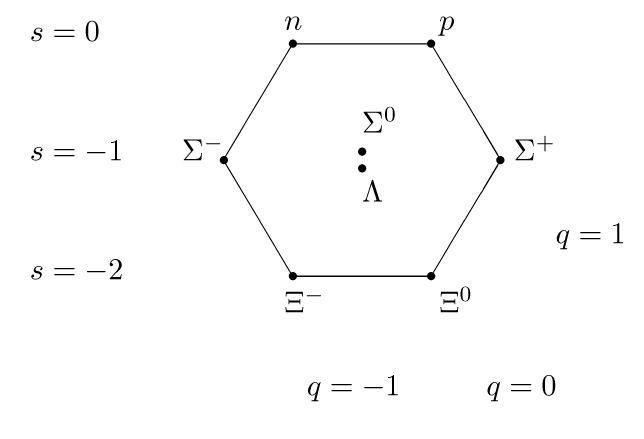
As particle colliders kept finding more and more particles, things started to get messy, until the physicist Murray Gell-Man organized the subatomic baryons and mesons into octets, a theory which he called "The Eightfold Way" after the Eightfold Path of Bhuddism.  Here is a meson octet:

The letter s is something called "strangeness" and q is charge.  Here is a baryon octet:

Note how physicists can organize these particles not using a geometric shape, but rather points and lines.  The subatomic plane corresponds to a line, which is needed before one can build a triangle (the atoms) which is needed before one can build a tetrahedron (molecules). Rather than a simple line with 2 points, both are arranged to form a hexagon.  Here is another one, called the baryon decuplet:

From the baryon decuplet, Gell-Mann was able to predict the existence of a particle before it was discovered. Again, the diagram is one of points and lines, forming a connected series of triangles. Here is the baryon decuplet again, this time showing the up, down and strange quarks used to compose each baryon:


And here is the Pythagorean Tetractys:


What! Wait a minute - what is the Pythagorean Tetractys?  It was a very ancient sacred symbol among the Pythagoreans. What does it have to do with particle physics?  Well, nothing.  Except that the best theory to explain the behaviours of many of the subatomic particles forms a Tetractys.

THE PYTHAGOREAN TETRACTYS

The Pythagoreans was esoteric philosophical sect in Greece, which focused on the symbolism of numbers in mathematics. Here is a description of the Tetractys, borrowed somewhat from Wikipedia:

1.  The first four numbers symbolize the harmony of the spheres and the Cosmos as: (1) Unity, (2) Dyad - Power - Limit/Unlimit (peras/apeiron), (3) Harmony (4) Kosmos.[2]
2.  The four rows add up to ten, which was unity of a higher order (The Dekad).
3.  The Tetractys symbolizes the four elements — fire, air, water, and earth.
Well that is interesting! In ancient times all of matter was assigned to the four elements. We now know most matter is baryonic matter.  And we now know that the numbers of the particles of baryonic matter form a Tetractys!  This took me by complete surprise.  A search on the internet shows some others have noted in, but just in passing.  However, there is more: The Tetractys represented the organization of space:
1. the first row represented zero-dimensions (a point)
2. the second row represented one-dimension (a line of two points)
3. the third row represented two-dimensions (a plane defined by a triangle of three points)
4. the fourth row represented three-dimensions (a tetrahedron defined by four points)
Recall that the first four planes of existence: space-time, subatomic particles, atoms and molecules can each be symbolized by a point, line, triangle and tetrahedron. Again, this is an example of how the smallest part contains the whole.

A prayer of the Pythagoreans shows the importance of the Tetractys (sometimes called the "Mystic Tetrad"), as the prayer was addressed to it:
"Bless us, divine number, thou who generated gods and men! O holy, holy Tetractys, thou that containest the root and source of the eternally flowing creation! For the divine number begins with the profound, pure unity until it comes to the holy four; then it begets the mother of all, the all-comprising, all-bounding, the first-born, the never-swerving, the never-tiring holy ten, the keyholder of all".
The Pythagorean oath also mentioned the Tetractys:
"By that pure, holy, four lettered name on high,
nature's eternal fountain and supply,
the parent of all souls that living be,
by him, with faith find oath, I swear to thee."

The Kabbalists, a mystic form of Judaism, took note of this Pythagorean symbol and connected it to the Tetragammaton, or the four letter name of Jehovah in Hebrew: YHWH. The name was so sacred that in Hebrew they pronounced it as "Lord" (Adonai). The other thing that they took note is that the numbers 1 through 4 add up to 10, and of course there are 10 commandments.

Thursday, January 24, 2013

The Universal Order of Design - the Tetrahedron


THE SYMBOLISM OF THE MOLECULAR WORLD

In Arthur M. Young's theory of process in his book, The Reflexive Universe, he subdivides all of existence into seven planes of existence:

In previous blogs I have corrected the above diagram (I should probably make my own), where the first plane concerns space-time, and light belongs with the subatomic particles in the Standard Model. The fourth plane is the molecular world, and as with each plane, it can be further divided into seven substates. In some of these substates, we can go further and discover seven more "sub-substates." I say state, substate or plane, but these are all the same words for a discrete level of order. Between two discrete levels of order, there is nothing. It is similar to how Planck discovered how energy is not continuous, but comes in discrete packets known as "quantum". Thus we have quantum physics. Young's book was written in the mid-70s, and as far as I can tell, the theory has been sitting there collecting dust.  So let's review the seven substates of the molecular world, which Young took from Charles Price, a well known chemist at the time:
1. Metals
2. Simple Compounds (Salts, Ionic Bond)
3. Nonfunctional Compounds (Covalent Bond)
4. Functional Compounds
5. Nonfunctional Polymers
6. Functional Polymers (Proteins)
7. DNA, viruses.
And since I no longer have that book, The Reflexive Universe, its hard for me to check up on the definitions of these levels. I was able to reconstruct the list from some youtube videos of Arthur M. Young which I put in a previous blog entry in this series. So my first reaction is, what is a nonfunctional and functional compound, and what is a nonfunctional and functional polymer? I am not seeing these definitions anywhere in scientific literature. I am guessing that a nonfunctional polymer is a non-biological polymer, and thus there is a similar meaning for nonfunctional compounds. But I am not seeing this distinction in molecular classifications. Young talks about this in his recorded lecture, and it puzzles me. So, lets take a look at each substate of the molecular world, this is what I can find:
1. Metallic bond - delocalized electrons not associated with a particular atom or molecule, common in metals. Its what allows metals to conduct heat and electricity.
2. Ionic bond - an electrostatic bond between ions. An ion is an atom where the number of electrons does not equal the number of protons.
3. (?? - some other stuff goes here)
4. Covalent Bond - a bond between atoms where electrons are shared to complete the outer electron shell
5. Polymers - a chain of repeating molecular units, not including the biopolymers.
6. Non-genetic Biopolymers - polypeptides (proteins), polysaccharides
7. Genetic Biopolymers - polynucleotides (DNA & RNA), and viruses. 
When Young says "Metals" he is in reality talking about the Metallic bond. We are missing a category of molecules, and I am marking that with "other stuff" - just as I did when I reviewed the subatomic world, and filled in a gap with quarks. The last time I made use of ionic and covalent bonding was to answer a question on a chemistry test in high school, so those two categories check out. The reason why I remember is our chemistry professor forced us to write a poem that contained elements of the periodic table. I believe mine was a love story of two elements that bonded together, but she gets bored of him and decides to bond with another element. Seeking revenge, her original bonded element then kills her new found partner. The detectives arrive, and they have to figure out which element of the periodic table killed her lover. Similar to The Tell-Tale Heart of Edgar Allen Poe, going through the elements of the periodic table begins to drive the suspect insane (as chemistry did to many of my classmates). He finally gets up and screams, "Iodide it, you Acetate!".  He gets thrown into prison, and tries to bribe the guard to escape. "How much to pass the gate? / Why of course, one mole of silver permanganate." So it ends. I can't believe I remembered that.

If we look at the fifth substate of molecules, simple molecules start to repeat their pattern, growing into a long chain: these are the polymers. The sixth and seventh categories are known as biopolymers - those that appear in biological organisms. The seventh is the most interesting, as that includes the double-helix of the DNA, which was only discovered after the scientist first had a dream about it. It also includes viruses - and there are millions of them. Very few have been mapped out. It is debatable whether or not viruses are living organisms - they are at the cusp between the molecular world and where living organisms begin. Although they require a host cell to replicate, there are some theories which state that life began from viruses.

So the first observation I made is that the classification of molecules is dependant on the types of bonds they make - metallic, ionic or covalent. I poked around, and discovered there is another type of molecular bonding, called "Van der Waals" forces - which are also called "weak" bonds, as these are intermolecular bonds - weak bonds between molecules, not atoms. So for the first four types of molecules, let's correct Young's diagram (again) to obtain the following molecular classifications:
1. Metallic bond - delocalized electrons not associated with a particular atom or molecule, common in metals.

2. Ionic bond - an electrostatic bond between ions. An ion is an atom where the number of electrons does not equal the number of protons.

3. Intermolecular ("weak") bond (e.g., Van der Waals force, Hydrogen bond, Halogen bond, Aurophilicity...)

4. Covalent bond - a bond between atoms where electrons are shared to complete the outer electron shell.


And now, for something very weird. Recall that different planes of existence correspond to each other. That is, the sequence of order between different planes of existence will show similar patterns. Recall that, Young wrote his books in the mid-70s, and thus he did not know what to put within the subatomic plane. And so I decided to fill in the subatomic plane with the current scientific knowledge that we have now. Here are the first four substates of the subatomic world (see previous blog entries):
1. Graviton. Gravitational force.
2. Photon. Electromagnetic force.
3. W/Z Bosons. Weak nuclear force.
4. Gluons. Strong nuclear force.
By correspondence, just as the first four substates of the subatomic plane are the force carrier particles (gauge bosons), the first four substates of the molecular plane are governed by its type of bond. Force carrier particles, and molecular bonding, correspond to each other. Just as in the atomic world, molecules get more and more constrained by each bond. Moreover, even the order of the forces, and the order of the bonding, correspond with each other:
1. Gravitational force and Metallic bonding. In Metallic bonding, electrons are delocalized, travelling in a lattice structure. Gravity operates in the "grid" of the space-time medium, and has infinite range. You can say gravity is "delocalized".


2. Electromagnetic force and Ionic bonding. Ionic bonding is electrostatic, thus is based on the electromagnetic force.
3. Weak nuclear force and Intermolecular "weak" bond. Here, separate scientific disciplines call this "weak" - both are weak at long range, but become very strong at short ranges.
4. Strong nuclear force and Covalent bond. Both are the strongest force and bond respectively. One tightly binds the nucleus of atoms, the other tightly binds atoms together to form molecules.
This correspondence between two separate planes of existence - the atomic and the molecular, which can be verified by science, just blew me away. Of course scientists will say the four forces of the subatomic world have nothing to do with the four bonding types of the molecular world. But they correspond with each other, and missing puzzle pieces to Young's theory are beginning to fall in place.  I would not have seen this if I didn't start collecting my thoughts in this blog. This means if we know one thing about one plane of existence, it may be possible to extend our knowledge into other planes of existence - or at least make educated guesses. Why is this happening? This is not an area that science has attempted to explain: everyone is busy in their own box of discipline, and so no one to my knowledge has even noticed this. It is a different way of approaching scientific knowledge. It is based on a theory that everything in the universe corresponds to each other, how small parts are a microcosm of the whole.

Just to remove any doubt, I decided to checkup on how modern chemistry classifies molecules. I looked up "classification of molecules". I found this scientific article entitled,  A classification of molecules, phases, and transitions as recognized by thermal analysis . In it, is the following diagram:


It is called "Grimm's tetrahedron of bonding". And we see there the Metallic bond, the Ionic bond, Weak bonds, and Covalent bond. And from the gist of the article, I gather that although we know a lot about chemistry, the knowledge we have has become increasingly fragmented and unordered. So what is that tetrahedron? That's a geometric shape with 4 sides. Recall that Young represented the molecular world with the tetrahedron? But I don't think he mentions this tetrahedron of bonding, I think he used that just to represent a geometric shape for the fourth plane of existence, the molecular world.

So what is this "Grimm's tetrahedron of bonding"? Why are the four bonds put together in a geometric shape? For this I found an excellent educational website on chemistry, called, The Chemogenesis Web book. Here is some information on the Grimm Tetrahedron:
"William Jensen reports, below, that Grimm and Dehlinger developed an early form of tetrahedron in the nineteen thirties. However, this knowledge appears to have been forgotten."
Sadly, this insight into molecular structures was left alone, until revived in the mid-1990s (see video below on some of the history of this concept). The tetrahedron of bonding is very useful for mapping out the classification of molecules. There is an article entitled Tetrahedra of Structure, Bonding & Material Type, which covers this in detail. Here is the tetrahedron again:


This shows how most people know of the first three kinds of bonds, but forget about the weak intermolecular bond. Which explains why Young (or Charles Price) missed it.  What about the 6 edges of the tetrahedron? Those correspond to molecules that have intermediate types of bonds, here are examples, where molecules appear on edges between the bonds that define them:


There are even more colorful diagrams: there is a PDF printout where you can print out a colored tetrahedron, to map out all the classifications of molecules. Here is a summary of how this concept was developed throughout the 20th century, and how it is useful to understanding the molecular world:


Some high level chemistry concepts are summarized well on the Chemogenesis web site, I highly recommend it, as it would have been very hard for me to find this material. So what about the polymers and biopolymers?  Unable to escape their bonding, molecules start to repeat their structure, become mobile, and move out and escape to become life forms. On the web site an analysis is done to show what material belongs at each corner of the tetrahedron. I will quote from the web site:
"But what about the fourth corner, Network Covalent? The most electronegative element that forms a network covalent material is carbon, 2.55."
Carbon is tetravalent - meaning that it has four electrons in its outer shell to from covalent chemical bonds. Moreover, according to Wikipedia,
"Carbon is...the fourth most abundant element in the universe by mass after hydrogen, helium, and oxygen."
Thus, the tetrahedron, the four moleculuar bonds, the four electrons in the outer shell of the carbon, carbon the fourth most abundant element by mass in the universe: we keep seeing the number 4, 4, 4, 4. In Young's model of the Reflexive Universe, the molecular world is the fourth plane of existence. It is from carbon that higher life forms exist: thus we have carbon-based life forms.

OTHER IMPLICATIONS OF THE TETRAHEDRON

Earlier I said that the tetrahedron was a representation of the molecular world, before I knew of Grimm's tetrahedron, or a classification of molecules by the tetrahedron. I am doubtful if Young was aware of this - even though in the youtube video, he uses a tetrahedron to represent molecules. There is a geometric corresponence for the first four planes of existence, as stated before. To recap:
1. Space-time = a geometric point. A point represents scalar particles (the Higgs-Boson is a scalar).
2. Subatomic particles = a line. Either a line represents a particle traveling in a wave, or something more fundamental: that particles are ultimately strings.
3. Atoms = a triangle. Three particle types make an atom: proton, neutron, electron. Moreover, the smallest atom, hydrogen, is composed of just three of these particles.
4. Molecules = a tetrahedron. Independent of this theory, chemists use a tetrahedron to classify molecules. There are four bond types between molecules.
So the implication of this pattern, is that it favors string theory. It is also an indication that if we see a pattern in one plane of existence, we can derive or guess patterns in lower or higher planes of existence. And this is what Swedenborg called the Doctrine of Correspondences. We say, "As above, so below." The smallest thing is a microcosm of the universe in more ways that we can imagine. Thus physicists, who seek to unify all the forces into one grand unified field theory, may be missing the point: its as if a chemist would like to see only one kind of bond between molecules. At a lower level, there is one kind of bond, but we should recognize that its different manifestations are a nature of a discrete degree of order. It would not be useful to a chemist to reduce things to one bond at a lower order.

As another example of how one part explains the whole, we see that the first plane of existence is that of space-time. From that, we can derive that the first substate of the subatomic world is the graviton. The pattern lends support to the existence of the graviton particle, which has not yet been directly observed, except perhaps gravity waves. Now lets take that to the atomic world. There are two atoms in the first substate: Hydrogen and Helium. These two elements are used to form stars. And when large stars begin to die, they become black holes, and create the largest known gravity wells in the universe. One small part explains the whole.

THE SYMBOLISM OF THE NUMBER 2 AND ITS MULTIPLES

According to Swedenborg, the number 2 and its multiples signify love, as the marriage between two beings. Marriage love is the highest form of love. Now look at this pattern:
Plane 2 = Subatomic particles. Gauge bosons are force particles, which attract other particles to form the atomic nucleus.
Plane 4 = Molecules. Bonds between atoms. Four bonds define the classifications of molecules. Highest stage of molecules: DNA and viruses.
Plane 6 = Animals. Animals are distinguished from plants in that they have sexual intercourse. The DNA molecule is transmitted to unite the genetic material of the male and female in order to multiply the species.
Plane 8 = Love.
So, we progressively see increasing orders of bonding, until we reach the highest form of bond, Love. The reason why I make it higher than plane 6, is that despite what some may think, sex is not in itself love. It is a natural form of love. So in marriage love, one first progresses from "a love of sex" to "the love of one of the sex." Swedenborg explains this in his work, Angelic Wisdom concerning Marriage Love. Unlike animals, only humans can reach this state. Or, humans can choose to remain in natural pleasures as animals do. Marriage love is hidden in the external natural form. But the eighth plane of order, Love, does not exist in our diagram. We only have seven planes of existence. Also recall, that in the atom there are a maximum of seven electron shells:


If the atom is the microcosm of the whole of existence, then what does the nucleus represent? I would say this: the atomic nucleus, and the 8th plane of existence, is one and the same, and represents God. God is the center of everything, and God is Love. Once we understand the discrete degrees of order in creation, we can better understand the Creator who made it.

Wednesday, January 23, 2013

The Universal Order of Design - String Theory

I keep trying to finish off this theory of everything based on a proposal by Arthur M. Young, but the problem with a theory of everything, there is everything to discuss.  Young published a book entitled The Reflexive Universe, where he stumbled upon a pattern of seven degrees of order in all of creation. Here is a diagram which sums it up:

As noted in previous blogs, he makes some errors, but at least he put the proposal out there so that it could be developed further. So, thus far I have corrected it, where there are seven planes of existence as follows:

1. Space-time. Scalar fields and 0 spin particles (Higgs-Boson field goes here)
2. Subatomic particles. Force mediating particles (single or double spin) and matter particles (half spin). Light belongs in this plane of reality.
3. Atoms
4. Molecules
5. Plants
6. Animals and Man
7. The Spiritual World - for the most part, an unknown state of existence.
Although Young left the subatomic plane blank, I was able to use his theory to sort out the plane of the subatomic particles.  Moreover, the pattern is predicting that the plane of space-time should have seven dimensions.  I looked up some modern theories, and separate theories in math and physics propose a world in which there are seven dimensions. String theory was one of them: it states that in addition to our 3 space dimensions and time, there are seven more spacial dimensions. This is what the math is saying - it has not been proven. However it has gone through some internal consistency checks and it has held up, and can unify the four forces.  It is just very, very hard to verify and validate.

What is string theory?  It is simple: instead of assuming that reality is composed of 0-dimension particles, these particles are in fact manifestations of vibrating strings:


1 - matter, 2 - molecules, 3 - atoms, 5 - subatomic particles, 6 - strings

To show that String Theory is a non-trivial solution to a problem, see the following excerpt from a NOVA documentary:


Now lets take a look at the first four planes of existence. They closely correspond to simple concepts in geometry:
1. Space-time. Scalar fields and particles. This is the closest we have to a "dimensionless" point.
2. Subatomic particles. If composed of strings, this order would correspond to a line.
3. Atoms. The third order, corresponding to a plane. Just as we need 3 points to create a flat plane, we need a minimum of 3 particles to make an atom. Of the seven categories of atoms, most atoms belong to the third category - transition metals (see previous blog).
4. Molecules. This corresponds to a 3 dimensional object.
Now of course, our simplistic concepts of a point, line, plane and solid do not accurately describe these four levels of reality.  We can say they correspond.  We can use simple geometric concepts to symbolically represent these realities. Throughout this theory of everything, planes of different orders correspond to each other, where one plane can describe higher or lower planes of existence.  So without doing the math, or understanding 7 or 11 dimensions, if we pay attention to the symbolism, we can guess what that plane of existence is like. Science cannot yet verify string theory. But through correspondence, its likely that the second plane is composed of strings.  And strings are not the final frontier: below that level, there are scalar fields. And this is where the ideas of Emanuel Swedenborg comes in, for he regarded the Doctrine of Correspondences as the science of sciences. It is the science that can explain everything, including higher level realities that are beyond the awareness of our senses.

WHY THREE DIMENSIONS IS NOT ENOUGH


Obviously, the String theory is wrong - there are only 3 dimensions and time, not 11 dimensions, right?  Well, let's think about it. In simple geometry, there are three dimensions, and every point has an x, y, and z coordinate:


But the problem with simple geometry, is what is a point?  A point is a dimensionless object. And logically,  a 0 dimension object does not exist.

Suppose we lived in a 2 dimensional world, we would experience a sphere as a circle.  But we live in a three dimensional world.  If there was a line in the fourth dimension, we would experience that line as a point.  If there was a plane in the fourth and fifth dimension, we would experience that as a line.  A solid object in the fourth, fifth and sixth dimensions, that would intersect as a plane. A moving solid object in the fourth, fifth, and sixth dimensions, that would become a solid object. Thus we can postulate 3 spacial dimensions, and 3 substance dimensions, plus time for movement: and the intersection of all these dimensions would fit in perfectly within our 3 dimensional world. Because we do not see those 3 substance dimensions, we can call those "compact" dimensions.

And that is what String theory is stating: apparently these vibrating strings originate from spacial dimensions beyond ours: except there are 7 more of them, not just 3. In those other dimensions, the strings exist as "branes" which manifest as vibrating strings in ours.

THE VIEW FROM EMANUEL SWEDENBORG

In the 20th century, the current thinking in science is that space-time is not nothing but rather one or more fields, and that there is no such thing as a particle.  The Higgs-Boson proves that there is a field that permeates the universe. But wait a minute - Swedenborg already said these things back in the 18th century.  Although many would probably discount his visions of heaven and hell, those who would ignore him are unaware he had clairvoyant abilities. On a number of occasions, he privately showed others that he could make contact with the dead in the spiritual world. On one occasion, he decided to pay a visit to Isaac Newton who had passed away in 1726.  And here is his description of the encounter (remember, Swedenborg wrote this in the 18th century):
Something shall be said here concerning vacuum. I once heard angels talking with Newton about vacuum, and saying that they could not bear the idea of vacuum as nothing; because in their world which is spiritual, and within or above the spaces and times of the natural world, they equally feel, think, are affected, love, will, breathe, yea speak and act; which things are utterly impossible in vacuum as nothing; because nothing is nothing, and of nothing nothing can be predicated. Newton said that he knew that the Divine which is, fills all things, and that he himself shuddered at the idea of nothing respecting vacuum, because that idea is destructive of all things; and he exhorted those who talked with him about vacuum, to beware of the idea of nothing, calling it a swoon, because in nothing no real existence of mind is possible. (Divine Love and Wisdom, n. 82, from Angelic Wisdom concerning the One God).
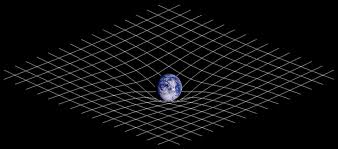
Apparently in the other world, Newton recognized his big mistake: he treated space as nothing, or a vacuum. Modern physics is telling us that space is not a vacuum: Einstein stated that gravity warps time and space, and the discovery of the Higgs-Boson in 2012 shows that all of space is permeated by a field that gives everything mass. And we still tend to think of mass as "particles".  So what did Swedenborg have to say about the nature of matter?  Look at these statements:
...it is a fallacy of the merely natural sense, that there are simple substances, which are monads and atoms; for whatever is within the range of the external sensual, the natural man believes to be such, or nothing. (Heavenly Arcana, n. 5084).
Obviously there are atoms; but by "monad" or "atom" Swedenborg is talking about an indivisible particle.
...every one shall be judged according to his works; for the end, or the love of his will, and the cause, or the reason of his understanding, are together in the effects, which are the works of his body; thus the quality of the whole man is in them. They who do not know these things, and do not thus distinguish the objects of reason, cannot avoid terminating the ideas of their thought in the atoms of Epicurus, the monads of Leibnitz, or the simple substances of Wolff, and thus closing up their understandings as with a bolt, so that they cannot even think from reason concerning spiritual influx, because they cannot think concerning any progression; for the author says concerning his simple substance, that if it is divided it falls into nothing. (Intercourse between the Soul and Body, n. 17, from Angelic Wisdom concerning the One God).
It is asserted by some that there is a substance so simple that it is not a form from lesser forms, and that from that substance, through process of massing, there arise substantial or composite things, and at length substances which are called material. But still no such most simple substances exist; for what is a substance without a form? It is something of which nothing can be predicated; and from an entity of which nothing can be predicated, no process of massing together can make anything. That there are innumerable things in the first created substances of all, that is, in the smallest and most simple things, will be seen in what follows, where forms will be treated of. (Divine Love and Wisdom, n. 229, from Angelic Wisdom concerning the One God).
As atoms were discovered during the nineteenth century, people must have thought Swedenborg was incorrect.  And here is an interesting statement - the smaller you go, the closer you will approach the infinite:
Know, that everything divided is more and more multiple, and not more and more simple,—because divided and divided it approaches nearer and nearer to the infinite, in which all things are, infinitely. This is a new thing that I relate to you, before unheard of. (Angelic Wisdom concerning Marriage Love, n. 329).
Well, for physicists, that is either depressing or comforting. Depressing, as they will never reach the final answer, but comforting, as there will always be something new to explore.  Swedenborg notes, that in the smallest thing, there are discrete and continuous degrees of order:
That the greatest and the smallest of all things consist of discrete and continuous degrees, or degrees of altitude and latitude, cannot be illustrated by examples from visible objects, because the smallest things do not appear before the eyes, and the greatest which do appear do not seem to be distinguished into degrees...The declarations of the angels on this matter are these: that there is nothing so small that there are not in it degrees of both kinds; thus nothing so small in any animal, nor in any plant, nor in any mineral, nor in the ether and the air, and because the ether and the air are receptacles of heat and light, that there is no least thing of heat and light; and because spiritual heat and spiritual light are the receptacles of love and wisdom, that there is no least thing of these in which there are not degrees of both kinds. The angels also declare that the least thing of an affection and the least of a thought, nay, that the least of an idea of thought, consists of degrees of both kinds, and that a least thing which does not consist of them is nothing; for it has no form, therefore no quality, and no state which can be changed and varied, and by this means exist. The angels confirm this by the truth, that the infinites in God the Creator, Who is the Lord from eternity, are distinctly one; and that there are infinite things in His infinites; and that in things infinitely infinite there are degrees of both kinds, which also in Him are distinctly one; and because these things are in Him, and all things are created by Him, and the things which are created resemble in some image those things which are in Him, it follows that there is not the least finite thing, in which there are not such degrees. That these degrees are equally in the least and in the greatest things, is because the Divine in the greatest and in the least things is the same. (Divine Love and Wisdom, n. 222-223, from Angelic Wisdom concerning the One God).