Saturday, February 2, 2013

The Universal Order of Design - Animals

THE SYMBOLISM OF THE ANIMAL KINGDOM

I have been blogging about the seven planes of known existence, as initially proposed by Athur M. Young in his book, The Reflexive Universe.  There were several gaps in the theory, and I have been trying to fill in some of those gaps with our current scientific knowledge.  With the world of plants, I discovered that traditional taxonomies are shifting due to current research in molecular phylogenetics.  And the case is no different with animals - the field is in flux, and the tendency has been moving towards genetic information, rather than form and function.  With the animal kingdom, we can see a gradual growth towards the human form. When discussing the animal kingdom, Emanuel Swedenborg makes a statement where he anticipated the theory of evolution which became dominant a century later:
The forms of the animal kingdom, which are called in a single word, animals, are all in accord with the flow of spiritual substances and forces; and from the conatus that is in these forms this flow tends to the human form, and to each and all things of it from head to heel; thus it tends in general to produce the organs of sense and the organs of motion, also the organs of nutrition and the organs of prolification. For this reason the entire heaven is in such a form, and all angels and spirits are such a form, and men on the earth are in such a form, and all beasts, birds, and fishes, for all these have like organs. This animal form derives its conatus to such things from the First from whom all things are, who is God, because He is Man. (Apocalypse Explained, n. 1208)
Young proposed dividing animals into seven stages, as follows:
1. Paramecea (one-celled animals).
2. Metazoa (many-celled animals) - Sponges
3. Coelenterates (one organ animals) - having identity, or a center, or inside and out
4. Mollusks (many organ animals). Many filae were put together for this one.
5. Annelids (segmentation)
6. Arthropods (side segments, or legs) - all insects, crabs, lobsters, shrimp. Increased legs, until finally down to six. Highly developed instincts. Exoskeleton.
7. Chordata, or vertebrates. Nerve cord.
Each time we go up a level of order, the complexity increases by orders of magnitude.  As with plants, lets take a look at these seven levels of animals.  Again, this is a bit difficult as taxonomic terminology keeps changing. But two things distinguish animals from plants: first, animals need to eat food instead of converting light energy, and secondly, they have their own mobility.

STAGE 1: UNICELLULAR ANIMALS

Unicellular Eukaryotic organisms that are animal-like are (were) generically known as Protozoans, and unicellular Eukaryotic plants are (were) generically known as Protophyta. These are older divisions and these terms are not used in modern taxonomies.  Young referred to Paramecium, which is a genus that belongs to the Protist kingdom. Unicellular Eukaryotic organisms that use photosynthesis belong to Algae of the plant kingdom. There seem to be border-line cases: for example, the algae Dinobryon feeds on organic matter and is motile in addition to making use of photosynthesis.

Rather than go through the taxonomic debate currently going on among biologists, I am going to keep this simple, and refer to unicellular eukaryotic animals as Protozoans.  They have their own mobility, and thus may possess hair like organelles called cilia, or a whip-like tail called the flagellum. I am including in this group choanoflaggellates, as well as amoebas which move by cytoplasmic flow.  Here is an image of choanoflagellates:


Choanoflagellates consume Bacteria, which is the first stage of the Plant kingdom.

STAGE 2: MULTICELLULAR ANIMALS

In the second stage we have multicellular animals, but still do not have specialized organs. In this group we have sponges, which belong to the phylum Porifera an the Parazoa subkingdom. I had mistakenly thought they belong to plants, but not so: they belong to the animal kingdom. Included in this we may or may not include the Placozoa phylum. The Choanoflagellates were key in the eventual evolution of sponges. From a science blog article Choanoflagellates to sponges to metazoa:
It seems that some one-celled animals with flagella, called choanoflagellates, became involved in sponge development. They resemble the choanocytes of sponges, which line the sponges’ inner passages and fan their flagellae to move sea water and food particles. With their stickiness or adhesion molecules, choanocytes aided the eventual transition to multi-cellular organisms, or metazoans.
Here is an image where we see Choanoflagellate-like cells (choanocytes) can be seen in the wall of a sponge:
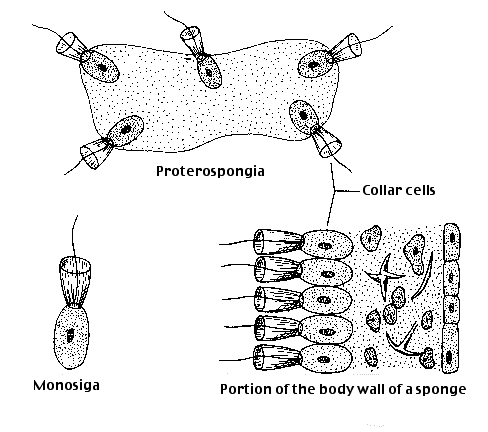

And from that, we get this:


Not quite, here is an actual image of some sponges:


It should be noted that some sponges have become carniverous and have lost their choanocytes.

STAGE 3: SINGLE ORGAN ANIMALS

If we look at Coelenterates, in modern biological taxonomy Coelentera is an obsolete term which covered two phyla: Ctenophora (comb jellies) and Cnidaria (coral animals, true jellies, sea anemones, sea pens...).  Both of these belong to the Subkingdom Eumetazoa, and are classified as "Radiata". Radiata are radially symmetric animals. Here is a Wikipedia entry explaining the difference between Sponges and Radiata:
Like cnidarians (jellyfish, etc.) and ctenophores (comb jellies), and unlike all other known metazoans, sponges' bodies consist of a non-living jelly-like mass sandwiched between two main layers of cells. Cnidarians and ctenophores have simple nervous systems, and their cell layers are bound by internal connections and by being mounted on a basement membrane (thin fibrous mat, also known as "basal lamina"). Sponges have no nervous systems, their middle jelly-like layers have large and varied populations of cells, and some types of cell in their outer layers may move into the middle layer and change their functions.
Here is a table showing the differences:

SpongesCnidarians and ctenophores
Nervous systemNoYes, simple
Cells in each layer bound togetherNo, except that Homoscleromorpha have basement membranes.Yes: inter-cell connections; basement membranes
Number of cells in middle "jelly" layerManyFew
Cells in outer layers can move inwards and change functionsYesNo


Cnidaria and Ctenophores rely on water flow through a body captivity for digestion and respiration. Both have specialized cells for capturing prey.  Their nervous system is decentralized with no brain. Unlike sponges, they can freely swim throughout the water.

Here is a diagram showing the Parazoa branch (the Sponges) and the Radiata:


When researching the differences between Parazoa and Radiata, I found this diagram showing the major clades of the animal kingdom from the web site site MAJOR CLADES OF THE ANIMAL KINGDOM.
This following figure is a modification of the summaries of Giribet et al. (2007) and Valentine (2004) in which the Animal Kingdom is monophyletic and forms four major clades: the CHOANOFLAGELLATES (CHOANOZOA), PARAZOA (Clade 2), RADIATA (Clade 4), and BILATERIA (Clade 5).   Here, the Bilateria is separated into the Deuterostomata (Clade 6) and the Protostomata (Clade 7).  The Protostomes are further divided into the Ecdysozoa (Clade 8), the Platyzoa (Clade 10), and the Lophotrochozoa (Clade 11). 

If we look to the right, there are seven main categories of the animal kingdom! Stage 1 is the Choanozoa, Stage 2 is the Parazoa, and we are now on Stage 3, the Radiata. Each time, there is a division.  Here is a description of the numbers:

Clade 1: The Metazoa: Development from a blastula.  Simple life history with gametic meiosis.
Clade 2: The Parazoa at the tissue-level of organization.
Clade 3: Organisms at the organ-level of organization with determinate development and 2-3 tissue layers.
Clade 4: The Radiata; diploblastic, usually with radial symmetry.
Clade 5: The Bilateria; triploblastic, usually bilaterally symmetrical.  Animal develops from a gastrula that forms a gut, mesoderm, and body cavity.
Clade 6: The Deuterostomes; the blastopore becomes the anus.
Clade 7: The Protostomes; the blastopore becomes the mouth.
Clade 8: The Ecdysozoa; the molting animals.
Clade 9: The Spiralia; the protostomes with spiral cleavage.
Clade 10: The Platyzoa; mostly animals in which the blastocoel becomes the body cavity, a pseudocoelom.
Clade 11: The Lophotrochozoa: animals that have a trochophore larva, some of which bear lophophores.

So this is interesting! It seems to be based on relatively recent research, and I just found this while writing this  blog. Instead of following Young, lets follow the above system for the rest of the stages and see what we find.

THE DEUTEROSTOMATA

I have no idea what this is, so I will quote from Wikipedia:

Deuterostomes (taxonomic term: Deuterostomia; from the Greek: "second mouth") are a superphylum of animals. They are a subtaxon of the Bilateria branch of the subregnum Eumetazoa, and are opposed to the protostomes. Deuterostomes are distinguished by their embryonic development; in deuterostomes, the first opening (the blastopore) becomes the anus, while in protostomes it becomes the mouth. Deuterostomes are also known as enterocoelomates because their coelom develops through enterocoely. There are four extant phyla of deuterostomes: 
Phylum Chordata (vertebrates and their kin)
Phylum Echinodermata (sea stars, sea urchins, sea cucumbers, etc.)
Phylum Hemichordata (acorn worms and possibly graptolites)
Phylum Xenoturbellida (2 species of worm-like animals) 
Superphylum Deuterostomia was redefined in 1995 based on molecular sequence analyses when the lophophorates were removed from it and combined with other protostome animals to form superphylum Lophotrochozoa.

Ok, this is now diverging from what Young stated.  Deuterostomes is where the blastospor becomes the anus. Here is a diagram showing that cell development:


The Chordata, or vertebrates, Young put in the seventh stage. And this superphylum of Deuterostomes is grouping some worms with the Chordata.  Humans grouped with certain worms?  That is definitely not what I was expecting.  It reminds me of these verses:

But I am a worm, and no man; A reproach of men, and despised by the people. (Ps. 22:6) 
Fear not, you worm Jacob, You men of Israel! I will help you, says the LORD And your Redeemer, the Holy One of Israel. (Isa. 41:14) 
And they shall go forth and look upon the corpses of the men who have transgressed against Me. For their worm does not die, And their fire is not quenched. They shall be an abhorrence to all flesh. (Isa. 66:24)

And all this time I thought "worm" was only figurative.

THE ECDYSOZOA

What is this?  I will quote from Wikipedia:
Ecdysozoa is a group of protostome animals, including Arthropoda (insects, chelicerata, crustaceans, and myriapods), Nematoda, and several smaller phyla. They were first defined by Aguinaldo et al. in 1997, based mainly on trees constructed using 18S ribosomal RNA genes. A large study in 2008 by Dunn et al. strongly supported the Ecdysozoa as a clade, that is, a group consisting of a common ancestor and all its descendants. The group is also supported by morphological characters, and can be considered as including all animals that shed their exoskeleton (see ecdysis). Groups corresponding roughly to the Ecdysozoa had been proposed previously by Perrier in 1897 and Seurat in 1920 based on morphology alone.

So, it would seem that molecular phylogenetics is becoming a nice complement to taxonomy based on earlier morphological studies. Still, this category is contested by a strong minority of biologists. The Arthropoda were classified by Young as the sixth stage of development for animals.

THE PLATYZOA

This category is relatively new, proposed by Thomas Cavalier-Smith in 1998. It includes the following traditional phylums:
Platyhelminthes (Flatworms)
Gastrotricha (microscopic aquatic animals)
Gnathifera (microscopic animals with jaws)
Rotifera (more microscopic animals)
Acanthocephala (parasitic worms)
Gnathostomulida (jaw worms)
Micrognathozoa (microscopic animals with jaws, discovered in 1994)
Cycliophora (aquatic animal, less than half a millimeter, discovered in 1995)

THE LOPHOTROCHOZOA

This is another new one, discovered on the basis of molecular data. It includes the Annelids, which Young placed in the fifth stage. However it is divided into two groups, the trochozoans and the lophophorata.  The former include the Mollusca, which Young placed in the fourth stage. Here is a sampling of the animals included in this clade:


THE SEVEN STAGES OF THE ANIMAL KINGDOM

Here is a chart showing taxonomic classification, the first based on morphology, the second based on molecular phylogeny:


Here is another chart of animal phylogeny:


The most interesting diagram was the one I stumbled upon later, showing the clades of the animal kingdom:


From the above information, it would seem that Young did not have enough information to form the classifications of the animal kingdom: his classifications for stages 4 and 5 are invalid, and not recognized in biology.  But, there is a pattern of seven stages of development in the animal clades as currently recognized by modern molecular phylogeny, which has refined our knowledge based on earlier morphological studies.  So, based on the above, we can divide the animal kingdom into seven stages:
1. Choanozoa. This corresponds to the unicellular stage.
2. Parazoa. This corresponds to the multicellular stage (sponges).
3. Radiata. This is the same as the older term "Coelenterates".
4. Platyzoa.
5. Lophotrochozoa.
6. Ecdysozoa.  This includes the Arthropods, the sixth stage.
7. Deuterostomata. This includes the Chordata, the seventh stage.
If we look at the diagram above of the animal clades, and flip the order of platyzoa with Lophotrochozoa, we end up with this numbering pattern for the seven stages: 1, 2, 3, 7, 6, 5, 4.  In other words, it can be represented by the Jewish candelebrum:


Wow, I certainly was not expecting that pattern! This candelebrum was placed in the Jewish temple, in the section that preceded the Holy of Holies. It also symbolizes the seven types of churches which will be present in the latter age, described in the Apocalypse. The Holy of Holies was hidden behind a veil - just as the seventh stage of existence is hidden to us - which represents the final state of existence, the spiritual world, which we become aware of when we transition away from the animal kingdom at the time of death, and move towards becoming angels.

Thursday, January 31, 2013

The Spiritual Symbolism of Plants

THE SPIRITUAL SYMBOLISM OF PLANTS

We know from scripture and revelation, that all plants are symbolic of spiritual things. Take for example some of the parables of Jesus:

Then He spoke many things to them in parables, saying: "Behold, a sower went out to sow.And as he sowed, some seed fell by the wayside; and the birds came and devoured them.Some fell on stony places, where they did not have much earth; and they immediately sprang up because they had no depth of earth.But when the sun was up they were scorched, and because they had no root they withered away.And some fell among thorns, and the thorns sprang up and choked them.But others fell on good ground and yielded a crop: some a hundredfold, some sixty, some thirty.He who has ears to hear, let him hear!" (Matt. 13:3-9)
When asked by His disciples to reveal the meaning of the parable, He then reveals the internal hidden meaning: the seed is the Word of God:


Therefore hear the parable of the sower: When anyone hears the word of the kingdom, and does not understand it, then the wicked one comes and snatches away what was sown in his heart. This is he who received seed by the wayside. (Matt. 13:18-19)

A "seed" is symbolic of truth that is implanted in one's heart.  If one accepts the truth, that there is a God, that one must live by His commandments, that little seed will begin to grow.  And if it grows properly, it will bear fruit:
But he who received seed on the good ground is he who hears the word and understands it, who indeed bears fruit and produces: some a hundredfold, some sixty, some thirty. (Matt. 13:23)
The "fruit" one bears is when one applies the truth to one's life. One begins to do good out of the love that grows within: not for the sake of self-honor or appearance.  In everything that is done, the deed is judged by one's intention. Good deeds done for the sake of merit or self-reward are not good, those are done for the sake of selfishness. One must learn to kill the "ego" within that seeks to rule over everything. Those who don't...well that is what psychiatrists call "narcissism."

This spiritual symbolism is not only applicable to this parable, it is a generic symbolism that can be applied to all of scripture.  And not only that, the symbolism can be applied to the entire world of plants. The entire vegetable kingdom has a spiritual correspondence, and this is what Emanuel Swedenborg saw in his heavenly visions:
When angels are discoursing about things of intelligence and wisdom, and about perceptions and knowledges, then the influx from them into corresponding societies of spirits, falls into representations of such things as are in the vegetable kingdom; as into representations of paradises, of vineyards, of forests, of meadows with flowers, and into other beauties, which exceed all human imagination. Hence it is, that those things which are of wisdom and intelligence are described in the Word by paradises, vineyards, forests, meadows; and that where these things are named, such things are signified. (Heavenly Arcana, n. 3220)
THE DISCRETE ORDERS OF PLANTS

When researching the modern botanical taxonomy for the plant kingdom, I discovered a lot of it was in flux. This is due to the fact that major strides are being made in genetic research.  But the downside of this is that science tends to ignore the form and function of living organisms.  On different planets, life can evolve in different ways according to the environment. But I believe that common patterns will appear, according to discrete degrees of order.  This is because a life organism will evolve according to use.  That is, if the form is useful, allowing for better survival, the life organism will probably evolve that way.  For example, our wisdom teeth are no longer useful, our jaws have decreased in size.  In some humans, the wisdom teeth have disappeared entirely. We still have left over remnants from our older evolution: e.g., we have an appendix, a tailbone, etc. They are no longer useful, or serve their original use, but were necessary steps in order to reach the human form.

As stated in the previous blog, we can divide the plant kingdom into seven stages, which closely follows its historical evolutionary past over the past millions of years:

STAGE 1. Mostly unicellular, or undistinguished multicellular, with no nucleus (Bacteria and Archaea)


STAGE 2. Mostly unicellular, or undistinguished multicellular, with no nucleus, ability of photosynthesis (Cyanobacteria)

Note: Cyanobacteria is a transitional category. Thus originally it was categorized among the algae, and now its listed among the bacteria. It is an important transitional step in evolution, and the only bacteria that can photsynthesize light. Thus I am listing it in the second stage.
STAGE 3. Unicellular or multicellular, with nucleus (Eukarotic cells), not highly organized (Algae, Fungi, Lichens). Lichens are a combination of a fungi with a photosynthetic partner, either Algae or Cyanobacteria.

STAGE 4. Distinguished multicellular, (Bryophytes).  Specialized tissues for different organs.
Note: in the previous blog I stated stage 4 was Embryophyta (following Arthur M. Young's example). That is incorrect, as it includes vascular plants. It should be Bryophyta.

STAGE 5. Vascular plants, spores only (Pteridophytes, etc.)

STAGE 6. Vascular plants, unenclosed seeds (Gymnosperm)
Coincidentally, I just noticed in the above diagram there are 7 stages in the lifecycle of the Gymnosperm seed.  I will have to take a look at that! Note it is a circular cycle.  I am suspecting there are other patterns in the other stages...I am just touching on the surface here...the smallest part of existence explains the whole.
STAGE 7. Vascular plants, enclosed seeds in flowers (Angiosperm)

In the seventh and final stage, we finally get fruit-bearing plants.

One thing to note, is that the discrete orders are cumulative: we see photosynthesis from stage 2 onwards, Eukarotic (nucleus) cells from stage 3 onwards, distinguished multicellular plants from stage 4 onwards, vascular plants from stage 5 onwards, then specialized seeds in stage 6, ending in flowers in stage 7. The symbolism of the seed is important in scripture, thus the form of the seed is important in classifying the plants.

THE CORRESPONDENCE OF PLANTS WITH OTHER ORDERS

I have been blogging about the seven planes of existence, as originally proposed by Arthur M. Young in his book The Reflexive Universe, but with corrections. There are seven discrete orders by which the universe has been created.  They are:
1. Space-time
2. Subatomic particles, including light
3. Atoms
4. Molecules
5. Plants
6. Animals & Man
7. (An unknown state of existence: the spiritual world of heaven and hell)
In the first plane, we have the dimensions of space-time.  Some physicists and mathematicians state there are seven dimensions -- or more (String Theory says 11).  Mathematically, the universe as we know it cannot be explained using just 3 dimensions - higher level math in physics is showing that there are more than 3. But I will get back to that later. The important thing to note is that unicellular organisms, beginning with bacteria, are a microcosm of the universe.  We see this little circular blobs expanding and growing. Likewise we live in a universe that is accelerating, similar to a little circular blob. We should not think of space-time as nothing, but a bubble. The discovery of the Higgs-Boson shows that there is a universal field throughout space, from which mass is created.

In the second plane, we have subatomic particles, including light. Thus in the second stage of existence, plants acquire the ability to photosynthesize light.  Light is symbolic of the truth, thus the plant kingdom corresponds to spiritual truths.

In the third plane, we have atoms which have formed a nucleus. In the third stage of plants, plants are formed from Eukarotic cells, which have a nucleus. Just as the DNA determines the kind of life organism that gets created, so the atomic number - the number of protons in the atomic nucleus - determines the properties of the atom.

In the fourth plane, we have molecules, with many different properties. In the fourth stage of plants, plants begin to have differentiated cell tissues.

In the fifth plane and higher, we have life forms. It is in the fifth stage that plants become vascular: that is, they start to form stems, stalks and trunks by which they can grow upward.  We see a progression towards the sky, thus the overall progression is spiritual, one that leans towards heaven.

It took millions of years to reach these higher stages...and it is only recently that science has discovered the facts concerning these stages of existence.  And it is from these facts that we can derive spiritual truths from correspondences, once we know of the seven discrete degrees of order.

THE ATOMIC NUCLEUS COMPARE TO THE CELLULAR NUCLEUS

I would like to concentrate a little bit on the spiritual correspondence between the nucleus of the atom, and the nucleus of Eukaryotic cells. It is from these Eukaryotic cells that all plants and animals have formed, so it is an important stage of existence. Is there a correspondence between the atomic nucleus, and the nucleus of DNA of living cells?  We have seen this before. The atomic nucleus is composed of protons and neutrons:


And here is the nucleus of Eukaryotic cells:


A nucleus is surrounded by a nuclear envelope, and within the nucleus, there is the nucleolus. Within the nucleolus the complicated process of transcribing ribosomal RNA takes place. Whereas the atomic nucleus is composed of a collection of protons and neutrons, the cellular nucleus is composed of a small nucleolus inside the bigger ball of the nucleus. It is a higher level of complexity: as the DNA in the nucleolus determines the form and functions of the life organism, so the atomic number of the atom - the number of protons - determines the nature of the atom. Thus in simple life forms, we see similar cells joining together to become multicellular, after which in the next stage multicellular organisms develop distinguished tissues.

The nucleus of living organisms - is the simplest seed of all.  Cell division can be symbolically represented by two intersecting circles:


The intersection of the two circles forms the vesica piscis, which of course is the symbol of Christianity:


In the incarnation - something mysterious happened - where Jehovah became incarnate in human form from the virgin Mary. Somehow, human parthenogenesis occurred, but instead of a female (as one would expect with XX chromosomes) there was a male (XY chromosomes).  In the parables of scripture, the seed that is planted is the Word of God:

In the beginning was the Word, and the Word was with God, and the Word was God. He was in the beginning with God. ...And the Word became flesh and dwelt among us, and we beheld His glory, the glory as of the only begotten of the Father, full of grace and truth. (John 1:1-2, 14)
And coincidentally, the fish sign - the vesica piscis - became the symbol of Christianity. But back then, no one knew about cell division, that would only become known centuries later.

Tuesday, January 29, 2013

The Universal Order of Plants - by Form and Function


For an introduction, I have labelled this series of blogs with the label "Universal Order", where I am reexamining the theory of the Reflexive Universe, by Arthur M. Young, inventor of the Bell Helicopter. All of existence keeps repeating a pattern of seven, divided into discrete degrees of order.  Beyond space-time, subatomic particles, atoms and molecules, we now enter the plant kingdom. And as the order increases, so does the complexity. Botanists will disagree on certain categories, and as our genetic knowledge has increased the classifications have changed - some of them quite recently. But the key here is to pay attention to form, to discrete degrees of order. Here I want to take a look at how Arthur M. Young divided the plant kingdom into seven categories:
1. Phytoplankton (Single Cell - not sure on this one)
2. Algae (Colonies)
3. Embryophytes (Embryos)
4. Psylophytes (Vascular stem)
5. Pteridophytes (Segments)
6. Gymnosperm (Seeds)
7. Angiosperm (Flowers)

So is this correct? There are many ways to classify and subclassify the plant kingdom, so I decided to look around and grab some plant charts:

Here is another:


And another, which does not include the algae:

And another one:


The first difference I see is that botanists will just refer to the "Algae Kingdom", and not distinguish between wandering single cells, and cells that group together to form colonies. Phytoplankton are classified under the Algae Kingdom.


So what is the definition of algae? From biology online:
A group of aquatic, photosynthetic, eukaryotic organisms ranging from unicellular to multicellular forms, and generally possess chlorophyll but lack true roots, stems and leaves characteristic of terrestrial plants.
In five kingdom scheme of classification, the algae, together with the protozoa, belong to Kingdom Protista. They are distinct from the protozoa by being photosynthetic. The algae are further grouped into various phyla: Euglenophyta (euglenids), Chrysophyta (diatoms), Pyrrophyta (dinoflaggelates), Chlorophyta (green algae), Phaeophyta (brown algae), and Rhodophyta (red algae). The Cyanophyta or blue-green algae, which are prokaryotic organisms, are traditionally included in this group but in modern classification, they are now grouped together with bacteria under Kingdom Monera.
Note the shifting of the classification of Cyanophyta.  Young divided the Algae kingdom into those that were unicellular, and those that were multicellular or which dwelt in colonies.

THE THREE DOMAINS OF UNICELLULAR LIFE FORMS

I was trying to find the taxonomy of unicellar plants, and this is where things got unbelievably complicated. Here is a diagram of the "tree of life":


In the above diagram, Eukaryota is misspelled, but I picked it since it shows viruses - science does not yet have an exact definition of "life", and it is debatable whether or not viruses are living or non-living. But this took me by surprise - I do not remember this diagram from my class in biology.  But I soon figured out why when I read up on bacteria. Here is what wikipedia says about "bacteria":
Once regarded as plants constituting the class Schizomycetes, bacteria are now classified as prokaryotes. Unlike cells of animals and other eukaryotes, bacterial cells do not contain a nucleus and rarely harbour membrane-bound organelles. Although the term bacteria traditionally included all prokaryotes, the scientific classification changed after the discovery in the 1990s that prokaryotes consist of two very different groups of organisms that evolved independently from an ancient common ancestor. These evolutionary domains are called Bacteria and Archaea.
So bacteria used to be plants. And now they are not. Arthur M. Young died in 1995, which explains the discrepancy with his theory. So what are Schizomycetes?  Here is one definition:
A class of unicellular or noncellular organisms that lack chlorophyll, comprise all the bacteria, and are prokaryotes, although formerly classified as fungi. Also called fission fungi.
The key point here is that bacteria lack chlorophyll, which is a key ingredient to the process of photosynthesis: the ability to convert light energy into food (there is one exception to that rule: cyanobacteria do make use of photosynthesis). But what is the difference between Bacteria and Archaea?  I had never heard of this.  From wikipedia:
In the past Archaea had been classed with bacteria as prokaryotes (or Kingdom Monera) and named archaebacteria, but this classification is regarded as outdated. In fact, the Archaea have an independent evolutionary history and show many differences in their biochemistry from other forms of life, and so they are now classified as a separate domain in the three-domain system. In this system, the phylogenetically distinct branches of evolutionary descent are the Archaea, Bacteria and Eukaryota.
So why the change? Its a different method of classification. Again from wikipedia:
For much of the 20th century, prokaryotes were regarded as a single group of organisms and classified based on their biochemistry, morphology and metabolism. For example, microbiologists tried to classify microorganisms based on the structures of their cell walls, their shapes, and the substances they consume. However, a new approach was proposed in 1965, using the sequences of the genes in these organisms to work out how different prokaryotes are related to each other. This approach, known as phylogenetics, is the main method used today.
In other words, instead of just depending on form and function, the classification is based on evolutionary history. The distinctions are however important when studying evolution:
The relationship between the three domains is of central importance for understanding the origin of life. Most of the metabolic pathways, which comprise the majority of an organism’s genes, are common between Archaea and Bacteria, while most genes involved in genome expression are common between Archaea and Eukaryota.
But we are concerned with order by form and function, not in how life evolved in particular on our planet earth. Life can evolve in different ways in different environments, especially on other planets. But there will always be a similar order, by form and function.  Here is another diagram showing the three domains:


Note: above diagram is out of date - Archaea are no longer considered part of Prokaryotes.

The important point out of this is that among the three domains of Bacteria, Archaea (formerly Archaebacteria as in the above diagram), and Eukaryota, is that plants and animals evolved from Eukaryota cells.  And what distinguishes Eukaryota from the other 2 domans?  Eukaryota have a nucleus which contains the genetic material. Bacteria and Archaea do not. For reasons I will explain later, lets consider Bacteria and Archaea as the first subclass of the plant kingdom, as in the former classification.

THE EUKARYOTA DOMAIN

And now for the unicellular Eukaryota.  Included in this is the Protist kingdom:
They are unicellular, or they are multicellular without specialized tissues, and this simple cellular organization distinguishes the protists from other eukaryotes, such as fungi, animals and plants.
The term protista was first used by Ernst Haeckel in 1866. Protists were traditionally subdivided into several groups based on similarities to the "higher" kingdoms: the unicellular "animal-like" protozoa, the "plant-like" protophyta (mostly unicellular algae), and the "fungus-like" slime molds and water molds. These traditional subdivisions, largely based on superficial commonalities, have been replaced by classifications based on phylogenetics (evolutionary relatedness among organisms). However, the older terms are still used as informal names to describe the morphology and ecology of various protists.
We see here a general trend where biologists are moving away from form and function, and classifying organisms based on genetics. While genetics should be used, classification should still be by form and function. Based on genetics, many classifications are currently in flux, and its a bit frustrating as I cannot find one definite answer. We are looking for discrete degrees of order, which will tend to follow the evolutionary chronology anyway.  The key here is that unicellular organisms in the Eukaryota domain can be divided into two classes: "animal-like" protozoa, which have independent movement, and protophyta, unicellular algae which have the ability of photosynthesis.

THE VASCULAR PLANTS

And now we hit another problem with Arthur M. Young's classification of plants: the "Psylophytes".  What is this?  Here is the Wikipedia entry for Psilophytopsida:
Psilophytopsida is a now obsolete class containing one order, Psilophytales, which was previously used to classify a number of extinct plants which are now placed elsewhere. The class was established in 1917, under the name Psilophyta, with only three genera (Rhynia, Horneophyton and Psilophyton) for a group of fossil plants from the Upper Silurian and Devonian periods which lack true roots and leaves, but have a vascular system within a branching cylindrical stem. The living Psilotaceae, the whisk-ferns, were sometimes added to the class, which was then usually called Psilopsida. This classification is no longer in use.
Ok, its obsolete. And primarily it was used for extinct plants. But the intention of Young was a category for vascular plants. So Young's theory really does need to be updated with our current knowledge, but still pay attention to the form and function.

A CLASSIFICATION OF PLANTS, BY FORM AND FUNCTION

This area, the plant kingdom, requires a bit more research on my part. But it is quite apparent that Young's classification is a bit out of date, and slightly incorrect. As particle colliders has begun to find more and more subatomic particled, Wolfgang Pauli said "Had I foreseen that, I would have gone into botany." Enrico Fermi told once told a student: "Young man, if I could remember the names of these particles, I would have been a botanist." I disagree: particle physicists have a much easier job classifying the particles, and its all based on math. This classification of plants is beginning to look like sociology and psychology: based on someone's opinion. The problem here is complicated: there is such an explosion of diversity in the plant realm. But, if we pay attention to form and function, we end up with the following generic (and tentative) subclasses of the plant kingdom:
1. Unicellular or colonial, with no nucleus (Bacteria and Archaea)
2. Unicellular or colonial, with no nucleus, ability of photosynthesis (Cyanobacteria)
3. Unicellular or multicellular, with nucleus, not highly organized (Algae, Fungi, Lichens)
4. Embryo Sporophyte (Embryophyta)
5. Vascular plants (Pteridophytes, etc.)
6. Seeds (Gymnosperm)
7. Flowers (Angiosperm)
So this is looking a bit better. First, lets classify by form and function.  I am avoiding the taxonomy terms because these classifications are constantly in flux, as genetic research is increasing our knowledge in the evolution of plants. Not only is the taxonomy in flux, but older definitions shift to something different as they acquire a new meaning. It also removes Young's artificial division of the vascular plants. The Embryophytes have now shifted from the 3rd to the fourth subclass.  He had identified the 3rd subclass with "identity".  But let me point out the following correspondence.  Take a look at the seven planes of existence:
1. Space-time.
2. Subatomic particles.
3. Atoms.
4. Molecules.
5. Plants.
6. Animals & Man.
7. (an unknown plane of existence)
In the third stage of plants, the cell gets a nucleus. That corresponds to the third plane of existence: atoms. Atoms also have a nucleus! Same word, different level of order. A nucleus corresponds to Young's idea of "identity".

I would like to talk a bit about Cyanobacteria. I have put it, rightly or wrongly, in a classification of its own. In the old classification, it belonged to the Algae. In the newer taxonomy, its placed among the Bacteria. I have put it in between according to the probably evolutionary history. It is an important subclass, as it is thought that the the ability of all plants to photosynthesize light came from Cyanobacteria. It is also thought that Cyanobacteria helped earth obtain its oxygen atmosphere. And, by correspondence, it corresponds to the second plane of existence, which is light.  This is not something Young would have noticed. Since he placed light in the first plane of existence, he incorrectly put photosynthesizing plankton in the first order of plants, if I recall correctly.

PLANTS AND ANIMALS IN THE SPIRITUAL WORLD

Swedenborg stated that the process where life becomes more and more complex originates from the spiritual world, where the "template" or "class" of these animals and plants exist.  And there are many more in the spiritual world than the ones we have seen in the natural world.  They all have a correspondence to spiritual ideas, thus its important to recognize the discrete degrees of order according to form and function. There are many things that can be said here, so I will just include one account of Swedenborg concerning a botanist:

A certain one who was renowned and celebrated in the learned world for his skill in the science of botany, heard in the other life after his decease, that flowers and trees are there also presented to view, at which he was astonished; and as that had been the enjoyment of his life, he was kindled with the desire of seeing whether it was so. Being taken up therefore into the paradisal regions, he saw most beautiful plantations of trees and most charming flower gardens of immense extent. And as he then came into the ardor of his enjoyment from affection, it was permitted him to wander over the field, and not only see them in detail, but also to gather them and bring them to close inspection, and to see thoroughly whether they were really so.
Speaking with me from thence, he said that he had never believed this, and that if such things had been heard of in the world, they would have been classed as paradoxes. And he related further that flowers were seen growing there in immense abundance which were never seen in the world, and which would be scarce comprehensible there by any perception; and that they all glowed from an incomprehensible brightness, because they were from the light of heaven. That the glow was from a spiritual origin, he was not yet able to perceive, that is, that they glowed because there was in each one of them something of intelligence and wisdom, which were of truth and good. He said further that men on earth would by no means believe this, for the reason that few believe there is any heaven and hell, and they who believe only know that in heaven there is joy, and few among them believe that there are such things there as eye has never seen, and ear has never heard, and mind has never conceived; and this though they know from the Word that stupendous things were seen by the prophets, and more by John, as recorded in the Apocalypse. Yet these were nothing else than the representatives which are continually being presented in heaven, and which were seen by John when his internal sight was opened.
But these things are comparatively of little moment. They who are in intelligence and wisdom itself, from which these things are, are in such a state of happiness that the things which have been related are to them among those of little importance. (Heavenly Arcana, n. 4529).
If I recall correctly, this is not the only account.  I believe I read a book by Mary Baxter describing her Near Death Experience, and was surprised to see a flower in such detail in the other life. What is more important here is to recognize that in the structure and order of plants, certain spiritual truths can be discerned. So it is good to have a strong foundation first, but starting with what we know from science.