Sunday, May 15, 2016

The New Church Prophecy of the 2300 Days, or the Cleansing of the Sanctuary


The prophecies of the books of Daniel concern the final corruption of the Christian Church, and the establishment of a New Church after a final judgment.  The book of Daniel is unique in that it contains prophetic time periods spanning long periods of time.  The one that is most well known and documented historically is the prophecy of Daniel 9, which spans a period of 490 years from 457 B.C. to 34 A.D.

Here, I want to focus on the prophecy of the 2300 days in the book of Daniel.  This prophecy happens to be a central one for the Seventh Day Adventist Church (for which I have respect due to their view on the 10 commandments).  The focus of much discussion is on two verses:
Then I heard one saint speaking, and another saint said unto that certain saint which spake, How long shall be the vision concerning the daily sacrifice, and the transgression of desolation, to give both the sanctuary and the host to be trodden under foot? And he said unto me, Unto two thousand and three hundred days; then shall the sanctuary be cleansed. (Dan 8:13-14, KJV)
There are two main interpretations of this prophecy of Daniel 8.  The "safe" interpretation is literal, treating it as a literal period of 2300 days.  Then there is another interpretation that more historical in nature, spanning a period of 2300 years, but the full meaning is still debated.  What I will do is briefly summarize the literal interpretation, then summarize and analyze the historical interpretation.  After that I will make the case for what I think is the true interpretation of the prophecy.

THE LITERAL INTERPRETATION OF THE PROPHECY OF DANIEL 8


The first interpretation is obvious: it is literal, the prophecy means what it says, and nothing more.  In the first part of the visions, a ram who two horns rises up, which the angel explains is the Medo-Persian Empire (539 - 332 B.C.) which arose after the fall of the Babylonian Empire in 539 B.C.  The ram is then attacked by a he-goat with a single horn which represents the Grecian Empire under Alexander the Great, which defeated the Medo-Persian Empire.  Afterwards the horn of the he-goat is broken, and in its place four horns rise up.  This represents the break up of the Grecian Empire into four dominions under the four generals of Alexander: the Seleucid kingdom, the Ptolemaic kingdom, the kingdom of Lysimachus, and the kingdom of Cassander:


Following this, a "little horn" rises up, which attacks the host of heaven and the prince of the host, and brings down the stars of heaven.  It then removes the daily sacrifice and casts down the sanctuary.  According to the literal interpretation, this refers to the Seleucid king Antiochus IV Epiphanes who reigned over the kingdom from 175 to 164 B.C.  He executed a war against the Jews, abolished their sacrifices, and established an idol in their own temple.  This is described in detail in the book of the Maccabees.  Eventually the temple was restored and rededicated, after which the Jews established the Feast Day of Hannukah.

So what about the 2300 days?  This would be about 6 years and 3 months.  The best explanation I have seen is it refers to a period from the corruption of the high priest to the rededication of the Jewish temple in 165 B.C.  From THE 2300 DAY PROPHECY OF DANIEL 8:
In the 142nd year of the kingdom of the Greeks (Seleucidae) Antiochus corrupted Menelaus, a usurper, who had murdered the previous high priest and had installed himself in that office. In time, Menelaus gave himself to converting Jews to Greek Culture, building a gymnasium and entering athletic events in the Greek fashion (naked). He and other Jews developed a false method of appearing uncircumcised, so far did he go in getting some to abandon their God, culture, and religion.
Two and a half years later Antiochus did indeed stop the daily sacrifice and set up an idol in the temple and an altar upon which swine were sacrificed. The temple fell into disuse, weeds and brush grew up in its courtyards. This was the root cause of the rebellion of the Maccabean family, who after three years of fighting, defeated the Greek forces, cleansed the temple, and reinstituted the daily sacrifice. Antiochus, upon hearing of this and other setbacks, took to his bed and in a fever died shortly thereafter.  
And here is the explanation of the 2300 days, accepted by several commentators:
From the time of the corruption of Menelaus until the death of Antiochus in the 149th year of the Greeks was about six years and three months or approximately 2,300 literal days. Many take the position that this fulfills the prophecy. These note that the prophecy includes the attack on the land and "the prince of the host," or high priest. Keil, Pulpit Commentary, Jamison, Faucett and Brown, Matthew Henry, and other commentators take this position.
There certainly is a close coincidence in the time, but there is no way to pinpoint the exact number of days because there is no exact date recorded either for the defection of Menelaus nor the death of Antiochus.
This is the literal interpretation.  It is so accurate, that Bible critics assume that the book of Daniel must have been written in the late second century B.C. To maintain their scholarly reputation, they of course ignore the prophecy of Daniel 9 which predicted the year of the crucifixion of Jesus Christ.

THE HISTORICAL INTERPRETATION OF THE PROPHECY OF DANIEL 8

In the historical interpretation, the war between the Jews and Antiochus IV Epiphanes is understood as a type of things to come.  This view is correct, as the rituals and historical events of the Jews are symbolic representations of the spiritual church that came after it.  Researchers have noted that the "little horn" in the prophecy of Daniel 8 also shows up in the prophecy of Daniel 7 (see Dan 7:8), and there is a similar description in the prophecies of Daniel 11-12 and Revelation 13.  Also, we have this explanation given:
Understand, O son of man: for at the time of the end shall be the vision (Dan. 8:17)
The vision thus concerns end times.  Thus, many conclude that the historical events surrounding Antiochus IV Epiphanes and the Jewish temple of the 2nd century was a representative type of things to come.  Biblical scholars who have concluded this are on the right track.  In the New Church, it is known that the Jewish people were a representative church, and historical events that happened to them were a type of things to come for the Christian Church.  The Seventh Day Adventist church has recognized the historical interpretation, and as they have the most research on this topic I will focus on their interpretation.  The 2300 days of Daniel 8 are understood to be a time period of 2300 years.  The "little horn" is understood to be Papal Rome which trampled upon the truths of the Christian church.  The issue here is to find a starting point for the 2300 year time period.  For this, they choose the starting point of 457 B.C. for the 490 year prophecy of Daniel 9.  Counting from 457 B.C., they arrive at the end date of 1844 A.D. as shown in the following chart:
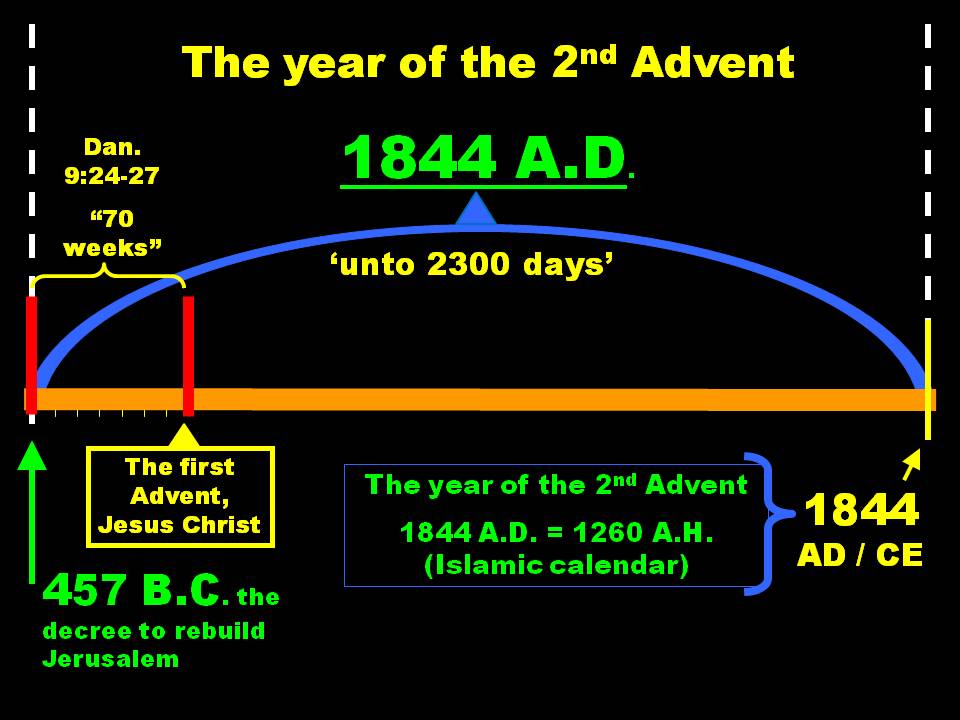

Originally, they thought the year 1844 A.D. was the year of the Second Coming, based on falsely interpreting scripture in a literal manner.  Subsequently they revisited scripture on this prophecy and now understand that the sanctuary is the sanctuary of heaven, and that the year 1844 A.D. marked the cleansing of the sanctuary of heaven.  Some of the teachings on the meaning of the "cleansing of the sanctuary" in heaven by Seventh Day Adventists are questionable as they are based on the external literal sense of scripture.  Further insight on this matter can be given from the visions received by Swedenborg.

ANALYSIS OF THE HISTORICAL INTERPRETATION

So the question to ask here, is the 2300 year prophecy valid, and does it start in 457 B.C. and end in 1844 A.D.?  Here is a link in which a Seventh Day Adventist does his own analysis in an article entitled 1844---is it biblical?  There are four main assumptions that need to be made, as follows:

1. One apocalyptic day equals one literal year.
2. Daniel 9 explains the mystery of Daniel 8.
3. The 490 years of Daniel 9 are "cut off" from the longer time span of 2300 years.
4. The 2300-year prophecy started in 457 B.C.

So which of these assumptions are true?  The first assumption is definitely correct: there is strong support that days equal prophetic years, and there is scripture to support that (see Num. 14:34, Eze. 4:5-6, and Dan. 9:24-27 in which days are used to represent years, see also The Day-year Principle).  Thus I would agree, the 2300 days of the corruption of the Jewish religion under Antiochus IV Epiphanes is representative of a longer 2300 year period.

So what about the second assumption?  This is somewhat true, as both prophecies concern end times, which are represented by the desolation and destruction of the Jewish temple.  Also, it is the same angel Gabriel who gives both visions:
Yea, while I was speaking in prayer, even the man Gabriel, whom I had seen in the vision at the beginning, being caused to fly swiftly, touched me about the time of the evening oblation.  (Dan. 9:21)
So what about the third assumption, that the 490 years are "cut off" from the larger time period of 2300 years?  This I would say is possibly true, but the 490 year period of Daniel 9 is more closely related to the 70 year desolation period .

So what about the fourth assumption, that the year 457 B.C. marks the beginning of the 2300 years?  This is speculative.  All that can be determined for certain is that the year 457 B.C. is the start date for the 490 year prophecy of Daniel 9 (for research on this, see Establishing the date 457 B.C).

THE SPIRITUAL INTERPRETATION OF DANIEL 8

As explained in  The Spiritual Meaning of Daniel's Prophecy of the Statue of Nebuchadnezzar, the literal interpretation is not the only interpretation of the prophecy.  It is in fact the lowest interpretation, and hidden within it is a more spiritual interpretation.  In the spiritual sense, every event, and every word of scripture, has a particular spiritual significance that in its most universal sense is related to the Lord and His church.  So let us take a look at the vision of Daniel 8 in detail:
Then I lifted up mine eyes, and saw, and, behold, there stood before the river a ram which had two horns: and the two horns were high; but one was higher than the other, and the higher came up last. (Dan. 8:3)
In the literal sense this simply refers to the Medo-Persian Empire, where the Median Empire initially had power, but later power passed into the hands of the Persian Empire.  In the spiritual sense, all things of scripture are related to love and truth, and this is no exception.  Horns are symbolic of power.  The initial small horn is symbolic of the truth of faith which comes first in time, but the second horn that comes up later and is taller than the first is the good of charity.  In one's spiritual development, one first learns the truth, but as one grows, one then does the good of charity and love which one learned from the truth.  The ram thus represents the spiritual church, which Swedenborg also demonstrates from multiple passages of scripture.  The goat which arises afterwards, however, represents the church that separates faith from charity:
"That a ram signifies that which is spiritual, or, what is the same, those who are spiritual, is plain also in Daniel — that a ram was seen by him standing before the river, which had two horns; afterward a he-goat of the goats, which smote him, broke his horns, and trampled him down (viii. 3, 4 and following verses); where nothing else is meant by the ram than the spiritual church, and by the he-goat of the goats those who are in faith separated from charity, or in truth separate from good, who gradually lift themselves up against good, and at length against the Lord — which is also described." (Swedenborg, Heavenly Arcana, n. 2830.6)
In other words, the he-goat represents those of the Protestant Church, who in the 16th century made faith alone saving, regardless of one's works, by misinterpreting the writings of the apostle Paul (see A New Perspective on Paul and the New Church Perspective on Paul).  That a goat represents this is also shown from multiple passages of scripture in Swedenborg's works (see The Divine Revelation of the New Jerusalem), for each and every animal in scripture represents something slightly different.  Swedenborg is more explicit about this prophecy of Daniel 8 in the following passage:
"From this what is signified by the "ram" and the "he-goat," and "the battle between them," in the eighth chapter of Daniel can be seen, namely, that the "ram" there means those who are in faith from charity, and the "he-goat" those who are in faith separated from charity. Thus the future state of the church is there described, namely, that faith separate would dissipate all charity, which is the good of life, and falsity therefrom would have rule in the Christian world." (Swedenborg, Apocalypse Explained, n. 817.4)
Thus it can be seen, that the historical events of Medo-Persia, Greece, the Jews, and the desecration of the Jewish temple were symbolic and representative of the future events which would beset the Christian church.  The destruction of true Christianity can be seen in the power that the Protestant churches have over much of the Christian church in espousing their basic doctrine, which was an invention of the 16th century.  As the he-goat came from the west, so we see that Protestants have their power in western Europe and the U.S.  The spiritual sense of the he-goat is described in the following passage, which I will quote in full:
"..."the he-goat of the goats that came over the faces of the whole earth" signifies faith separate from charity, springing from evil of life; "the he-goat of the goats" is that faith; the "west" evil of life; and "the earth" the church; "he had a conspicuous horn between the eyes" signifies that this is from self-intelligence; "he ran upon the ram in the wrath of his strength, and brake his two horns, and cast him down to the earth, and trampled upon him," signifies the entire destruction of charity and of faith therefrom, for when charity is destroyed faith also is destroyed, for the latter is from the former; "the great horn of the he-goat was broken, and in place of it there came up four toward the four winds of the heavens," signifies all falsities conjoined with evils therefrom, "horns" signifying the falsities of evil, "four" their conjunction, and "the four winds of the heavens" all, both falsities and evils; "out of one of them came forth a little horn" signifies justification by faith, for this is born of the principle of faith alone; it is said to be "little" because it does not appear as a falsity. That this horn "grew exceedingly towards the south, and towards the east, and towards beauty, and grew even to the host of the heavens, and cast down some of the host to the earth, and trampled upon them," signifies that it destroyed all the truths and goods of the church; "the south" meaning where truth is in the light, "the east" and "beauty" where good is in clearness through truth, "the host of the heavens" all truths and goods of heavens and the church; "to cast down the host to the earth, and to trample upon them," signifies to destroy utterly; that "even to the prince of the host it magnified itself," and that "the dwelling place of his sanctuary was cast down," signifies the denial of the Lord's Divine Human, and the consequent vastation of the church; "the prince of the host" is the Lord in respect to the Divine Human, because from that proceed all the truths and goods that constitute the church; "the dwelling place of the sanctuary" is the church where these are; this plainly means the truths destroyed by falsities, for it is said, "it cast down truth to the earth."" (Swedenborg, Apocalypse Explained, n. 316.16)
So the meaning of the sanctuary is now clear: it is not the Jewish temple, but represents the corruption and desecration of Christianity from within.  It also represents the denial that the human of Jesus Christ is the Son of God, this denial comes in the form of the doctrine of a trinity of three persons.  The original truth of Christianity is that Jesus is Jehovah in human form, with Him is the Divine trinity of the Divine itself, the Divine Human, and the Divine proceeding.  The Nicene Creed is a falsehood, an invention of men.  For more information on the doctrine of the Divine Human, how the fullness of the Godhead is revealed in one person Jesus Christ, see The Lost Doctrine of the Temple of the Divine Human and The Divine Human of the New Church.  From this we conclude: the sanctuary, in the highest sense, represents the doctrine and truth of the Divine Human.  For the Lord himself is the temple (see John 2:19-21), and He Himself is the foundation of the church.

THE SPIRITUAL INTERPRETATION OF THE 2300 DAYS

From the spiritual sense, we now know that the prophecy of Daniel 8 spans a long period of time, and that it concerns the spiritual development and corruption of the Christian church.  We now arrive at the spiritual interpretation of the 2300 days.  However the passage has been mistranslated by the KJV, first here is a more literal translation:
Then I heard one saint speaking, and another saint said unto that certain saint which spake, How long shall be the vision concerning the daily sacrifice, and the transgression of desolation, to give both the sanctuary and the host to be trodden under foot? And he said unto me, Unto two thousand and three hundred evenings and mornings; then shall the sanctuary be cleansed. (Dan 8:13-14)
In the Hebrew, it does not say "days," instead it literally says "evenings and mornings."  At first it seems insignificant, but the gloss of the translators hides the internal spiritual meaning.  Leading up to the year 1844 A.D., interpreters thought this referred to the Second Advent, and Swedenborg confirms that they are correct in their interpretation from the spiritual significance of "morning" which Swedenborg demonstrates from multiple passages (see The Divine Revelation of the New Jerusalem), some are below:
"That the Lord's coming or the approach of His kingdom is not compared to the morning, but is called the morning, may be seen in Daniel: A holy one said, . . . How long shall be the vision, the continual sacrifice, and the transgression that maketh desolate? . . . He said unto me, Until evening and morning, two thousand three hundred, then shall the sanctuary be justified. . . . The vision of the evening and the morning which hath been told is truth (viii. 13, 14, 26). Morning here stands manifestly for the Lord's coming." (Heavenly Arcana, n. 2405.4)
Here is another passage:
"That the coming of the Lord into the world is signified by evening and morning, is evident in Daniel: Then I heard a holy one speaking . . . How long shall be the vision, the continual sacrifice, and the transgression . . . to give both the sanctuary and the host to be trodden down? And he said to me, until evening and morning two thousand three hundred; then shall the sanctuary be justified (viii. 13, 14). That here by evening is meant the last time, when the church was altogether vastated and the Lord came into the world, and by morning the light and rising of a new church from Him, is manifest." (Heavenly Arcana, n. 7844.4)
Another passage:
"That morning signifies the first state of the church, and also a state of love, is evident from Daniel: One holy one said, how long shall be the vision, the continual sacrifice, and the wasting transgression? . . . And he said to me, until evening and morning two thousand three hundred; then shall the sanctuary be justified (viii. 13, 14). The subject here is the coming of the Lord; evening is the state of the church before His coming, while morning is the first state of the church after His coming, and in the supreme sense it is the Lord Himself. That the Lord in the supreme sense is the morning, is because He is the Sun of heaven, and the Sun of heaven never sets, but is always rising; hence also the Lord is called the east, consequently also the morning (n. 2405, 2780, 9668)" (Heavenly Arcana, n. 10134.10)
There are several other passages, which repeat the same thing.  From the spiritual sense, we now know that the Seventh Day Adventists were correct in interpreting the end of the 2300 day prophecy as predicting the Second Advent.  However, due to their literal interpretation of scripture, they falsely expected a literal physical return of Jesus.  With the wrong date.  In the New Church, the Second Advent is not a return of Jesus in physical form, but rather it is the revelation of the spiritual sense of the Word.  The First Advent was a revelation of the Word in human flesh (see John 1); the Second Advent is the revelation of the spiritual sense of the Word in scripture, revealing how the Bible is Divinely inspired.  This again can be shown in Swedenborg's commentary on the prophecies of the Second Advent in scripture; a complete explanation would take volumes (again, see The Divine Revelation of the New Jerusalem for the proof of this assertion).

THE TIME PERIOD OF THE 2300 YEAR PROPHECY OF DANIEL 8

So now we arrive at the time period of the 2300 years.  We have seen that the historical interpretation is correct, that the 2300 days is a prophetic period of 2300 years, spanning the Christian era.  We also know from the revelations received by Swedenborg is that the end of the 2300 years refers to the Second Advent.  On these two points the Seventh Day Adventists are correct.

But what of the start date?  We should pay attention to the question: it is asked how long the period is for the entire vision (Dan. 8:13).  The vision begins as follows:
The ram which thou sawest having two horns are the kings of Media and Persia. (Dan. 8:20)
So the answer is actually quite simple: the 2300 year prophetic time period begins with the beginning of the Medo-Persian Empire.  This begins of course with the fall of Babylon in 539 B.C., which was also the end of the Babylonian Empire.  Upon the fall of Babylon, Darius the Mede was made co-regent with Cyrus king of Persia.  This year 539 B.C. is known for certain as we have astronomical datings in cuneiform tablets, as well as other chronological synchronisms in various records.  The year 539 B.C, the fall of Babylon, marked the end of the 70 year period of desolation in the prophecies of Jeremiah.  Indeed, Daniel even mentions this at the start of the prophecy of Daniel 9, which he notes took place in the first year of Darius the Mede (539 B.C.):
In the first year of Darius the son of Ahasuerus, of the seed of the Medes, which was made king over the realm of the Chaldeans; In the first year of his reign I Daniel understood by books the number of the years, whereof the word of the LORD came to Jeremiah the prophet, that he would accomplish seventy years in the desolations of Jerusalem. (Dan. 9:1-2)
The fall of Babylon is the focus of numerous prophecies.  Note that in the literal interpretation, the 2300 days corresponds to the corruption and desecration of the Jewish temple.  Likewise, the night that Babylon fell, king Belshazzar of Babylon profaned the treasures of the Jewish temple (see Dan. 5:1-5, 23).  At that moment handwriting appears on the wall, which is interpreted as follows:
And this is the writing that was written, MENE, MENE, TEKEL, UPHARSIN.This is the interpretation of the thing: MENE; God hath numbered thy kingdom, and finished it.TEKEL; Thou art weighed in the balances, and art found wanting.PERES; Thy kingdom is divided, and given to the Medes and Persians. (Dan. 5:25-28)
The fall of Babylon is thus marked as a date of importance.  Thus in the historical interpretation of Daniel 8, the year 539 B.C. should be chosen as the start date, not 457 B.C.  This for the following reasons:
1. The vision of the 2300 days begins with the rise of the Medo-Persian Empire in 539 B.C.
2. The visions of Daniel 8 and 9 are related.  The vision of Daniel 9 is based on the 70 year prophecy which had ended in that year, 539 B.C.
3. The vision of the 2300 days begins with the corruption and desolation of the Jewish temple. This corresponds to the 70 year desolation period which had ended in 539 B.C.
4. The prophecies of Daniel 8 and Daniel 9 are two separate longer extensions of the 70 year desolation period which ended in 539 B.C.
5.  The date of 539 B.C. is marked as an important date which appeared in the "writing on the wall" in the palace of Belshazzar.
So, if we take 539 B.C. as the start date, counting 2300 years from that date brings us to the year 1762 A.D.  And at first it would seem to most that nothing in particular happened on that date.  However, it was at this time that Emanuel Swedenborg had been receiving revelations in waking visions concerning the doctrines of the New Church, which he declared was the Second Advent of the Lord.  In his visions, Swedenborg saw that a last judgment took place in the spiritual world, in a region known as the "world of spirits" which is a region mid-way between heaven and hell.  A judgment was executed on those who had not yet been judged; after the judgment many were either cast to hell or brought up to heaven.  This is described in much detail in two works, The Final Judgment and The Final Judgment Continued (also known as The Last Judgment and The Last Judgment Continued).  In other words, the Seventh Day Adventists are correct in their understanding that there was a "cleansing of the sanctuary" in heaven.  But they do not have a complete idea on the meaning, and they got the date wrong.  But the doctrine in itself is correct.  Not only that, they state that the end of the 2300 years marks the beginning of the "Investigative Judgment."  Here is their official position, from Heavenly Sanctuary:
The investigative judgment reveals to heavenly intelligences who among the dead are asleep in Christ and therefore, in Him, are deemed worthy to have part in the first resurrection. It also makes manifest who among the living are abiding in Christ, keeping the commandments of God and the faith of Jesus, and in Him, therefore, are ready for translation into His everlasting kingdom. This judgment vindicates the justice of God in saving those who believe in Jesus. It declares that those who have remained loyal to God shall receive the kingdom. The completion of this ministry of Christ will mark the close of human probation before the Second Advent.
WHAT HAPPENED IN THE YEAR 1762 A.D.?

According to Swedenborg, the "dead who are asleep" refer to many of those who were caught in the middle region of the world of spirits.  In the Last Judgment, which took place in the spiritual world, an investigative judgment took place in the year 1757 A.D.  Literalists, such as many within the SDA church, were expecting a literal physical resurrection and judgment to take place on earth, not understanding that all are judged in the spiritual world.  What is interesting about the SDA church is that they get some parts right, and other parts wrong.  And all this with no knowledge of Emanuel Swedenborg, because they have adopted the false doctrine that there is no afterlife.  In The Final Judgment Continued, Swedenborg offers a nice summary of the work The Final Judgment:
"In the former little work on "The Final Judgment" the following subjects were treated of: The destruction of the world is not meant by the day of the final judgment (n. 1-5). The procreations of the human race on the earths will never cease (n. 6-13). Heaven and Hell are from the human race (n. 14-22). All who have ever been born men from the beginning of creation and are deceased, are either in heaven or in hell (n. 23-27). The final judgment must be where all are together, thus in the spiritual world, and not on earth (n. 28-32). The final judgment takes place when the end of the church is come, and the end of the church is when there is no faith, because there is no charity (n. 33-39). All things predicted in the Apocalypse are at this day fulfilled (n. 40-44). The final judgment has been accomplished (n. 45-52). Babylon and its destruction (n. 53-64). The former heaven and its abolishment (n. 65-72). The state of the world and of the church hereafter (n. 73, 74)." (The Final Judgment Continued, n. 1)
The 2300 year period begins in the year 539 B.C., with the fall of the literal kingdom of Babylon.  Babylon, in the spiritual sense, represents those who use religion to obtain dominion over others.  Spiritual Babylon is thus the Roman Catholic Church, and the Last Judgment of 1757 A.D. removed its power in the spiritual world.  Much of the visions that Swedenborg received concerned the destruction of the spiritual Babylon, which makes a start date of 539 B.C. all the more appropriate to the 2300 year prophecy.

The obvious question now is how come the 2300 year prophecy ends in the year 1762 A.D., and not the year 1757 A.D.?  Swedenborg makes clear that the Last Judgment in 1757 A.D. was the first step in providing new revelations and doctrines of the New Church:
"III. Before the final judgment was effected upon them, much of the communication between heaven and the world, thus also between the Lord and the church, was intercepted.
IV. After the final judgment the communication was restored.
V. Hence it is, that since the final judgment has been effected, and not before, revelations have been made for the New Church."  (The Final Judgment Continued, n. 8)
So, what revelation was made in the year 1762 A.D.?  The main work that Swedenborg worked on in this year was a little small work known as The Doctrine of the Lord.  This was then published in 1763 A.D. along with three other works as The Four Doctrines.  But what many do not realize is that little work The Doctrine of the Lord is the central doctrine of the New Church: it states that Jesus is Jehovah in human form, and that the human form Jehovah assumed is the Son of God.  Moreover, His human form had been made one with the Divine, and is the Divine Human.  A trinity of three persons is a falsehood.  Note, as stated above, in the spiritual sense Swedenborg had stated that for Daniel 8 the sanctuary that is cast down and trampled upon is the Divine Human.  Moreover, in Swedenborg's visions it was revealed that the work The Doctrine of the Lord was very important - this small work is the little book, the book of the seven thunders in Revelation 10 (see The Mystery of the Book of Seven Thunders Explained).  In Apocalypse Revealed, Swedenborg states the following:
I will lay open what was in the little book. In the little book were the things which are contained in the Doctrine of the New Jerusalem concerning the Lord (Apocalypse Revealed, n. 465)
This of course, refers to the work that was published in 1763 A.D., but was probably completed in 1762 A.D.  So anyone who ever wondered what was in the book of seven thunders in Revelation, now you know.

SUMMARY CONCLUSION

I had to cover a lot of ground here.  I can summarize this in the following points:
1.  The prophecies of Daniel have both a literal and spiritual interpretation.
2.  The historical interpretation of the prophecy of Daniel 8 is partially correct.
3.  The Seventh Day Adventist interpretation is partially correct, but they chose the wrong start date.
4.  In the spiritual sense, the prophecy of Daniel 8 deals with a long time span concerning the corruption of the Christian Church.
5.  A Last Judgment took place in the spiritual world in the year 1757 A.D.  This was independently revealed to the Seventh Day Adventist church as the "cleansing of the sanctuary" in heaven, albeit with a later date.
6.  The SDA church needs to reassess some of their doctrines, not all of them are correct.  But the essential idea of some of them are correct.
7.  Although Emanuel Swedenborg was unaware of the 2300 year time period (he himself discouraged prophecy), information in the revelations confirm it.
8.  The interpretation matches the time of the revelation of the Divine Human in the work The Doctrine of the Lord.
9.  The Second Advent is not a physical return of Jesus in the clouds of the sky, but rather the Second Advent is the revelation of the spiritual sense of the Word, and the revelation of the true doctrines of the New Church.
This of course will probably bring up more questions than it answers, as I tried to restrict the material to the 2300 day prophecy.  There will also be resistance to it as some have probably been taught differently on these topics.  But the evidence is there for anyone to examine, to consider the revelations and doctrines of the New Church, as foreseen in scripture.

Sunday, May 8, 2016

The Ancient Christology of the Shepherd of Hermas


The revelation of the New Church declares that Jesus Christ is Jehovah in human form, and that the human in which He became incarnate was transformed into a Divine Human upon the resurrection, by which all of humanity was saved from the dominion of hell.  The revelation also states that the trinity of three person of the 4th century A.D. was an invention of man and not part of the original gospel of Christ (see The False Belief of a Trinity of three beings: TRITHEISM).

So the question is, what was the theology of the original Christians of the first century A.D.?  It was simple, and they did not theologize that much.  I briefly touched on this in an early post entitled The Nicene Creed: a distorted version of the Apostle's Creed, where one can easily see that the earlier Apostle's Creed declared Jesus to be the Son of God born in time to the virgin Mary.  This also happens to be the position of the New Church, but it still acknowledges that Jesus was pre-existent as Jehovah.  The Nicene Creed basically invented a Son of God "born from eternity, not begotten," an utter paradox.  It has created a paradoxical faith, which no one understands and thus is a topic of conversation most avoid.

THE TEXT OF THE SHEPHERD OF HERMAS

If we want to examine the beliefs of the early Christian church, there are very few texts to examine, but one very ancient Christian text stands out, called The Shepherd of Hermas, which is written as a religious parable, or if one believes it literally, contains a series of heavenly visions.  Everything is taught in the form of an allegory, and some of the content is similar in nature to the spiritual symbolism of scripture as revealed in Heavenly Arcana (aka Arcana Coelestia).

So, who wrote it, and when?  This was once a highly valued text within the early Christian church.  It was written in Rome by Hermas, a former slave, in the 1st or 2nd century A.D.  Here is a summary of the high respect the work had among the early church fathers from the Catholic site NewAdvent Encyclopedia, under Hermas:
"[The Shepherd of Hermas is] a work which had great authority in ancient times and was ranked with Holy Scripture. Eusebius tells us that it was publicly read in the churches, and that while some denied it to be canonical, others "considered it most necessary". St. Athanasius speaks of it, together with the Didache, in connection with the deuterocanonical books of the Old Testament, as uncanonical yet recommended by the ancients for the reading of catechumens. Elsewhere he calls it a most profitable book. Rufinus similarly says that the ancients wished it to be read, but not to be used as an authority as to the Faith. It is found with the Epistle of Barnabas at the end of the New Testament in the great Siniatic Bible Aleph (fourth century), and between the Acts of the Apostles and the Acts of Paul in the stichometrical list of the Codex Claromontanus. In accordance with this conflicting evidence, we find two lines of opinion among the earlier Fathers. St. Irenæus and Tertullian (in his Catholic days) cite the "Shepherd" as Scripture. Clement of Alexandria constantly quotes it with reverence, and so does Origen, who held that the author was the Hermas mentioned by St. Paul, Romans 16:14. He says the work seems to him to be very useful, and Divinely inspired; yet he repeatedly apologizes, when he has occasion to quote it, on the ground that "many people despise it".
It was a very popular Christian work in the 2nd, 3rd and 4th centuries.  And then it just mysteriously dies out and disappears, and if you ask anyone now they probably never heard of it.  So when was it written?  Three ancient witnesses suggest that Hermas was the brother of Pope Pius I, whose pontificate was in the middle of the 2nd century A.D.  However other researchers state evidence that it was written in the late 1st century A.D.  From The Shepherd of Hermas:

The scholar John A. T. Robinson makes a detailed argument that in fact Shepherd was written before AD 85. This is because
a) Robinson believes that all the canonical New Testament books predate the fall of Jerusalem in AD.70.
b) Irenaeus quotes it as scripture in "Against Heresy" (c. 180) thus undermining the testimony of the Muratorian fragment, which, if believed, would place it during the bishopric in Rome of Pius (140–155). Robinson believes that Irenaeus would not count a 2nd-century text as scripture.
c) Tertullian, in De Pudicitia (c. 215) strongly disparages Hermas, but without mentioning the late composition which would have fatally undermined its canonicity.
d) Origen freely cites Hermas as scripture, and in his Commentary on Romans attributes it to the Hermas of Rom.16:14 (an identification supported by Coleborne).
e) Robinson believes that the internal evidence of Vision 2.4.2 refers to Clement, apparently before he became Bishop of Rome, for which Robinson cites in support G. Edmundson's Bampton lectures of 1913. Edmundson dates Hermas c. 90 on the basis that Clement became Bishop of Rome in 92. Robinson states that there is no reason to suppose that this reference is a pseudonymous fiction.
f) Robinson discounts the testimony of the Muratonian fragment, saying that for no other book should its unsupported evidence be taken seriously, and it is full of palpable mistakes.

What is interesting here, is that Hermas, the author of the work, may have known the apostle Paul, for Paul mentions a Hermas in one of his letters:
Greet Rufus, chosen in the Lord; also his mother, who has been a mother to me as well.  Greet Asyncritus, Phlegon, Hermes, Patrobas, Hermas, and the brothers  who are with them.  (Rom. 16:13-14)
As a side note, what many people do not realize is that Rufus is one Rufus Pudens Pudentius, a Roman Senator thats known in Roman history.  He and the apostle Paul were likely half brothers.  Rufus married one Claudia, also mentioned in the epistle of Romans, who was of British royalty (see British Royalty: Founders of the Roman Church).  So Hermas is likely a real person as well who lived in Rome, and as early as the 2nd century there was a tradition that it was this same Hermas who wrote The Shepherd of Hermas.

THE CHRISTOLOGY OF THE SHEPHERD OF HERMAS

So here is likely a first century Christian work by someone who knew the apostle Paul directly.  This work is completely untainted by the later Nicene Creed; it is just simple Christianity.  And in it are a set of visions and parables.  However it is the fifth parable that caught my attention.  It describes a Christology that does not fit the trinity of the Nicene Creed which would be developed over two centuries later.  And to my surprise, it is in agreement with the doctrine of the New Church.  As a parable, it is not completely explained.  I will quote the entire parable from this online translation, The Shepherd of Hermas:
"A certain man had a field and many slaves, and he planted a certain part of the field with a vineyard, and selecting a faithful and beloved and much valued slave, he called him to him, and said, 'Take this vineyard which I have planted, and stake it until I come, and do nothing else to the vineyard; and attend to this order of mine, and you shall receive your freedom from me.' And the master of the slave departed to a foreign country. And when he was gone, the slave took and staked the vineyard; and when he had finished the staking of the vines, he saw that the vineyard was full of weeds. He then reflected, saying, 'I have kept this order of my master: I will dig up the rest of this vineyard, and it will be more beautiful when dug up; and being free of weeds, it will yield more fruit, not being choked by them.' He took, therefore, and dug up the vineyard, and rooted out all the weeds that were in it. And that vineyard became very beautiful and fruitful, Having no weeds to choke it. And after a certain time the master of the slave and of the field returned, and entered into the vineyard. And seeing that the vines were suitably supported on stakes, and the ground, moreover, dug up, and all the weeds rooted out, and the vines fruitful, he was greatly pleased with the work of his slave. And calling his beloved son who was his heir, and his friends who were his councillors, he told them what orders he had given his slave, and what he had found performed. And they rejoiced along with the slave at the testimony which his master bore to him. And he said to them, 'I promised this slave freedom if he obeyed the command which I gave him; and he has kept my command, and done besides a good work to the vineyard, and has pleased me exceedingly. In return, therefore, for the work which he has done, I wish to make him co-heir with my son, because, having good thoughts, he did not neglect them, but carried them out.' With this resolution of the master his son and friends were well pleased, viz., that the slave should be co-heir with the son. After a few days the master made a feast, and sent to his slave many dishes from his table. And the slave receiving the dishes that were sent him from his master, took of them what was sufficient for himself, and distributed the rest among his fellow-slaves. And his fellow-slaves rejoiced to receive the dishes, and began to pray for him, that he might find still greater favour with his master for having so treated them. His master heard all these things that were done, and was again greatly pleased with his conduct. And the master again calling; together his friends and his son, reported to them the slave's proceeding with regard to the dishes which he had sent him. And they were still more satisfied that the slave should become co-heir with his son."
On a first read, it looks like someone just simply took the parable of the vineyard from the gospel of Matthew (see Matt. 21:33-41), and modified it to give it a happy ending.  Also one may first think that the faithful slave is Hermas himself.  But that is not what the parable means.  It is explained later, in the following passage:
"I shall unfold to you the meaning of the similitudes of the field, and of all the others that follow, that you may make them known to every one. Hear now," he said, "and understand them. The field is this world; and the Lord of the field is He who created, and perfected, and strengthened all things; and the slave is the Son of God; and the vines are this people, whom He Himself planted; and the stakes are the holy angels of the Lord, who keep His people together; and the weeds that were plucked out of the vineyard are the iniquities of God's servants; and the dishes which He sent Him from His table are the commandments which He gave His people through His Son; and the friends and fellow-councillors are the holy angels who were first created; and the Master's absence from home is the time that remains until His appearing."
I highlighted the last portion, the parable is related to the Second Coming, more on that later.  The slave is not Hermas, but rather the slave is the Son of God.  Which is strange, as the slave is portrayed as a separate person from the son of the Master.  Hermas is then confused, and asks why is Jesus portrayed as a slave.  At first the answer is not given, and it is explained one should ask the Lord to open one's understanding.  But Hermas persists, and the following answer is given:
"Hear," he answered: "the Son of God is not in the form of a slave, but in great power and might." "How so, sir?" I said; "I do not understand." "Because," he answered, "God planted the vineyard, that is to say, He created the people, and gave them to His Son; and the Son appointed His angels over them to keep them; and He Himself purged away their sins, having suffered many trials and undergone many labours, for no one is able to dig without labour and toil. He Himself, then, having purged away the sins of the people, showed them the paths of life by giving them the law which He received from His Father. And why the Lord took His Son as councillor, and the glorious angels, regarding the heirship of the slave, listen. The holy, pre-existent Spirit, that created every creature, God made to dwell in flesh, which He chose. This flesh, accordingly, in which the Holy Spirit dwelt, was nobly subject to that Spirit, walking religiously and chastely, in no respect defiling the Spirit; and accordingly, after living excellently and purely, and after labouring and co-operating with the Spirit, and having in everything acted vigorously and courageously along with the Holy Spirit, He assumed it as a partner with it. For this conduct of the flesh pleased Him, because it was not defiled on the earth while having the Holy Spirit. He took, therefore, as fellow-councillors His Son and the glorious angels, in order that this flesh, which had been subject to the body without a fault, might have some place of tabernacle, and that it might not appear that the reward [of its servitude had been lost ], for the flesh that has been found without spot or defilement, in which the Holy Spirit dwelt, [will receive a reward]. You have now the explanation of this parable also."
When I reread this portion of the Shepherd of Hermas, I was surprised.  In the revelations of the New Church, it was revealed that Jesus inherited flesh of a weak nature from His mother Mary, which could be tempted by the evil spirits of hell.  However His soul was Divine, and fought against all of hell through the human form.  This happened in stages, until all sin was rooted out in the external human form, and it was transformed into a Divine Human.  What Swedenborg describes in page after page in Heavenly Arcana, in Doctrine of the Lord, and in True Christian Religion, is here summed up in a very short parable.  The doctrine of the Divine Human of the New Church is that Jesus born in time to the virgin Mary is the Son of God, and His human form was made completely Divine.  A form of this doctrine of the New Church is here described in a very short parable in one of the earliest documents of the Christian Church.  The pre-existent form of Jehovah before He became incarnate in flesh is also described, oddly enough, as the son of the Master.  This is described in explicit detail in the visions of Swedenborg.  Here is one notable passage where Swedenborg asked the angels concerning the Lord's pre-existent form before He became incarnate:
“I have been told from heaven that in the Lord from eternity, Who is Jehovah, before the assumption of the Human in the world, there were the two prior degrees actually, and the third degree in potency, such as they are also with the angels; but that after the assumption of the Human in the world, He put on also the third degree, which is called the natural, and that thereby He became a man similar to man in the world, with the difference, however, that this degree, like the prior degrees, is infinite and uncreated in Him, while these degrees in angel and in man are finite and created. For the Divine which had filled all spaces without space (n. 69-72), penetrated also to the ultimate things of nature. But before the assumption of the Human, the Divine influx into the natural degree was mediate through the angelic heavens, but after the assumption immediate from Himself. And this is the reason why all the churches in the world before His coming were representative of spiritual and celestial things, but after His coming became spiritual-natural and celestial-natural, and representative worship was abolished. This too was the reason why the sun of the angelic heaven, which, as was said above, is the first proceeding of His Divine Love and Divine Wisdom, after the assumption of the Human shone forth with a more glorious radiance and splendor than before the assumption." (Swedenborg, Divine Love and Wisdom, n. 233)
This assumption of a human form is thus the "slave" of the parable, and the pre-existent Divine Human in the heavens is the "son of the Master."  By making the human Divine, or one with the Divine, the human became a "co-heir."  But what about the Master's absence from His home until he returns?  This is the Second Coming, when people begin to realize that the Father exists in the Son as the soul does the body, that Jesus is truly Jehovah in human form.

So why did the Shepherd of Hermas eventually die out and disappear, before being rediscovered centuries later?  This was due to the Nicene Creed, and the definition of a trinity of three persons, by people who did not understand the allegorical way of speaking.  Once the Trinity became the established doctrine, other heresies were rooted out.  One particular heresy was "Adoptionism," which makes the error by declaring that Jesus was not the Christ until he was baptized by the Holy Spirit.  This particular heresy probably made use of the Shepherd of Hermas by misinterpreting the parable, and thus it fell out of favour following the fourth century A.D.  The truth of the matter, is Jesus is Jehovah in human form, which began when He was conceived by the Holy Spirit at birth - not later during a baptism ritual.  He is thus described as the "Word made flesh."  Interpreted properly, the Shepherd of Hermas provides confirmation that the revelation of the New Church is a revelation that all Christians should know about to have a better understanding of Jesus Christ.

Thursday, April 28, 2016

The Divine Inspiration of the Epistles of Paul, and a Lost Epistle of Paul


In the early Christian church, the definition of the Biblical canon was largely defined by the authorship of the work - if it was written by an apostle of Jesus, it was included in the canon of the New Testament.  By the 4th century A.D. the canon of the New Testament was largely defined, which was largely based on authorship of the work.  But which works are Divinely inspired?  For most people, all the works are Divinely inspired based on what books are currently in the Bible.  But the New Testament itself gives a more narrow definition - only the words that come directly from God, through revelation and vision, are Divinely inspired:
All scripture is given by inspiration of God, and is profitable for doctrine, for reproof, for correction, for instruction in righteousness (2 Tim. 3:16)
If it contains the words of God, received through revelation, then the scripture is Divinely inspired.  As Jesus is the Word of God incarnate (see John 1), everything that Jesus said can be considered as directly Divinely inspired.  If we restrict ourselves to the words of Jesus, then in the New Testament the works that contain the most Divine Inspiration would be the four Gospels and the book of Revelation.  Among the other works, there are very short quotes of Jesus in the book of Acts, and one direct quote of Jesus in the epistles of Paul (2 Cor. 12:9).

DIVINE INSPIRATION ACCORDING TO THE NEW CHURCH

In the revelation of the New Church, the canon of scripture is not based on authorship, nor on tradition, nor on the basis of church authority.  Divine inspiration of any work is based on the content of the revelation itself.  Typical means of inspiration was through direct vision, through dreams, or direct auditory experience of the spoken Word.  What was revealed to Emanuel Swedenborg in the 18th century is that when God reveals Himself, the very words are Divinely inspired in such a manner that they follow a particular pattern.  This pattern is symbolic, and the symbolism can be recognized through a system of correspondences.  This is described in detail in a multi-volume work Heavenly Arcana (aka Arcana Coelestia).  Using this system of correspondences, one can often recognize whether a work is Divinely inspired or not through its content, and not merely trusting tradition or authority.

Using this system of correspondences, revealed in waking vision, it was shown to Swedenborg that the Law (Torah - the first five books of Moses), the Prophets (Nevi'im) and the Psalms were indeed Divinely inspired.  They all have different authors, but follow a common pattern.  Jesus confirmed that these are Divinely inspired in the gospel of Luke:
These are the words which I spake unto you, while I was yet with you, that all things must be fulfilled, which were written in the Law of Moses, and in the Prophets, and in the Psalms, concerning me. (see Luke 24:44).
Outside of this canon, the Jews had a separate set of books known as the "writings."  Among these, Swedenborg was shown that Daniel and Lamentations were Divinely inspired.  Works that are "semi-inspired" are Job, Proverbs and Song of Songs, but these works are not written where subsequent statements follow each other in a coherent series.

When Swedenborg arrived at the New Testament, to the surprise of many he discovered that only the four gospels of the book of Revelation were Divinely inspired.  And by Divine inspiration, Swedenborg is talking about Divine inspiration in a very strict sense, where the words themselves are written in a series of correspondences, where hidden behind the literal sense of scripture there is a spiritual sense.  That there is a hidden spiritual sense in scripture is confirmed by Jesus Himself:
And the disciples came, and said unto him, Why speakest thou unto them in parables?  He answered and said unto them, Because it is given unto you to know the mysteries of the kingdom of heaven, but to them it is not given. (Matt. 13:10-11)
And here is this interesting passage, where Jesus confirms He is not only speaking in parables and figures of speech, but also in the future will reveal things more plainly:
I have said these things to you in figures of speech. The hour is coming when I will no longer speak to you in figures of speech but will tell you plainly about the Father. (John 16:25)
And this, unknown to most, has been fulfilled in the revelations received by Emanuel Swedenborg in the 18th century, who was directed by Jesus Himself to reveal the internal spiritual sense of scripture, which is explained in a massive multi-volume work, Heavenly Arcana (aka Arcana Coelestia).  It is the best proof that explains why and how scripture is Divinely inspired.  Traditional Christianity, when questioned on the Divine inspiration of the Bible, cannot offer a comprehensive proof.  The doctrines of the New Church can, if one take the time to examine them.

THE DIVINE INFLUENCE OF THE EPISTLES OF PAUL

The one main reason major Christian denominations do not reference Swedenborg, and may be a bit wary of him, is that he did not include the epistles of Paul as among the Divinely inspired works of the Bible.  Most sermons are based on the writings of Paul, and Protestant churches in particular are dependent on Paul for their theology and doctrine of faith.  Thus they falsely assume Swedenborg rejected the epistles of Paul since he disagreed with them.  But this is not true - Swedenborg did not reject the teachings of Paul.  In fact, he confirmed the teachings, and in many ways anticipated modern theological thought on the epistles of Paul (for an in depth analysis, see A New Perspective on Paul and the New Church Perspective on Paul).

However, there is one matter here that is not so well known even within the New Church itself.  Although Swedenborg was shown that the letters of Paul were not Divinely inspired, he confirms - in his unpublished diary - that the letters of Paul were indeed Divinely influenced:
"...the Lord spoke from Divine Wisdom Itself, by correspondences, exactly as He also spoke by the prophets, consequently from His own Divine; and that Paul indeed spoke from inspiration, but not in the same way as the prophets, to whom every single word was dictated but that his inspiration was that he received an influx, according to those things which were with him, which is quite a different inspiration, and has no conjunction with heaven by correspondences." (Spiritual Diary, n. 6062)
In other words, one can say that the letters of Paul are inspired to a lesser degree - they are Divinely influenced in their overall thoughts, but not down to the very words themselves.  Thus the New Church should make a distinction: works that are Divinely inspired and works that are Divinely influenced.  There are thus degrees or levels of inspiration, according to the content of the work itself.  Divine inspiration is strictly any content that was received by revelation, and is written in a form of symbolic correspondences.  Divinely influenced works are those that are more doctrinal in nature, offering explanation for Divinely inspired scripture.

THE REASON FOR "LESSER" DIVINELY INFLUENCED SCRIPTURE

Most have a simple view of Divine inspiration of scripture: it is or it isn't.  But if one recognizes different degrees of inspiration, and keeps a distinction between Divinely inspired works and those that are Divinely influenced, one can reach a greater understanding of the truth.  One can distinguish Divine truth, and keep it separate from the teachings and traditions of men.

The reason why the epistles of Paul are included in scripture, and should remain in scripture, is for a very good reason, explained in the following passage from Swedenborg's diary:
That the Epistles of Paul have not an internal sense is known in the other life; but it is permitted that they may be in the Church, lest those who are of the Church should work evil to the Word of the Lord, in which is the internal sense. For if man lives ill, and yet believes in the holy Word, then he works evil to heaven; therefore the Epistles of Paul are permitted, and therefore Paul was not permitted to take one parable, not even a doctrine, from the Lord, and to expound and unfold it; but he took all things from himself. The Church, indeed, explains the Word of the Lord, but by means of the Epistles of Paul; for which reason also it everywhere departs from the good of charity, and accepts the truth of faith; which, however, the Lord has taught, but in such wise that the good of charity should be the all. (Spiritual Diary, n. 4824)
In a private letter, Swedenborg also explains that these letters were included as doctrinal matters needed to be simplified for the public:
"With reference to the writings of the Apostles and Paul I have not included these in ARCANA COELESTIA, and this for the reason that they are doctrinal writings, and so are not written in the style of the Word as are the Prophets, David, the Gospels, and the Revelation. The style of the Word wholly consists of correspondences, on which account it effects an immediate communication with heaven. In the doctrinal writings, however, there is another style which indeed communicates with heaven, but mediately. That they were so written by the Apostles was in order that the new Christian Church might commence through these, on which account doctrinal matters could not be written in the very style of the Word, but in a manner that might be more clearly and more directly understood. Nonetheless, the writings of the Apostles are good books for the Church, maintaining the doctrine of charity and its faith as strongly as ever did the Lord Himself in the Gospels and in the Revelation, as can be clearly seen and observed if one attends to the matter while reading those writings." (Letter, Harley)
With actual scripture, when one reads it with an open heart, direct communication is opened with heaven and the angels, even though a person may be unaware of it at the time.  With Divinely influenced writings, which tend to be more doctrinal in nature, communication is indirect or mediate.

If one understands this approach to the letters of Paul, and the letters of the apostles, one can have a better understanding of other works that may contain a degree of Divine influence but are not Divinely inspired.  In this, I would classify the works of Swedenborg himself as "Divinely influenced."  But according to Swedenborg's own definition, his works are definitely not Divinely inspired in the same way scripture is. Scripture must follow the Divine pattern of symbolic correspondences, as declared in the Doctrine of Sacred Scripture. Swedenborg even spells it out by giving the list of books that are Divinely inspired.

What other works are Divinely influenced, but not Divinely inspired?  The Quran, Swedenborg says, does contain a partial heavenly revelation, but it is only there in an obscure manner.  The reason for that was to introduce those who originate from polygamous cultures to Jesus, without revealing His true nature so that polygamy would not be mixed with the more internal holy revelation.  It was also written in such a way to offer opposition to the false doctrine of a trinity of three persons. Thus the Quran (or Koran) can be classified as Divinely influenced, but not Divinely inspired in the same way the Bible is.  Interestingly, the Quran affirms that the gospels of the New Testament should still be followed, and does not mention the epistles of Paul.

A LOST EPISTLE OF THE APOSTLE PAUL

There are certain works that are quoted in the Bible, that are Divinely inspired, but are now lost to us.  Or may be lost.  One, which was used to compose portions of the Old Testament, is the book of Jasher (see The Lost Book of Jasher, the Exodus, and Emanuel Swedenborg).  However, since most among Christian churches are focused on the epistles of Paul to the exclusion of everything else, I thought I would offer something interesting here.  Swedenborg, in his visions, was shown that there is indeed a lost epistle of Paul that did not make it into the Biblical canon:
The difference between a holiness that is merely attributed and a holiness which is seen, may be illustrated by this example seen and heard in the spiritual world: An epistle was read written by Paul while he dwelt in the world, but not published, without any one's knowing that it was by Paul. The hearers first regarded it as of little moment; but when it was discovered to be one of Paul's epistles, it was received with joy, and one and all the things therein were adored. It was manifest from this, that merely attributing holiness to the Word and the sacraments, when made by the primates of the clerical order, does indeed give the stamp of holiness; but it is otherwise when the holiness itself is disclosed and presented so as to be seen before the eyes, which is done by a revelation of the spiritual sense; by this means external holiness becomes internal, and attribution of holiness becomes acknowledgment of it. (True Christian Religion, n. 701)
As with the book of Jasher, it is my belief that this lost epistle of Paul was still intact in some written form when Swedenborg wrote this in the 18th century.  And indeed, there is an interesting case to be made for a lost epistle of the apostle Paul that did not make it into the Biblical canon: it is known to scholars as the Epistle to the Laodiceans.  Most consider it a forgery, that it was written since it was possibly mentioned in another epistle of Paul:
And when this letter has been read among you, have it also read in the church of the Laodiceans; and see that you also read the letter from Laodicea. (Col. 4:16)
Despite the opinion of scholars, there are several ancient witnesses that state there was once an Epistle to Laodiceans.  In the Muratonian fragment of the 2nd century A.D., it mentions that the heretic Marcion included the Epistle to the Laodiceans in his canon.  Marcion's canon contained only the gospel of Luke and the epistles of Paul to the exclusion of everything else.  Somehow a version of an Epistle to the Laodiceans made it into Western Latin Bibles, but no copy of it has been found in Greek or Syriac texts.  In the fourth century A.D. Jerome knew of it and stated it was "rejected by everyone."  The earliest text of it survives in a Latin Bible from 546 A.D., and it can be found in over 100 different ancient Latin versions of the Bible.  It is short, and contains statements found in his other epistles.  Here is one translation, which is taken from The Wesley Center Online: Epistle To The Laodiceans:
1 Paul, an apostle not of men nor by man, but by Jesus Christ, unto the brethren that are at Laodicea.
2 Grace be unto you and peace from God the Father and the Lord Jesus Christ.
3 I give thanks unto Christ in all my prayers, that ye continue in him and persevere in his works, looking for the promise at the day of judgement.
4 Neither do the vain talkings of some overset you, which creep in, that they may turn you away from the truth of the Gospel which is preached by me.
5 And now shall God cause that they that are of me shall continue ministering unto the increase of the truth of the Gospel and accomplishing goodness, and the work of salvation, even eternal life.
5 And now are my bonds seen of all men, which I suffer in Christ, wherein I rejoice and am glad.
7 And unto me this is for everlasting salvation, which also is brought about by your prayers, and the ministry of the Holy Ghost, whether by life or by death.
8 For verily to me life is in Christ, and to die is joy.
9 And unto him (or And also) shall he work his mercy in you that ye may have the same love, and be of one mind.
10 Therefore, dearly beloved, as ye have heard in my presence so hold fast and work in the fear of God, and it shall be unto you for life eternal.
11 For it is God that worketh in you.
12 And do ye without afterthought whatsoever ye do.
13 And for the rest, dearly beloved, rejoice in Christ, and beware of them that are filthy in lucre.
14 Let all your petitions be made openly before God, and be ye steadfast in the mind of Christ.
15 And what things are sound and true and sober and just and to be loved, do ye.
16 And what ye have heard and received, keep fast in your heart.
17 And peace shall be unto you.
18 The saints salute you.
19 The grace of the Lord Jesus be with your spirit.
20 And cause this epistle to be read unto them of Colossae, and the epistle of the Colossians to be read unto you.
Is it genuine or not?  It did find its way into the earliest canon of the Bible, as well as western Latin Bibles.  Is it the one seen by Swedenborg in his vision?  We do not know, but everything about this curious epistle fits Swedenborg's vision - the lost epistle of Paul was still intact, not published (not in the Biblical canon), and considered not to be the epistle of Paul.  Only the Epistle to the Laodiceans fits all the criteria of Swedenborg's vision.  And perhaps this entire epistle is symbolic of the church of Laodicea itself in the book of Revelation, which is ultimately rejected out of God's mouth:
I know your works: you are neither cold nor hot. Would that you were either cold or hot!So, because you are lukewarm, and neither hot nor cold, I will spit you out of my mouth. For you say, I am rich, I have prospered, and I need nothing, not realizing that you are wretched, pitiable, poor, blind, and naked.I counsel you to buy from me gold refined by fire, so that you may be rich, and white garments so that you may clothe yourself and the shame of your nakedness may not be seen, and salve to anoint your eyes, so that you may see. (Rev. 3:15-18)
The ancient city of Laodicea, now in ruins